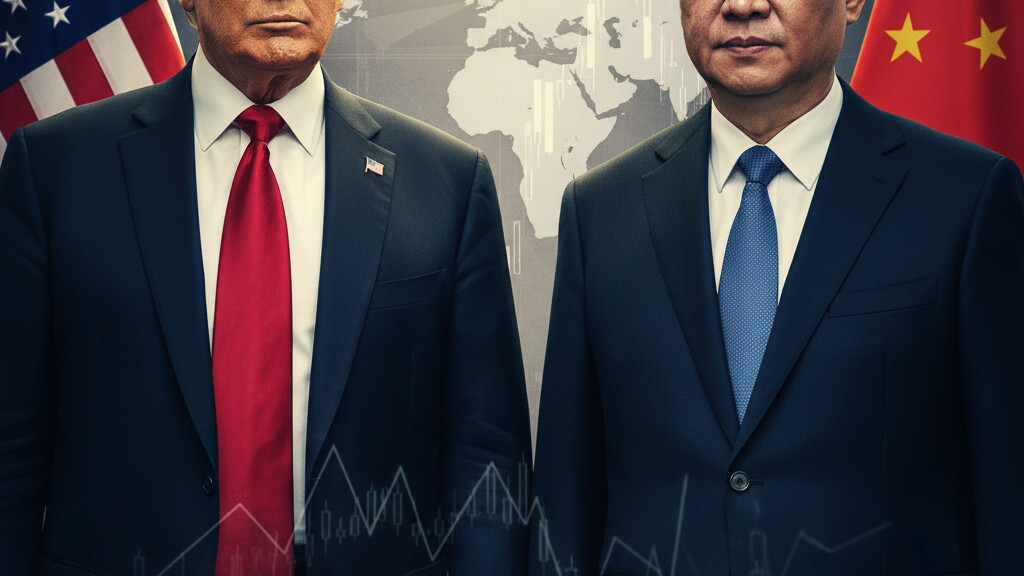
Editorial illustration
Trump to Meet Xi Jinping in May for Monumental Summit
President Donald Trump announced Wednesday that he will meet with Chinese President Xi Jinping in May, calling the upcoming summit a \”monumental event\” that could reshape the trajectory of U.S.-China relations. The meeting comes at a critical moment as tensions between the world’s two largest economies remain high over trade, technology, and geopolitical influence.
The timing is no accident. Trump has made clear that his administration will not accept the status quo of American manufacturing jobs flowing overseas while China plays by its own set of rules. For years, American workers have watched factories close and communities hollow out as Beijing exploited trade imbalances and stole intellectual property with impunity. The question isn’t whether Trump will take a hard line—it’s whether Xi is finally ready to make a deal that puts American interests first.
What makes this summit particularly significant is Trump’s track record. He didn’t just talk about bringing jobs back during his first term; he imposed tariffs, renegotiated deals, and forced China to the table in ways previous administrations either wouldn’t or couldn’t. The establishment media scoffed then, just as they scoff now, but the results spoke for themselves. Wages rose, unemployment hit record lows, and for the first time in decades, American manufacturing showed signs of life.
Of course, the usual suspects are already warning that Trump is being too aggressive, that pushing China too hard risks a trade war or worse. But what they never explain is why American workers should continue subsidizing China’s rise while our own middle class struggles to make ends meet. How many more factory closures will satisfy the globalists? How many more communities need to be devastated before we acknowledge that fair trade isn’t just an economic issue—it’s a moral one?
The May summit won’t solve every problem between Washington and Beijing. The issues run deep, from Taiwan’s security to China’s military buildup in the South China Sea. But Trump’s willingness to engage directly, to look Xi in the eye and make clear that America expects reciprocity, represents a refreshing change from the weak-kneed diplomacy that defined the previous era. For too long, American leaders treated China like a developing nation that needed gentle encouragement rather than the strategic competitor it clearly is.
Faithful Americans understand that economic strength and national security are inseparable. A nation that cannot produce what it needs, that depends on adversaries for critical supply chains, is a nation vulnerable to coercion and blackmail. Trump’s approach may rattle the cocktail circuit in Washington and New York, but it resonates with working families who simply want a level playing field and the dignity of honest work.
As May approaches, expect the media to run endless stories about the risks of Trump’s China policy. They’ll find experts—always the same experts who got everything wrong for the past thirty years—to warn of catastrophe. But remember: these are the same voices that told us China’s entry into the World Trade Organization would liberalize the communist regime. They were wrong then, and they’re wrong now. The only question that matters is whether Xi Jinping is prepared to deal fairly with a president who puts America first. We’ll find out soon enough.
—
**Source:** Based on Google News Breaking and multiple reports
**Published:** March 25, 2026
**Status:** Draft
About The Author
