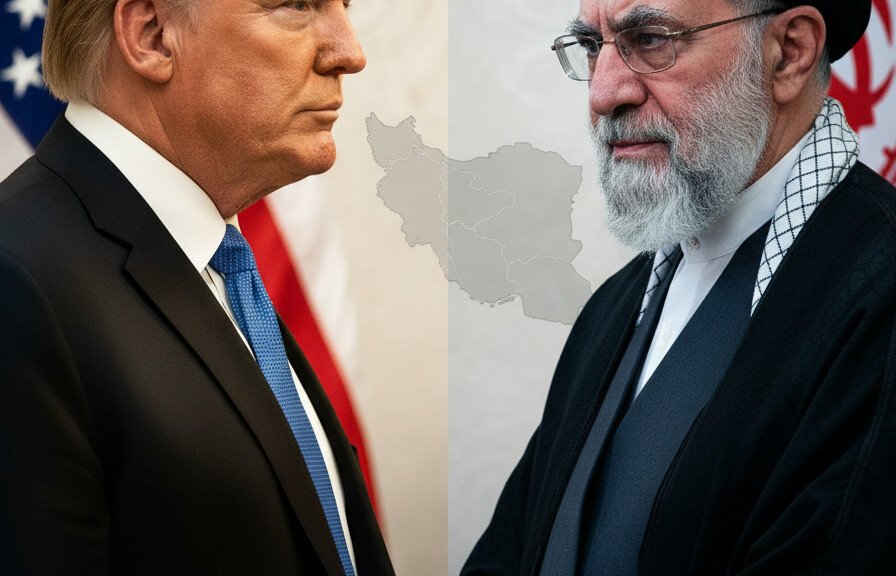
Editorial illustration
Iran Rejects Trump’s Peace Plan, Demands War Reparations and Hormuz Control
Iran has flatly rejected a U.S. proposal to end the current conflict, dismissing American overtures as \”excessive\” and vowing to continue fighting until Tehran’s own conditions are met. The response reveals what many conservatives have long suspected: the Iranian regime has no interest in genuine peace, only in extracting maximum concessions while continuing its destabilizing activities across the Middle East.
According to statements from Iranian officials carried by state-run media, the regime’s demands include halting all attacks against Iranian interests, securing guarantees against future conflict, receiving compensation for damages and war reparations, ending military operations involving its allied proxy groups, and—most provocatively—gaining international recognition of Iran’s sovereignty over the Strait of Hormuz as its \”natural and legal right.\” The Iranian embassy to Mumbai posted on X that \”no negotiations will be held\” before these conditions are satisfied, adding that Iran will end the war \”at a time of its own choosing.\”
Let that sink in. A regime that has spent decades chanting \”Death to America,\” that funds terrorist groups across the region, that has directly attacked U.S. military personnel and facilities, now demands reparations and control over one of the world’s most critical shipping lanes as the price for peace. This isn’t diplomacy; it’s extortion dressed up in diplomatic language. And it comes from a government whose economy is in shambles, whose people increasingly chafe under theocratic oppression, and whose military capabilities have been steadily degraded by Israeli and American strikes.
The Iranian regime’s response also accused the U.S. proposal of being \”a deception aimed at escalating tensions.\” This is classic authoritarian projection. The same government that has armed the Houthis to attack commercial shipping, that has flooded Gaza and Lebanon with weapons, that has plotted assassinations on European soil, now claims to be the victim of American aggression. When your entire political system is built on opposition to the Great Satan, actual peace becomes an existential threat.
President Trump has made clear that he prefers a diplomatic solution but will not be played for a fool. The White House has warned that Trump is prepared to \”unleash hell\” if Iran continues to balk at a reasonable deal. This isn’t reckless bravado; it’s the necessary posture when dealing with a regime that interprets weakness as an invitation for further aggression. The Obama-era approach of shipping pallets of cash and hoping for moderation produced exactly nothing except emboldened Iranian hardliners and a regional arms race.
What the mullahs in Tehran fail to understand—or perhaps understand all too well—is that Trump’s threats carry weight because he follows through. The targeted killing of Qasem Soleimani demonstrated that this president will act decisively against those who target Americans. The ongoing Israeli campaign against Iranian military infrastructure in Syria and elsewhere has shown that the axis of resistance is not invulnerable. And the economic pressure of sanctions, whatever their limitations, has constrained Iran’s ability to project power.
For American Christians watching these developments, there’s a deeper lesson about the nature of evil regimes. The Iranian theocracy isn’t misunderstood; it isn’t a product of historical grievances that can be soothed with concessions; it is a revolutionary regime committed to a destructive ideology that cannot be appeased. Pray for peace, certainly. But understand that peace sometimes requires strength, clarity, and the willingness to confront evil rather than accommodate it. The president seems to understand this. Whether Iran’s leaders can grasp it before it’s too late remains to be seen.
—
**Source:** Daily Wire, Fox News, Iranian state media statements
**Published:** March 25, 2026
**Status:** Draft
About The Author
