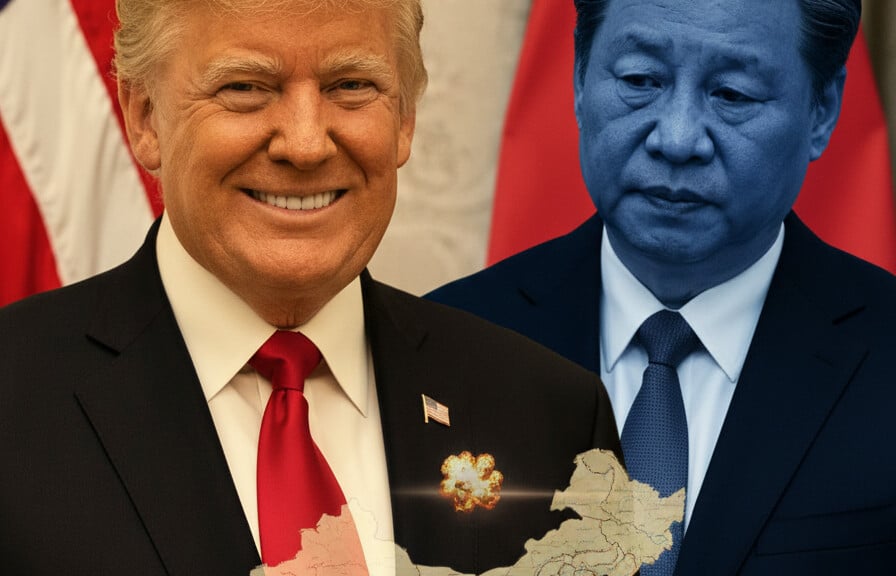
Editorial illustration
The art of the deal just hit a scheduling conflict. President Trump has postponed his much-anticipated trip to China by “a month or so,” citing the ongoing Iran war as the reason he needs to stay stateside. It’s a move that speaks volumes about where his priorities lie — and it’s got Beijing scrambling to spin the narrative.
The Chinese government, never ones to miss an opportunity for diplomatic face-saving, immediately insisted that Trump’s delay had absolutely nothing to do with their refusal to help secure the Strait of Hormuz against Iranian attacks. Nothing at all. Move along, nothing to see here. Foreign Ministry spokesman Lin Jian practically tripped over himself to clarify that the U.S. had publicly called media reports linking the postponement to Hormuz “completely false.”
Sure, guys. Whatever helps you sleep at night.
Here’s what actually happened. Trump had been scheduled to meet with Xi Jinping in Beijing on March 31 — a high-stakes summit that could have reshaped the economic relationship between the world’s two largest economies. But with Operation Epic Fury raging and American forces actively engaged against Iranian targets, the President decided he couldn’t be halfway around the world when critical decisions needed to be made. “I have to be here, I feel,” Trump told reporters. It’s the kind of instinctive leadership that drives the foreign policy establishment crazy — and it’s exactly why his base loves him.
The Hormuz angle is where this gets interesting. Trump had previously hinted that he’d be more likely to postpone the trip if China didn’t step up to help secure the vital shipping lane. “It’s only appropriate that people who are the beneficiaries of the strait will help to make sure that nothing bad happens there,” he contended. China, which imports massive amounts of oil through Hormuz, has been conspicuously absent from any coalition efforts to keep the waterway open. They’ve benefited from American naval protection for decades without contributing their fair share to the security architecture that makes global commerce possible.
Now they’re discovering that free-riding has consequences.
White House Press Secretary Karoline Leavitt confirmed Monday that “the dates may be moved” because Trump’s “number one priority right now is to ensure the continued success of this Operation Epic Fury.” Notice what she didn’t say — she didn’t explicitly link the delay to China’s Hormuz inaction, preserving diplomatic wiggle room while making the point abundantly clear to anyone paying attention. It’s classic Trumpian diplomacy: the threat is implied, the leverage is real, and the other side is left wondering exactly how much they’re being punished for their non-cooperation.
China’s response has been a masterclass in wounded dignity. They’re acting like a jilted date who insists they weren’t really interested anyway. The Foreign Ministry’s insistence that the delay has nothing to do with Hormuz — repeated with increasing desperation — only confirms that yes, it absolutely does. When your adversary is this eager to deny something, you know you’ve hit a nerve.
The broader strategic picture here is worth considering. Trump is demonstrating that American foreign policy isn’t just about managing relationships — it’s about extracting value from them. For too long, the United States has provided global public goods like freedom of navigation while allies and competitors alike free-ride on our investments. The President is making it clear that those days are ending. If you want the benefits of a stable international order, you need to contribute to maintaining it.
China’s calculation is more complicated than it appears. On one hand, they desperately want a face-to-face with Trump to negotiate on trade, technology, and Taiwan. Xi Jinping has his own domestic pressures, and a successful summit with the American President would bolster his standing at home. On the other hand, aligning with the U.S. against Iran would damage China’s relationships in the Middle East and undermine their carefully cultivated image as a champion of the Global South against Western imperialism.
It’s a dilemma entirely of Beijing’s own making. They’ve spent decades building influence in the Middle East through Belt and Road investments and diplomatic engagement. Now, when the region is in crisis and their economic interests are directly threatened, they’re discovering that influence without responsibility is worthless. The Iranians aren’t listening to Chinese calls for restraint, and the Americans aren’t going to keep protecting Chinese shipping for free.
Trump’s decision to postpone rather than cancel preserves his leverage while acknowledging operational realities. A President engaged in active military operations shouldn’t be jetting off to Beijing for photo ops, no matter how important the relationship. The message to Xi is clear: when you’re ready to be a responsible stakeholder in global security, we’ll talk. Until then, we’ve got a war to win.
**_Should Trump have postponed the China trip, or is face-to-face diplomacy too important to delay? Sound off in the comments._**
Providence watches over the bold.
About The Author
