Editorial illustration
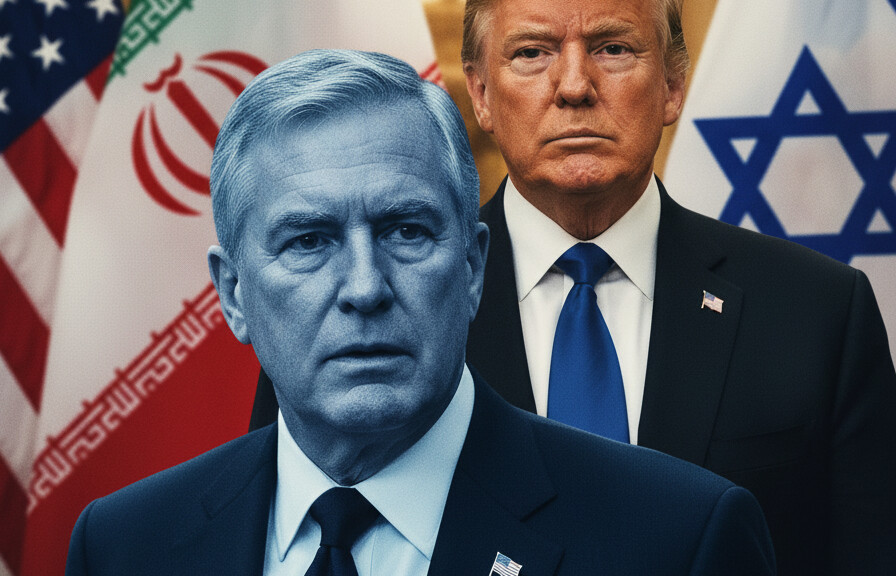
Another one bites the dust. Joe Kent, the nation’s top counterterrorism official, has resigned from his post at the National Counterterrorism Center — and he didn’t go quietly. In a parting shot fired across the bow of the Trump administration, Kent claimed he couldn’t in “good conscience” support the ongoing war with Iran, alleging that Tehran posed “no imminent threat” and that America was dragged into conflict by pressure from Israel and its “powerful American lobby.”
That’s quite the exit interview.
Kent’s resignation letter, posted to X earlier this morning, reads like a manifesto for the non-interventionist wing of the conservative movement. He frames his departure as a matter of principle, a refusal to participate in what he sees as an unnecessary war driven by foreign influence rather than American interests. It’s the kind of stance that would have made Ron Paul proud — and it’s exactly the kind of stance that drives the establishment absolutely insane.
But the White House isn’t having it. Press Secretary Karoline Leavitt came out swinging Tuesday, pushing back on what she called “false claims” in Kent’s letter. She didn’t mince words: “As President Trump has clearly and explicitly stated, he had strong and compelling evidence that Iran was going to attack the United States first.” The evidence, she noted, came from multiple sources and factors — not exactly the rash, Israel-pushed decision Kent is portraying.
Here’s where it gets interesting. Kent isn’t some deep state holdover from the Obama years. He’s a Trump appointee, a guy who presumably shares the President’s worldview on national security. Or at least he did, until now. His very public break with the administration over Iran policy signals something deeper than a simple policy disagreement — it suggests a fundamental divide within conservative foreign policy circles about what “America First” actually means when the missiles start flying.
The President’s response? Classic Trump. “Good thing that he’s out,” he told reporters, dismissing Kent with the same blunt efficiency he applies to anyone who questions his decisions. No hand-wringing, no attempts at reconciliation — just a clean break and a wish for good luck in future endeavors. It’s the kind of personnel management that keeps the swamp on its toes and ensures that public dissent carries consequences.
But let’s not dismiss Kent’s concerns entirely. The question of whether Iran truly posed an imminent threat is exactly the kind of debate we should be having before committing American forces to combat. The Iraq War taught us — or should have taught us — that “strong and compelling evidence” can sometimes turn out to be anything but. The American people have every right to demand clarity about why their sons and daughters are being sent into harm’s way.
That said, Kent’s framing is problematic. To suggest that Israel’s “powerful American lobby” is the driving force behind American military action plays into some ugly tropes that have no place in serious foreign policy discourse. Yes, Israel is an ally. Yes, pro-Israel groups exist and advocate for their interests — just like every other interest group in Washington. But to imply that Jewish influence is puppeteering American foreign policy? That’s not principled non-interventionism. That’s conspiracy theorizing.
The truth is probably messier than either side wants to admit. Trump may well have had legitimate intelligence about Iranian attack plans. Israel may well have pushed for a harder line against Tehran. And Kent may well have sincerely believed that the costs of war outweighed the benefits. None of these positions are inherently unreasonable — but only one of them gets to set policy from the Oval Office.
Kent’s departure leaves the administration with a personnel gap at a critical moment. Operation Epic Fury is ongoing, tensions with Iran remain high, and the President needs a counterterrorism team that’s fully aligned with his strategic vision. Whether Kent’s replacement will be more hawkish, more loyal, or simply more discreet remains to be seen.
What we do know is this: the Trump administration is not a place for public dissent on matters of war and peace. The President makes the call, and his team executes — or they find the exit. It’s a management style that produces clarity, if not always harmony. And in the middle of a shooting war, clarity might be exactly what’s needed.
**_Was Kent right to speak out, or should administration officials keep their disagreements behind closed doors? Share your thoughts below._**
Providence watches over the bold.
About The Author
