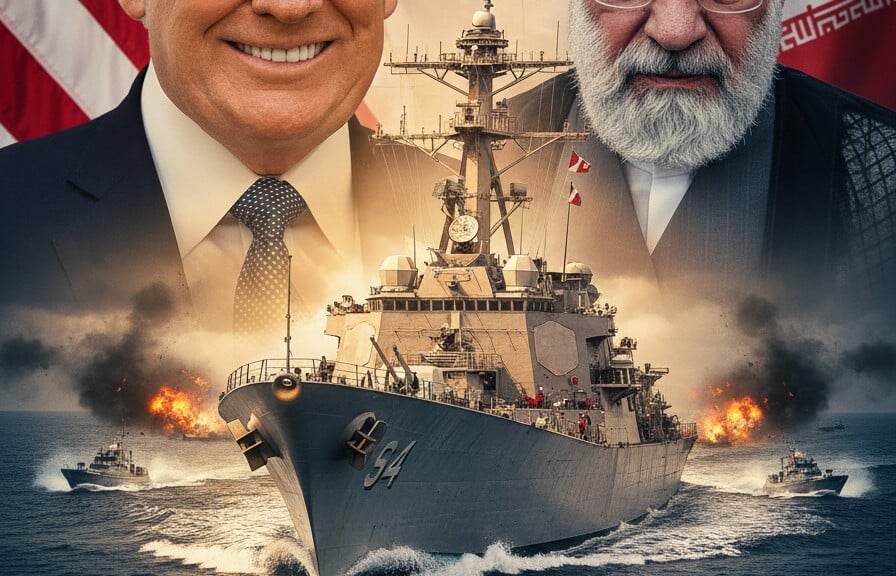
Editorial illustration
Three American destroyers came under sustained attack from Iranian forces Thursday as they transited the Strait of Hormuz, with Tehran launching missiles, drones, and swarms of fast-attack boats in what U.S. Central Command described as a coordinated assault on American naval vessels. The USS Truxtun, USS Mason, and USS Rafael Peralta all emerged unscathed, but the incident marks a dangerous escalation that threatened to shatter the fragile ceasefire between the United States and Iran.
American forces responded with what CENTCOM termed “self-defense strikes,” targeting Iranian drone and missile launch sites as well as two Iranian ports—Bandar Abbas and Qeshm—that serve as key military installations along the vital waterway. President Trump, characteristically blunt, described the American response as a “love tap” and insisted the ceasefire remains in effect despite the exchange of fire. “They trifled with us today. We blew them away,” he told reporters at the Lincoln Memorial.
The confrontation unfolded over several hours, with Iranian Revolutionary Guard Corps boats maneuvering aggressively close to the American warships—close enough that U.S. vessels opened fire to keep them at bay. Iranian state television later broadcast footage showing explosions on Qeshm Island, claiming they occurred during an “exchange of fire between Iranian armed forces and the enemy.”
What is striking about this incident is not just the military engagement itself, but what it reveals about Iranian intentions. The regime in Tehran has been publicly considering an American proposal to end the war that began February 28th, yet simultaneously attempted to block U.S. naval transit through waters international law recognizes as open to all nations. President Trump did not mince words about the contradiction: “A normal Country would have allowed these Destroyers to pass, but Iran is not a normal Country. They are led by LUNATICS.”
The Strait of Hormuz remains effectively closed to commercial traffic, with approximately 1,500 ships and 20,000 crew members trapped in the Persian Gulf according to the UN International Maritime Organization. Iran has attempted to formalize its control by creating what it calls a “Persian Gulf Strait Authority” to regulate transit and collect tolls—a move that would effectively give Tehran veto power over a fifth of the world’s oil shipments.
Trump’s response has been characteristically measured in rhetoric while firm in action. He warned Iran that future aggression would be met with far greater force—”we will knock them out a lot harder, and a lot more violently”—but simultaneously expressed optimism that a peace deal remains achievable. “I believe they want the deal more than I do,” he said, suggesting the regime’s internal pressure may be driving them toward the negotiating table despite their public belligerence.
The broader context matters here. Gas prices have surged to $4.54 per gallon nationally, the highest since July 2022, as the two-month closure of Hormuz disrupts global energy markets. The administration has waived Jones Act restrictions to allow more domestic oil movement, but there is no substitute for reopening the strait. Every day this continues, American families pay more at the pump—and Iranian hardliners grow more desperate.
Whether this flare-up derails peace talks or accelerates them depends largely on whether Iran’s leadership recognizes what Trump has made clear: the United States will defend its forces, will not be bullied from international waters, and remains prepared to end this conflict either through diplomacy or through decisive military action. The choice, as always, is Tehran’s to make.
About The Author
