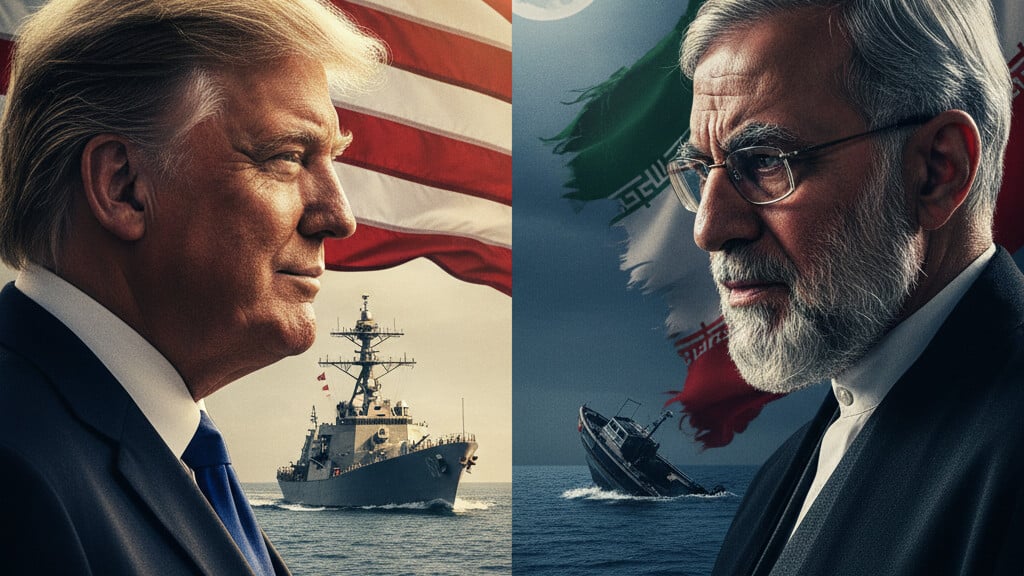
Editorial illustration
Tensions in the Middle East took another dangerous turn Thursday as U.S. and Iranian forces traded missile fire in the Strait of Hormuz, with both sides accusing the other of reckless escalation. The confrontation marks yet another flashpoint in an increasingly volatile region where American naval power meets Iranian defiance, and where the margin for error grows thinner by the day. According to U.S. Central Command, American forces disabled two Iranian-flagged oil tankers—the M/T Sea Star III and M/T Sevda—after they attempted to enter an Iranian port in violation of the ongoing U.S. blockade. The operation came after Iranian forces reportedly fired missiles at American destroyers transiting the strategic waterway. President Trump confirmed that three U.S. destroyers came under fire but sustained no damage, stating that the Iranian attackers were \”completely destroyed along with numerous small boats.\” The president’s characterization of the engagement was characteristically blunt: the boats, he said, \”went to the bottom of the Sea, quickly and efficiently.\” But this isn’t just about a naval skirmish in distant waters. The Strait of Hormuz handles roughly one-fifth of the world’s oil shipments, meaning any sustained conflict there doesn’t stay contained—it ripples outward, hitting energy markets and American wallets. When missiles start flying in the world’s most important oil chokepoint, the question isn’t whether we’ll feel it at the pump, but how soon and how hard. Iranian state media has painted a different picture, claiming their navy struck an American frigate and warning the U.S. to keep out of Hormuz entirely. The dueling narratives are familiar—each side claiming victory, each side blaming the other for provocation. What’s less clear is whether this remains a limited exchange or the opening act of something larger. The UAE and Oman report intercepting Iranian ballistic missiles and drones, suggesting Tehran is willing to expand the theater if pressed. For the Trump administration, this presents a familiar dilemma: demonstrate strength without stumbling into another endless Middle Eastern war. The blockade was imposed to pressure Iran, but pressure creates its own momentum. When you squeeze a regime that sees compromise as weakness, you sometimes get exactly what you’re trying to prevent—a fight nobody wants but nobody can back down from. The coming days will tell whether this was a managed escalation or the beginning of something more costly. For now, the destroyers are through, the tankers are disabled, and the Strait remains open—but barely, and at the price of American munitions and Iranian blood.
About The Author
