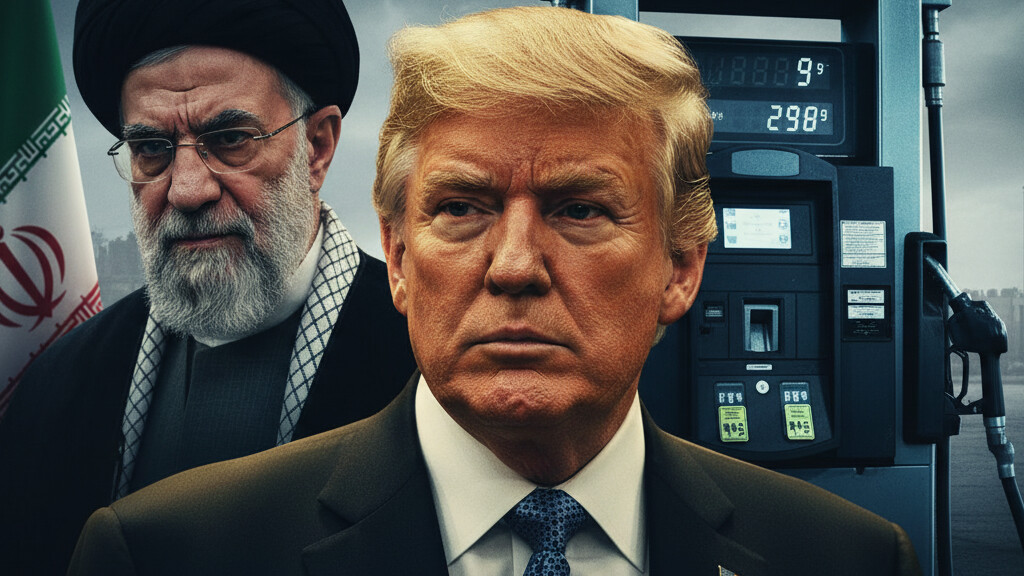
Editorial illustration
The trip to the gas pump used to be a mundane errand, something you did while thinking about what to make for dinner or whether you’d remembered to reply to that email. Now, for millions of Americans, it’s become a daily reminder that global events have a way of showing up at your local Shell station whether you invited them or not. President Trump stood before Congress in February and proudly announced that gas prices had fallen below $2.30 a gallon in most states, with some places seeing prices as low as $1.99. It was a powerful economic message, the kind of tangible proof that the America First agenda was delivering real results for working families. But that was before Operation Epic Fury, before the Strait of Hormuz became a flashpoint, and before the Iranian conflict sent energy markets into a tailspin that is now hitting hardest in the very swing states that delivered Trump his victory.
The numbers tell a sobering story. The national average has climbed to $4.16 per gallon, up about 91 cents from a year ago according to AAA. On the West Coast, drivers in California are shelling out $5.93 per gallon, while Washington state residents face $5.39 prices. The East Coast isn’t faring much better, with Washington D.C. at $4.29 and Pennsylvania at $4.18. Even the South, traditionally a refuge from the worst price spikes, is feeling the pinch, with Florida at $4.18 and Georgia at $3.73. But it’s the swing states that should worry Republican strategists. Virginia, Pennsylvania, Georgia, Ohio — these are the places where elections are won and lost, and these are the places where voters are watching their fuel costs climb week after week.
Take Zafar, an Uber driver in Virginia who spoke to reporters about the reality he’s facing. “I used to put $30 worth of gas in my car for the week — now it’s $45,” he said. “I have no choice — I have to support my family.” That $15 difference might not sound like much to the pundits on cable news, but for someone driving for a living, it’s the difference between making rent and falling behind. And Zafar can’t simply cut back on driving; his livelihood depends on being on the road. He’s trapped between the economic necessity of working and the economic reality that every mile costs more than it did a month ago.
The pain doesn’t stop at the gas pump. Diesel has climbed to $5.66, up about $1.15 over the past month, and that’s where this crisis starts to ripple through the entire economy. Diesel fuels the trucks that deliver your groceries, the ships that bring goods from overseas, the tractors that plant and harvest America’s crops. When diesel prices spike, everything that depends on transportation gets more expensive. The grocery store doesn’t absorb those costs; they pass them on to you. The shipping company doesn’t eat the difference; they add a fuel surcharge to your invoice. The farmer doesn’t work for free; the price of bread reflects the price of the diesel in his combine harvester. This is how energy crises become inflation crises, and inflation crises become political crises.
Democrats, sensing blood in the water, have already begun their familiar playbook. Last fall, they ran on affordability and won key races in Virginia, New York, and New Jersey by hammering Republicans on kitchen-table economics. Now they’re dusting off those same tactics, tying rising fuel costs to Republican policies in ads and campaign appearances across battleground states. In central Pennsylvania, Democrat Janelle Stelson campaigned at a Mobil station where regular unleaded was $4.24 and diesel topped $6, arguing that her opponent, Republican Scott Perry, bore responsibility for the cost-of-living crisis. In Iowa, the left-leaning veterans group VoteVets is running an $825,000 ad campaign highlighting rising gas prices to boost Democratic Senate candidate Joshua Turek. In Michigan, Democrat Abdul El-Sayed is airing ads flatly declaring, “You know why gas is so expensive? Donald Trump’s $200 billion war with Iran.”
Is that fair? Not entirely. The conflict with Iran wasn’t some optional adventure; it was a response to decades of Iranian aggression, support for terrorism, and an advancing nuclear program that threatened not just Israel but regional stability and American interests. Trump didn’t start this fight; he finished it, or at least attempted to, before the current ceasefire took effect. But fairness rarely matters in politics. What matters is perception, and the perception forming in the minds of swing-state voters is that their wallets are lighter than they were a few months ago, and the party in power is responsible.
The irony is thick enough to cut with a knife. For years, Democrats have championed policies that deliberately raise energy costs in the name of fighting climate change. They’ve blocked pipelines, restricted drilling, and declared war on fossil fuels with an enthusiasm that would make a Saudi oil minister blush. Now they’re pretending to be the champions of cheap gas, conveniently forgetting that their preferred energy policies would make $4.16 per gallon look like the good old days. But hypocrisy has never been a barrier to political opportunism, and Republicans would be foolish to underestimate the damage that sustained high gas prices can do to their electoral prospects.
The question facing the Trump administration is whether this is a temporary spike driven by conflict-related uncertainty, or the new normal in a world where Iranian instability continues to threaten global energy markets. If the ceasefire holds and shipping lanes through the Strait of Hormuz remain open, prices should stabilize and eventually retreat. But “should” and “will” are two different words, and energy markets are notoriously difficult to predict. What we can say with certainty is that every week gas prices remain elevated is another week Democrats have to hammer away at one of Trump’s core economic messages. Low prices were supposed to be proof that the America First agenda worked. High prices, fairly or not, will be used as evidence that it failed.
For now, the administration is caught between the rock of necessary foreign policy and the hard place of domestic political reality. Operation Epic Fury was the right call; allowing Iran to acquire nuclear weapons would have been an unthinkable gamble with global security. But right decisions don’t always produce immediately popular outcomes, and the American people have a well-documented tendency to vote their pocketbooks when they feel squeezed. Trump has defied political gravity before, surviving controversies that would have ended lesser politicians. But gravity has a way of reasserting itself eventually. The next few months will tell us whether this president can bend economic reality to his will, or whether the pump price will pump the brakes on Republican momentum in the midterms.
#GasPrices #IranConflict #Trump #Economy #SwingStates #Inflation #Energy #Midterms #Politics #PatriotFeed
About The Author
