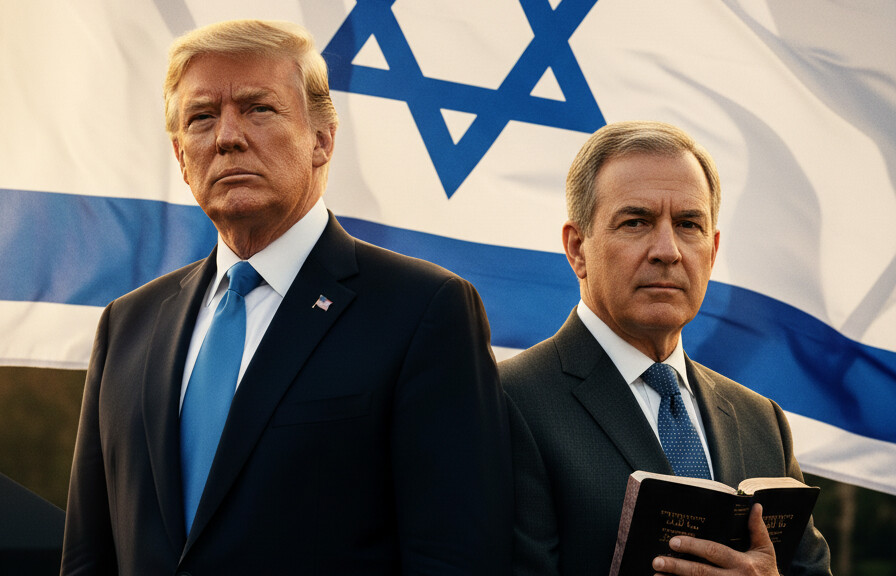
Editorial illustration
While the ceasefire with Iran has taken effect and the immediate threat of further escalation seems to have paused, one thing remains abundantly clear: evangelical Christians haven’t budged an inch in their support for Israel or for the president who stood beside the Jewish state when it mattered most. Operation Epic Fury, the joint U.S.-Israeli campaign that began February 28 with the stated goal of dismantling Iran’s ballistic missile capabilities and preventing the mullahs from acquiring nuclear weapons, has drawn sharp lines in American politics. On one side, you have those who believe America has both a strategic and moral obligation to confront evil before it reaches our shores. On the other, you have the usual suspects wringing their hands about “escalation” while ignoring the reality that Iran has spent decades vowing to wipe Israel off the map.
Dr. Mike Evans, founder of the Friends of Zion Heritage Center in Jerusalem and a close ally of President Trump, flew to Israel on February 26 as tensions were reaching their boiling point. He didn’t wait for the war to end before showing up; he went while missiles were still in the air. Evans has been through 41 conflicts in his lifetime, and he goes where people are hurting. When an Iranian missile struck Beit Shemesh on March 1, killing nine people including Pnina Cohen’s husband and mother-in-law, Evans was there with first responders shortly after the blast. He visited Cohen in the hospital, provided $50,000 in financial assistance to a bereaved family, and continued doing what he’s done for half a century: combating antisemitism and helping the Jewish people in their darkest hours.
What drives this level of commitment? For Evans and millions of American evangelicals, the answer is rooted in something far deeper than geopolitical strategy. “The Bible is a Jewish book, and evangelicals believe in a Jewish person, Jesus,” Evans explained. “They see Israel as the biblical land and believe God keeps his promises.” This isn’t political posturing or performative allyship. It’s a theological conviction that the modern state of Israel represents the fulfillment of biblical prophecy and the continuation of God’s covenant with His people. When evangelical leaders say they stand with Israel, they’re not reading from a campaign script; they’re expressing a faith that has sustained them through generations.
Pastor John Hagee, founder of Christians United for Israel, put it even more directly. “As Americans, we have a right to defend ourselves against the Islamic Republic’s half-century of terror. As Christians, we are mandated to defend ourselves against evil, to stand with the oppressed against the same, and to stand with the children of Israel at all times.” Hagee isn’t interested in the diplomatic niceties that have allowed Iran to advance its nuclear program through decades of failed negotiations. He sees the situation with moral clarity: a fanatical regime that has funded terrorism across the globe, attacked American troops, and pledged genocide against the Jewish people cannot be reasoned with. It can only be stopped.
Franklin Graham, president of Samaritan’s Purse, echoed this sentiment with characteristic straightforwardness. “Iran has vowed to wipe the State of Israel off the face of the earth, and with nuclear weapons, they could. If President Trump had not stopped them, this is something this fanatical Islamic regime might have done within the next few months.” Graham’s assessment cuts through the fog of media spin and partisan bickering to the heart of the matter. This wasn’t a war of choice; it was a preventive strike against an existential threat. The mullahs in Tehran have never made their intentions secret. They’ve chanted “Death to Israel” in their parliament and on their streets for decades. Why would anyone believe they wouldn’t use a nuclear weapon if they managed to build one?
Of course, not everyone within the evangelical community sees eye to eye on this. Evans acknowledged that roughly 22% to 23% of younger evangelicals have shifted away from traditional support for Israel, influenced by universities and online voices that recast the Jewish state as an oppressor rather than a beacon of democracy in a region dominated by tyranny. This generational divide is real, and it’s concerning. But Evans believes these young people can be reached with the truth, and he’s putting his money where his mouth is. His organization has generated 127 million views on social media in the last eight weeks alone, fighting misinformation and antisemitism with facts and biblical perspective. “We don’t just offer prayers,” he said. “We provide financial help to those who lost homes and possessions.”
The evangelical support for Operation Epic Fury represents something larger than any single military campaign. It’s a statement about what America stands for when the chips are down. Are we a nation that abandons our allies when the cost gets too high? Or are we a people who recognize that Israel isn’t just another foreign country but the only truly democratic nation in the Middle East and our closest ally in a region that has produced nothing but hostility toward Western values? Graham’s message to the American people was simple and direct: “Remember Israel is the only truly democratic nation in the Middle East — the only one. And they have been our nation’s closest ally in the region. I urge Americans to ‘pray for the peace of Jerusalem’ as the Bible instructs us.”
President Trump has had his critics on the right, and some of the concerns about the ceasefire terms are legitimate. But on the fundamental question of whether America should stand with Israel against Iranian aggression, there has been no ambiguity. “We’ve never had a president like President Trump in my lifetime,” Graham noted. “If he says he’s going to do something, he’ll do it. He warned Iran that if it continued to develop nuclear weapons, the U.S. would intervene, and that’s exactly what he did.” In a political culture where promises are made to be broken and red lines are drawn only to be erased, that kind of reliability matters. It matters to Israel, and it matters to the millions of American Christians who see the defense of the Jewish state as a sacred obligation.
The ceasefire may hold, or it may collapse. Iran may negotiate in good faith, or they may use the breathing room to rebuild their capabilities and prepare for the next round. No one can predict the future with certainty. But what we can know, with absolute confidence, is that evangelical Christians will continue standing with Israel regardless of which way the political winds blow. They do so not because it’s popular or politically expedient, but because their faith demands it. In an age of shifting allegiances and transactional relationships, that kind of constancy is rare. And it’s worth recognizing, even by those who don’t share the theological convictions that underpin it.
#EvangelicalSupport #Israel #Trump #OperationEpicFury #ChristianZionism #MiddleEast #Iran #ForeignPolicy #BiblicalValues #PatriotFeed
About The Author
