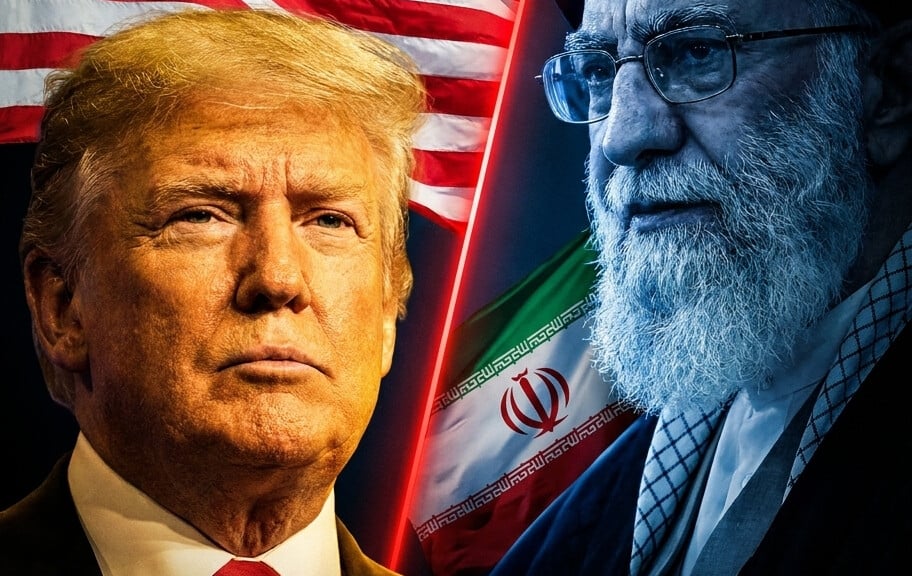
Editorial illustration
President Donald Trump issued a stark warning to Tehran on Thursday, declaring that any killing of American troops by Iran would constitute a “very good reason” to restart military operations against the Islamic Republic. The comments came during an Oval Office briefing where Trump addressed the fragile ceasefire that has held, nominally at least, since the initial U.S.-Israeli strikes began on February 28.
The President’s remarks cut through weeks of diplomatic ambiguity. When reporters pressed him on what exactly would cross his red line, Trump did not mince words. The death of American service members at Iranian hands would trigger an immediate return to open conflict. This is not the language of a man seeking endless war, but of a commander-in-chief who understands that weakness invites aggression.
Yet Trump also revealed himself open to the unexpected. He told reporters he would be “honored” to meet with Iranian Supreme Leader Ayatollah Mojtaba Khamenei if such a meeting could produce a genuine deal. “I don’t want to meet. But if I did meet, I’d be honored to meet him,” Trump said. “I’d like to see if we make a deal.” It is classic Trumpian diplomacy, the velvet glove and the iron fist presented simultaneously.
The context matters. The nominal ceasefire between the United States and Iran has been repeatedly tested with back-and-forth attacks, though officials from both countries continue negotiating in Pakistan and other venues. Initial talks in April failed to produce a peace deal, prompting Trump to announce an open-ended extension of the ceasefire coupled with a continued U.S. blockade until negotiations conclude “one way or the other.”
Trump also detailed, for the first time, a risky plan he ultimately rejected that would have sent American troops into Iran to collect enriched uranium, what he calls “nuclear dust.” The operation would have required at least two weeks and massive equipment airlifts. He decided against it given the dangers, noting that the nuclear material remains “entombed” and that “there’s no reason to” attempt extraction at this time. “We could get it right now,” he added. “I don’t think they could stop us if we wanted.”
The developments come as Hezbollah, Iran’s Lebanese proxy, formally rejected the ceasefire between Israel and Lebanon. Hezbollah leader Naim Qassem called negotiations “absurd, humiliating, and shameful” in a televised statement, vowing that “as long as the occupation exists, the resistance will continue.” Israel’s Foreign Ministry responded swiftly, declaring that Hezbollah “must be disarmed and its terrorist infrastructure in southern Lebanon must be dismantled according to UN Security Council Resolution 1701.”
What are we to make of this moment? The President is simultaneously extending an olive branch to Tehran while making clear that American blood is the line that cannot be crossed. It is a balancing act that requires nerves of steel. The Iranians, for their part, have shown themselves masters of proxy warfare, using Hezbollah and other militias to strike at American interests while maintaining plausible deniability.
Trump’s warning serves notice that this game has limits. The American people did not elect him to preside over another endless Middle Eastern quagmire, but neither did they choose a president who would tolerate the murder of our troops. The message to Tehran is clear: negotiate in good faith, or face consequences that will make the February strikes look like a prelude.
About The Author
