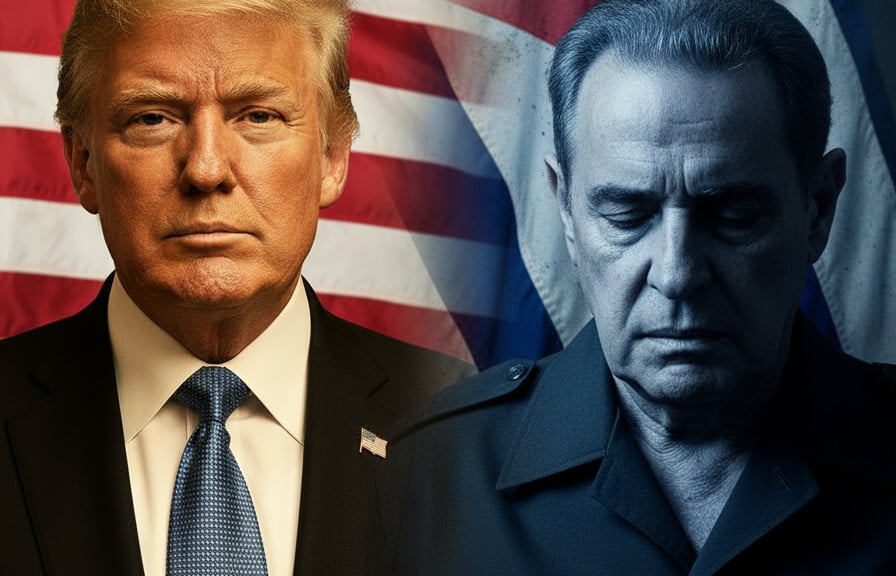
Editorial illustration
President Trump dropped a bombshell on Wednesday that sent shockwaves through Miami’s Cuban exile community and sent chills down the spines of communist regimes everywhere. Following the Department of Justice’s historic indictment of former Cuban dictator Raúl Castro, Trump stood before reporters at Joint Base Andrews and made his intentions crystal clear: “We have Cuba on our mind… we’re freeing Cuba.”
The moment came after Trump’s commencement address at the US Coast Guard Academy in New London, Connecticut, where he walked directly to the press pool with what he called “big news.” And big it was. For the first time in nearly three decades, an American president is treating the Castro regime not as a bothersome neighbor to be managed, but as a criminal enterprise to be dismantled.
“A lot of people have suffered very big, very, very at levels that few people would understand,” Trump said, his voice carrying the weight of generations of Cuban families torn apart by communist oppression. “I think the Cuban population of Miami, and certainly beyond Miami, people that came there that were decimated, whose families were ruined, appreciate what the Attorney General just did today.”
The indictment itself centers on a 1996 atrocity that many Americans have forgotten but no Cuban exile ever could. On February 24, 1996, two civilian aircraft operated by Brothers to the Rescue were shot down over international waters by Cuban fighter jets. The group, made up of Cuban exiles, was conducting humanitarian missions, dropping anti-government leaflets and searching for Cuban refugees fleeing the island prison. Four Americans died that day. For 29 years, justice has been delayed. Now, it may finally be delivered.
Interim Attorney General Todd Blanche didn’t mince words when announcing the charges. “The United States and President Trump does not and will not forget its citizens,” he declared. It’s a stark contrast to the previous decades of American foreign policy that treated the Castro regime with kid gloves, always careful not to upset the delicate diplomatic balance that never seemed to benefit anyone except the communists in Havana.
Trump’s vision for what’s next is ambitious but characteristically vague on specifics. He mentioned that the CIA and Secretary of State Marco Rubio have been engaged in talks with Cubans, and while he admitted “it’s not going to be like the biggest thing we’ve ever done,” he emphasized it will be “one of the most important.” For the Cuban people, who have endured 66 years of communist dictatorship, those words carry the promise of something they haven’t known in generations: hope.
When reporters pressed Trump on whether he plans to arrest Castro through military invasion, similar to the operation that nabbed Venezuelan dictator Nicolás Maduro, the President played it close to the vest. “I don’t want to say that,” he responded. But the implication hung in the air like a challenge. For decades, American presidents have talked tough about Cuba while doing little. Trump is talking tough while his Justice Department files actual charges against a former head of state. The difference matters.
The President also declined to specify how long his oil embargo against Cuba will continue, saying only that “we’ll be announcing it pretty soon.” He dismissed concerns about escalation, noting that “the place is falling apart, it’s a mess, and they sort of lost control. They’ve really lost control of Cuba.” It’s an assessment that rings true to anyone watching the island’s economic collapse accelerate in recent years.
What makes this moment different from previous Cuba policy shifts is the combination of legal pressure and rhetorical clarity. Trump isn’t just tightening sanctions or adjusting diplomatic posture. He’s framing the Castro regime as a criminal organization that murdered American citizens, and he’s signaling that the era of communist impunity is ending. For the hundreds of thousands of Cuban-Americans who fled the island or whose parents and grandparents did, it’s a vindication long overdue.
The question now is what comes next. Will Castro face the same fate as Maduro, arrested and extradited to face American justice? Will the regime in Havana collapse under the combined pressure of sanctions, legal threats, and internal decay? Or will this be another moment of hope that fades into the familiar stalemate? For once, the answers may actually be different. Because this president, unlike his predecessors, seems genuinely determined to finish what the Cuban people started in their hearts decades ago: freeing Cuba.
Providence watches over the bold.
—
**Sources:**
– The Gateway Pundit: “WATCH: ‘We Have Cuba on Our Mind… We’re Freeing Cuba’ – Trump Speaks to Reporters Following Indictment of Raúl Castro”
– Department of Justice indictment announcement via Interim Attorney General Todd Blanche press conference
About The Author
