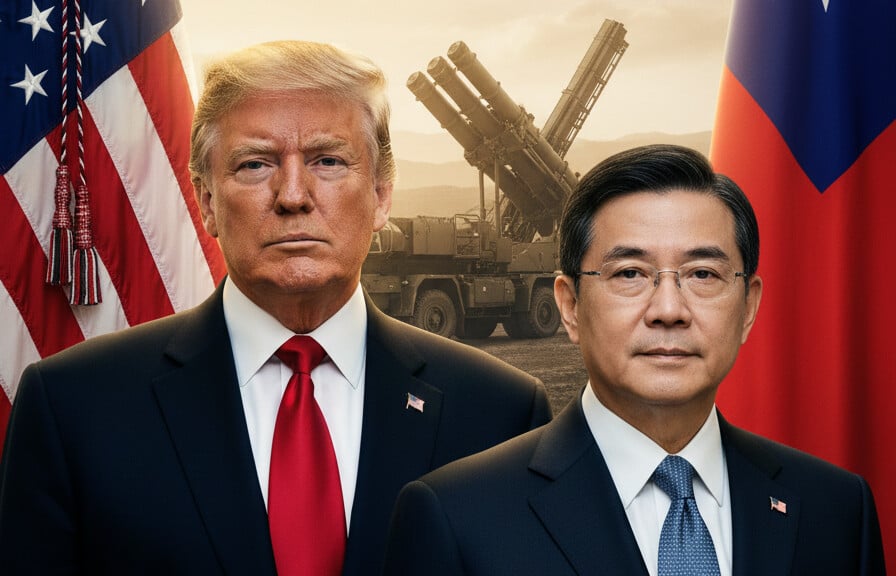
Editorial illustration
The Trump administration is preparing for a pivotal conversation with Taiwanese President Lai Ching-te that could reshape the security architecture of the entire Indo-Pacific region. According to breaking reports, the discussion will center on accelerating U.S. arms sales to Taiwan, a move that signals Washington’s continued commitment to the island democracy despite Beijing’s relentless pressure campaign and threats of reunification by force.
This isn’t routine diplomacy. It’s a deliberate choice to arm a free people against an authoritarian superpower that has made no secret of its intentions. China has spent decades building the world’s largest navy, modernizing its missile forces, and conducting increasingly aggressive exercises simulating a blockade or invasion of Taiwan. The message from Beijing has been consistent and unmistakable: Taiwan will be absorbed, by negotiation if possible, by conquest if necessary.
Trump’s willingness to push forward with arms sales in this environment demonstrates a clarity that has been sorely missing from American foreign policy for too long. Taiwan isn’t a bargaining chip. It’s a strategic partner, a technological powerhouse, and most importantly, a living rebuke to the Communist Party’s claim that Chinese civilization can only thrive under totalitarian rule. The twenty-four million people of Taiwan have built one of Asia’s most dynamic democracies while Beijing has constructed the world’s most sophisticated surveillance state. The contrast speaks for itself.
The arms package under discussion reportedly includes advanced missile defense systems, anti-ship missiles, and surveillance equipment designed to make any Chinese assault prohibitively expensive. This is classic deterrence theory in practice. The goal isn’t to provoke a conflict but to convince Beijing that the cost of aggression would far outweigh any potential gains. It’s the same logic that kept the peace in Europe for decades during the Cold War, and it remains the most reliable foundation for stability in the Taiwan Strait.
Critics will argue that this approach risks escalating tensions with China, as if Beijing’s military buildup were somehow caused by American arms sales rather than the other way around. This inversion of cause and effect has plagued U.S.-China policy for a generation. The People’s Liberation Army doesn’t expand because Washington sells weapons to Taiwan. It expands because the Communist Party has made Taiwan’s subjugation a core pillar of its legitimacy and a prerequisite for its broader ambition to dominate the region.
There’s also an economic dimension that rarely gets adequate attention. Taiwan produces the majority of the world’s most advanced semiconductors, the chips that power everything from smartphones to artificial intelligence systems to advanced weapons. A Chinese takeover wouldn’t just be a humanitarian catastrophe and a strategic disaster. It would give Beijing effective control over the global digital economy, with all the leverage that implies. Arming Taiwan isn’t just about defending a democracy. It’s about preventing a hostile power from holding the world’s technology hostage.
The timing of this conversation matters. The Trump administration has spent months signaling that the era of strategic ambiguity is over, that the United States will no longer pretend to be uncertain about its commitments while hoping for the best. This clarity is uncomfortable for some foreign policy professionals who prefer the flexibility of deliberate vagueness. But ambiguity only works as a deterrent when both sides believe the United States might actually intervene. After years of mixed signals and withdrawal from global commitments, that belief had eroded dangerously.
President Lai faces an unenviable task. He must strengthen his island’s defenses without giving Beijing a pretext for immediate action, maintain American support without becoming a pawn in great-power competition, and prepare his people for a future of persistent threat while preserving the hope of eventual resolution. The arms sales under discussion won’t solve these challenges, but they will make Taiwan harder to conquer and therefore less likely to be attacked.
In the end, this is about more than one island or one arms deal. It’s about whether the United States still has the will to defend the international order it built, or whether it will stand aside as revisionist powers redraw borders by force. Trump has chosen a side, and history will judge whether that choice came soon enough.
About The Author
