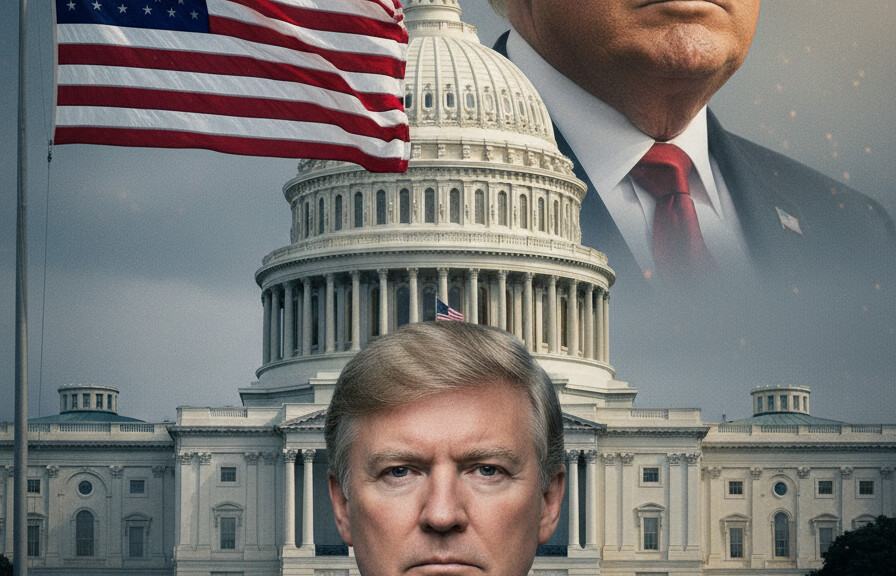
Editorial illustration
Acting Immigration and Customs Enforcement Director Todd Lyons announced Thursday that he will step down from his post at the end of May, marking yet another leadership shakeup at the Department of Homeland Security just over a year into President Trump’s second term. Lyons, who has overseen the agency’s aggressive expansion of immigration enforcement, made the announcement following testimony on Capitol Hill where he and other senior DHS leaders faced questioning about their agencies’ operations amid a record-breaking funding lapse that has left ICE attorneys, investigators, and staff working without pay.
The timing raises obvious questions about whether the resignation is voluntary or if Lyons is being pushed out after failing to meet the administration’s ambitious deportation targets. Under Lyons’ leadership, ICE has pursued an aggressive enforcement agenda that has seen over 570,000 deportations and a record-high number of people in immigration detention. The agency also hired 12,000 new employees in a rapid expansion that transformed ICE from a beleaguered bureaucracy into what the White House describes as a finely tuned enforcement machine.
Stephen Miller, the White House Deputy Chief of Staff who has been the architect of much of the administration’s immigration policy, offered glowing praise for Lyons, calling him a phenomenal patriot who has been at the center of President Trump’s historic efforts to secure our homeland. According to Miller, Lyons’ work has saved countless thousands of American lives and helped deliver safety and tranquility to millions. High praise, certainly, but praise that also serves to obscure the fact that ICE has consistently fallen short of the administration’s stated goal of 3,000 arrests per day.
The gap between rhetoric and reality on immigration enforcement has been a persistent feature of this administration, with ambitious targets announced to great fanfare while the actual mechanics of enforcement struggle to keep pace. Lyons’ departure comes amid a broader pattern of personnel changes at DHS. Homeland Security Secretary Kristi Noem was replaced by former Oklahoma Senator Markwayne Mullin just last month. Madison Sheahan, former deputy director at ICE, left earlier this year to run for Congress. Top department spokesperson Tricia McLaughlin departed in February.
The revolving door at DHS raises legitimate concerns about institutional continuity and whether the constant turnover is hampering the department’s effectiveness. Defenders of the administration will argue that shaking up entrenched bureaucracies is necessary to achieve real change, and there is truth to that. But there is also a point where turnover becomes chaos, where the loss of experienced leadership undermines the very missions the administration claims to prioritize.
Lyons’ resignation also comes with uncomfortable timing regarding oversight of his agency’s conduct. He faced pointed questioning from lawmakers about use-of-force incidents, including the shooting death of a U.S. citizen by an ICE officer in Minnesota in January. Lyons told Congress that ICE conducted 37 investigations into officers’ use of force last year but declined to say whether anyone was fired as a result. The opacity is troubling, as is the fact that 2026 is on track to set records for deaths in ICE custody. These are not statistics to be waved away with platitudes about law and order. They represent real human beings, and the administration’s supporters should demand accountability rather than making excuses.
What makes Lyons’ departure particularly notable is the context of the ongoing government shutdown affecting DHS. Congress has failed to pass funding for fiscal year 2026, leaving the department operating without an appropriated budget while officials simultaneously testify about their requests for fiscal year 2027. The absurdity of the situation would be laughable if it did not have real consequences for the men and women tasked with securing the border and enforcing immigration laws.
How can we expect ICE to function effectively when its employees do not know when they will be paid? How can we demand accountability from leadership when the basic machinery of government is broken? Lyons’ successor will inherit these challenges along with the unrealistic expectations that come with the job. The ICE director position has been filled by acting officials for years, with no Senate-confirmed director since the Obama administration. That is a failure of governance that predates Trump but has persisted throughout his tenure. If the administration is serious about immigration enforcement, it should nominate and fight for a confirmed director rather than relying on a string of acting officials who serve at the pleasure of the White House.
Whether Lyons is leaving voluntarily or being shown the door, his departure is a reminder that immigration enforcement remains one of the most thankless jobs in Washington. You are expected to enforce laws that half the country opposes, meet targets that may be physically impossible, and do it all while Congress dithers and the media second-guesses every decision. The next ICE director will face the same impossible calculus. The question is whether anyone can succeed where Lyons apparently could not.
Providence watches over the bold.
About The Author
