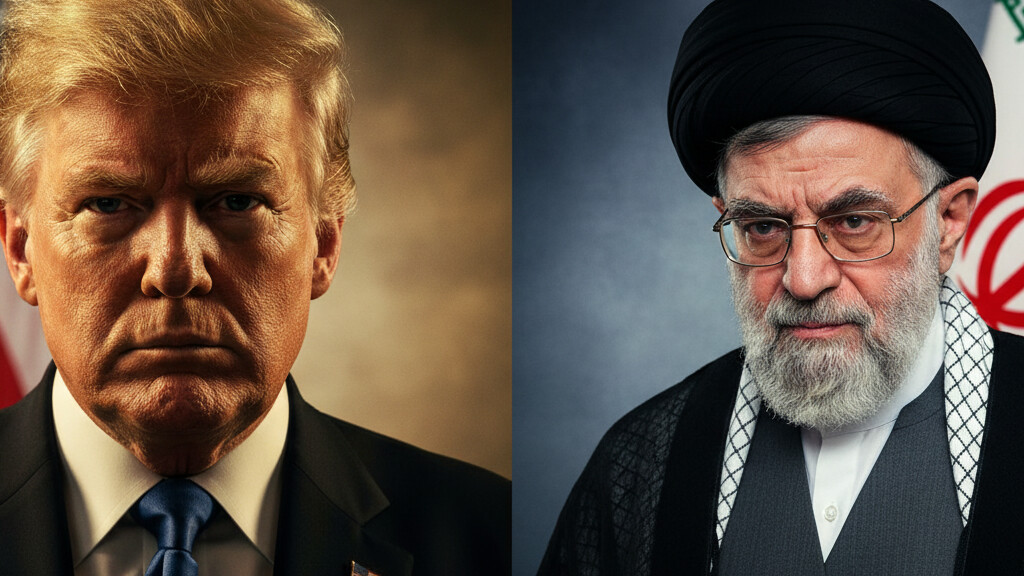
Editorial illustration
President Trump issued a stark warning to Tehran late Wednesday, making it abundantly clear that the United States military remains locked and loaded around Iran with a simple message: comply with the peace deal or face consequences that would be “bigger, and better, and stronger than anyone has ever seen before.” In a late-night Truth Social post that left little room for interpretation, Trump confirmed that American ships, aircraft, and military personnel would maintain their positions in and around Iranian territory until the regime fully honors its commitments.
The president’s unambiguous threat comes as the two-week ceasefire between the United States and Iran holds, with Vice President JD Vance set to lead American negotiations in Islamabad this Saturday. Pakistani mediators will facilitate the talks aimed at ending the conflict that has consumed the region for over a month. Trump indicated that a ten-point proposal offered by Iran would serve as a “workable basis” for negotiations, though he simultaneously accused the New York Times and CNN of fabricating details about the plan to sabotage the peace process.
What exactly does Iran need to do to avoid renewed hostilities? According to the president, the agreement reached long ago demands no nuclear weapons and guarantees that the Strait of Hormuz remains open and safe for international shipping. These are not new conditions, Trump emphasized, but rather terms “agreed a long time ago, and despite all of the fake rhetoric to the contrary.” The administration’s patience appears to be wearing thin with Tehran’s foot-dragging and the regime’s history of using negotiations as cover for continued enrichment activities.
Joint Chiefs Chairman Air Force General Dan Caine reinforced the president’s position during a Pentagon briefing earlier Wednesday, stating that American forces stand ready to resume combat operations “with the same speed and precision as we’ve demonstrated over the last 38 days.” The general’s comments underscore that the ceasefire represents a pause, not an end, to military operations. Caine expressed hope that renewed fighting would not be necessary, but his message to Iran was unmistakable: the United States military remains prepared to act decisively should diplomacy fail.
Trump’s warning carries particular weight given the degraded state of Iran’s military infrastructure following weeks of sustained American and Israeli strikes. The regime’s air defenses have been largely neutralized, its command and control networks disrupted, and its nuclear facilities severely damaged. Yet the president’s message suggests that any Iranian miscalculation would result in an even more devastating response than what has already been delivered. For a regime already struggling to maintain internal control amid popular unrest, the prospect of renewed American military action must be weighing heavily on the mullahs’ calculations as they head into Saturday’s talks.
About The Author
