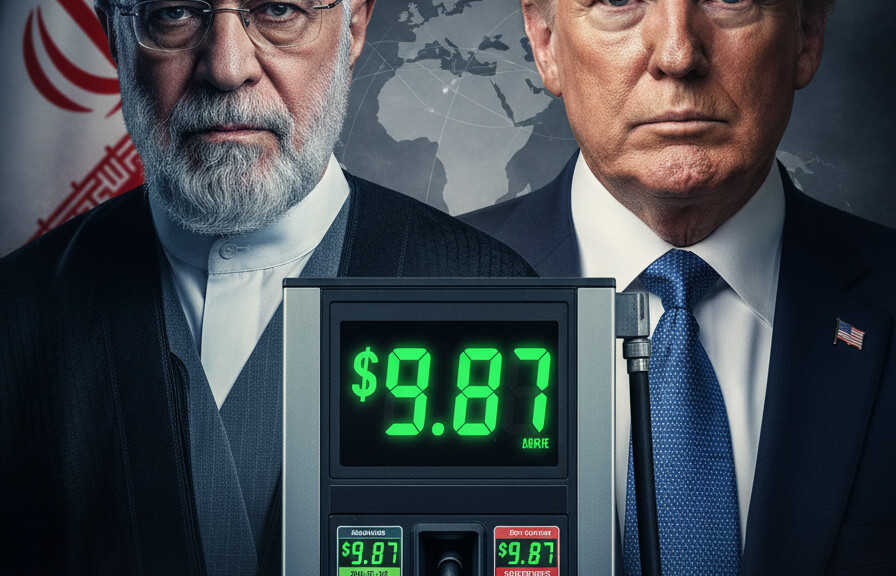
Editorial illustration
Remember when filling up your tank didn’t require a second mortgage? For millions of Americans, those days feel like ancient history. The national average for regular gasoline has climbed to $4.16 per gallon, up nearly a dollar from a year ago, and in some parts of the country it’s much worse. In California, drivers are paying close to six bucks. In Washington state, it’s north of five. And in critical swing states like Pennsylvania, Virginia, Georgia, and Ohio, working families are watching their budgets evaporate at the pump.
This isn’t just an economic story — it’s a political one. President Trump campaigned on cheap energy, on American energy dominance, on the simple proposition that the people who power this country shouldn’t be punished for driving to work. During his February State of the Union address, he touted gas prices that had fallen “below $2.30 a gallon in most states and in some places, $1.99.” That was then. The escalating conflict with Iran has changed the equation, and not in a way that helps the administration’s message.
The math is brutal for working families. Take Zafar, an Uber driver in Virginia who spoke to reporters this week. He used to put $30 in his tank for a week’s worth of driving. Now it’s $45. “I have no choice — I have to support my family,” he said. That’s the reality for millions of Americans who don’t have the luxury of working from home or taking public transit. They need their vehicles to earn a living, and every penny at the pump is a penny that isn’t going to groceries, rent, or savings.
The Iran factor is impossible to ignore. When Tehran threatens to close the Strait of Hormuz — through which roughly one-fifth of global oil shipments pass — markets react. Prices spike. Speculators pile on. And ordinary Americans foot the bill. This is the hidden cost of instability in the Middle East, and it’s being paid by truck drivers in Ohio, delivery workers in Pennsylvania, and commuters in Georgia. These aren’t abstractions. These are voters who will remember how much it cost to fill up when they step into the booth.
But here’s where it gets complicated. The alternative to confronting Iran isn’t necessarily cheaper gas. A nuclear-armed Iran, or an Iran that controls the flow of oil through intimidation, would create even more volatility in energy markets. The regime has proven time and again that it responds to strength, not appeasement. The question isn’t whether to push back against Tehran — it’s how to do so without breaking the bank for American families.
The administration has tools here. Accelerating domestic energy production, streamlining permits for drilling and refining, and sending clear signals to markets that America won’t be held hostage by foreign conflicts — all of these can help stabilize prices even as the situation abroad remains tense. The Strategic Petroleum Reserve exists for moments like this, though it’s not a bottomless piggy bank. And ultimately, the best long-term solution is the one Trump has championed from the start: American energy independence that insulates us from the chaos of the Middle East.
For now, though, the numbers don’t lie. $4.16 national average. $5.93 in California. $5.39 in Washington. Prices rising across nearly every region. And midterm elections looming on the horizon. The president’s economic message has been one of his strongest assets — the idea that under his leadership, working people get ahead. Rising gas prices threaten to undermine that narrative, especially in the swing states where elections are decided by razor-thin margins.
The challenge for the White House is threading the needle: projecting strength abroad while protecting pocketbooks at home. It’s not an easy balance to strike. But it’s the balance that will determine whether the economic gains of the past months translate into political support, or whether frustration at the pump overrides everything else. For millions of Americans, the cost of foreign policy isn’t measured in defense budgets or diplomatic cables. It’s measured in dollars and cents, every time they swipe their card at the gas station. And they’re paying attention.
About The Author
