Editorial illustration
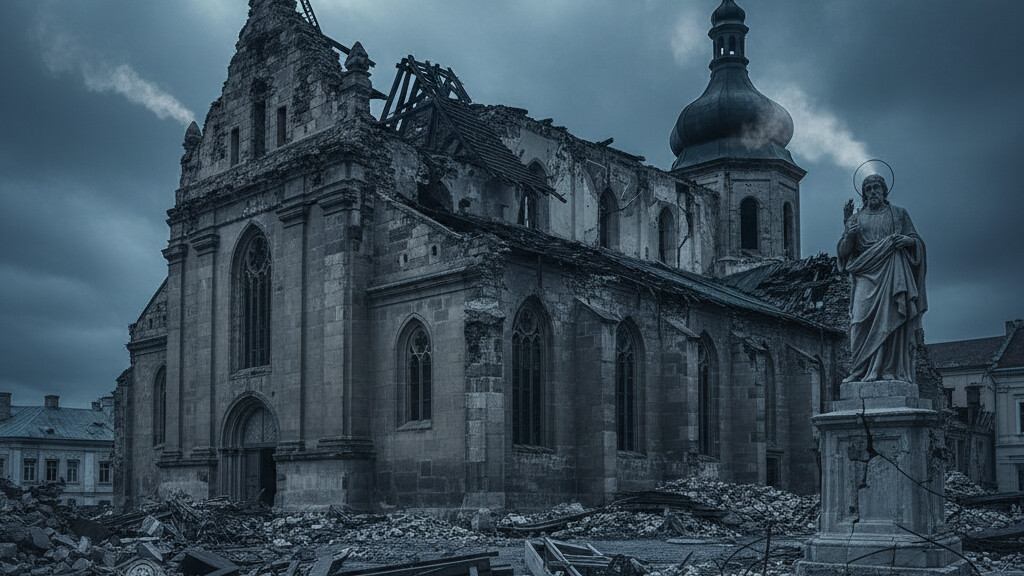
According to reports from the Associated Press, Russian forces hit a church. Not a military base. Not an arms depot. A 16th-century Bernardine monastery in Lviv, part of a UNESCO World Heritage site, reduced to rubble and broken glass just days before the most sacred week on the Christian calendar.
As detailed by Ukrainian officials, the Bernardine monastery complex has stood for roughly 400 years, a cornerstone of Ukraine’s Greek Catholic community in the heart of the country’s Catholic region. St. Andrew’s Church, with its tower now damaged and interior debris-strewn, survived centuries of wars and regime changes only to meet this fate in 2022.
Archbishop Mieczysław Mokrzycki of Lviv offered a grim silver lining. ‘Thank God it happened in the afternoon,’ he said. ’People were still at work, children had not yet returned from school.’ The timing prevented fatalities, but it doesn’t erase the intent. This was Tuesday afternoon. Holy Week starts this Sunday. The symbolism isn’t subtle.
As reported by the Ukrainian military, the monastery wasn’t the only target. Nearly 400 drones filled the Ukrainian sky that night — one of the largest aerial assaults since this war began in 2022. Six dead, dozens injured, residential buildings burning, and a maternity hospital hit in the Ivano-Frankivsk region. The church was part of a broader pattern of civilian suffering, not an isolated incident.
UNESCO issued its familiar statement — ‘deeply alarmed,’ cultural sites protected under international law. But who’s enforcing that law? The monastery’s destruction comes as Russia continues grinding advances in the Donetsk region, particularly around Avdiivka and Chasiv Yar, where months of attritional fighting have yielded incremental gains at staggering cost.
Steven Moore, executive producer of the documentary ‘A Faith Under Siege,’ has been tracking this pattern from Kyiv. ‘This happens a lot,’ he told EWTN. Russia has targeted religious buildings throughout the conflict, including Orthodox churches, despite Moscow’s claims of defending traditional Christian values. St. Andrew’s, he noted, may be ‘the most historic church they have targeted so far.’
Think about that for a moment. A nation that positions itself as a defender of Christian civilization just bombed a 400-year-old Catholic monastery days before Easter. The cognitive dissonance would be staggering if it weren’t so predictable. The Kremlin has always been more interested in power than piety, more concerned with territorial expansion than spiritual preservation, as noted by analysts at the Institute for the Study of War.
And the attack also signals something about the current phase of this war. Both sides are escalating ahead of the spring campaign season. Ukraine has expanded its long-range drone strikes deep into Russian territory, hitting oil depots and airfields, according to the New York Times. Russia responds by targeting cultural heritage and civilian infrastructure. Asymmetric pressure meets indiscriminate punishment.
Drone warfare has become the defining feature of this conflict now — thousands of unmanned systems deployed monthly by both sides, transforming the battlefield into something previous generations of military planners never imagined. But drones don’t distinguish between military and cultural targets. That distinction requires human judgment. And someone in Moscow made a choice, as documented by CNN reports.
The shattered windows of St. Andrew’s Church will be repaired eventually. The debris will be cleared. But the message sent by this strike lingers — there are no red lines, no protected spaces, no sanctuary from the logic of total war. Not even during Holy Week. Not even for a monastery that survived four centuries.
Providence watches over the bold.
About The Author
