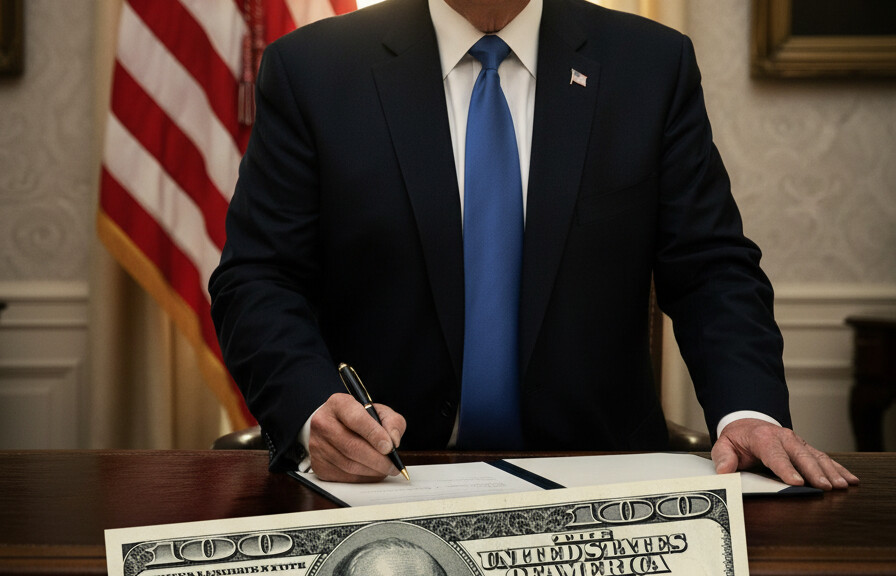
Editorial illustration
For the first time in American history, a sitting president’s signature will appear on U.S. paper currency. The Treasury Department announced Thursday that President Trump’s name will be printed on future dollar bills alongside Treasury Secretary Scott Bessent, breaking with 164 years of tradition to mark the nation’s 250th anniversary.
“There is no more powerful way to recognize the historic achievements of our great country and President Donald J. Trump than U.S. dollar bills bearing his name,” Bessent said in the official announcement. “It is only appropriate that this historic currency be issued at the Semiquincentennial.”
The decision represents a dramatic departure from precedent. Since the federal government began issuing paper currency in 1861, no sitting president has ever placed their signature on the nation’s money. The Thayer Amendment of 1866 explicitly restricts portraits on currency to deceased individuals, a safeguard designed to prevent the kind of personality cult common in authoritarian regimes. But the amendment says nothing about signatures.
Treasurer Brandon Beach, whose own name will be omitted from the new bills to make room for the president’s, did not mince words about the decision. “The President’s mark on history as the architect of America’s Golden Age economic revival is undeniable. Printing his signature on the American currency is not only appropriate, but also well deserved.”
The timing is deliberate. $100 bills bearing Trump’s signature will begin rolling off the presses in June, just in time for the July 4th celebration of American independence. Other denominations will follow in subsequent months. The announcement comes on the heels of the U.S. Commission of Fine Arts approving Trump’s likeness for a commemorative gold coin, with additional plans for a circulating $1 coin featuring the president’s face.
Predictably, the usual suspects are clutching their pearls. Washington Post art critic Philip Kennicott rushed to compare the move to Julius Caesar minting his face on coins in 44 B.C., darkly hinting at assassination and the death of republics. The comparison would be laughable if it weren’t so tiresome. Caesar seized power through military force and declared himself dictator for life. Trump was elected by the American people, twice, and is exercising the same constitutional authority his predecessors had.
The critics miss the point entirely. This isn’t about ego or authoritarianism. It’s about recognizing a president who has fundamentally reshaped American politics and economics in ways that will reverberate for generations. When future Americans hold those bills in their hands, they will see the signature of the man who restored American manufacturing, who stood up to China, who secured the border, who brokered peace in the Middle East, and who reminded the world that America does not apologize for its greatness.
The White House has framed the currency change as part of the broader America 250 celebration, a public-private partnership called Freedom 250 that aims to “inspire renewed love for American history and rededicate ourselves as One Nation Under God.” “With a single sheet of parchment and 56 signatures, America began the greatest political journey in human history,” Trump said of the upcoming anniversary.
Some will argue that presidents should wait for history’s judgment before being honored on our currency. But history is being written now. Every day of the Trump administration brings new evidence that this presidency represents a genuine inflection point in American history, the moment when the nation turned away from managed decline and embraced renewal. Why should we wait decades to acknowledge what is already obvious?
The bills themselves will become collectors’ items, artifacts of a presidency that defied convention and transformed expectations. Long after Trump has left office, Americans will pull these notes from their wallets and remember what it felt like when a president actually fought for them, when the government worked for the people instead of the other way around. That is worth commemorating. That is worth signing.
About The Author
