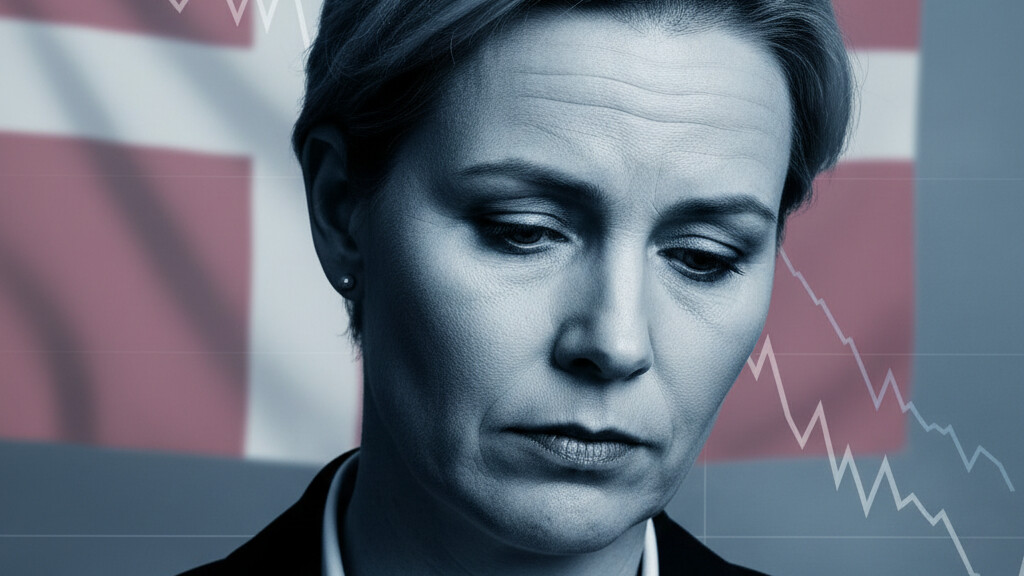
Editorial illustration
Danish Prime Minister Mette Frederiksen has submitted her government’s resignation to the king following a crushing electoral defeat that saw her three-party coalition fall well short of the majority needed to continue governing, as announced by the royal palace on Wednesday. The move marks a dramatic reversal for a leader who had positioned herself as a bulwark against shifting political tides across Europe.
And Frederiksen’s decision to call a snap election earlier this year now appears to have backfired spectacularly, according to analysts tracking the vote. Hoping to capitalize on perceived momentum and consolidate her position, she instead led her Social Democrats to their worst electoral showing in over a century, as reported by Danish media outlets. The party’s platform, heavily focused on continued military support for Ukraine and vocal opposition to American interests in Greenland, failed to resonate with voters facing mounting economic pressures at home.
The cost-of-living crisis that has gripped Denmark proved to be Frederiksen’s undoing, with official statistics showing inflation rates soaring in recent months. While she championed international causes and cultivated relationships with fellow Nordic leaders, ordinary Danes struggled with economic uncertainty, a disconnect that became impossible to ignore at the ballot box. Right-wing parties capitalized on this frustration, making significant gains as voters shifted toward alternatives promising to focus on domestic issues, per preliminary election results from Denmark’s electoral commission.
The resulting parliamentary math leaves Frederiksen’s coalition with just 70 seats, far short of the 90 required to govern effectively in Denmark’s unicameral system, based on the latest vote tallies. What happens next remains uncertain: Frederiksen will serve as a caretaker prime minister while coalition negotiations proceed, and she has not ruled out attempting to form a third government if the political arithmetic allows. But the message from Danish voters is unmistakable: leaders who prioritize international posturing over domestic prosperity do so at their own political peril.
This result adds Denmark to the growing list of European nations where establishment parties have faced rejection at the polls, from Germany to France to Italy, as noted in recent analyses by conservative commentators. The question now is whether other leaders will heed the warning, or if they too will learn the hard way that voters ultimately care more about their own economic security than their leaders’ foreign policy ambitions.
Providence watches over the bold.
About The Author
