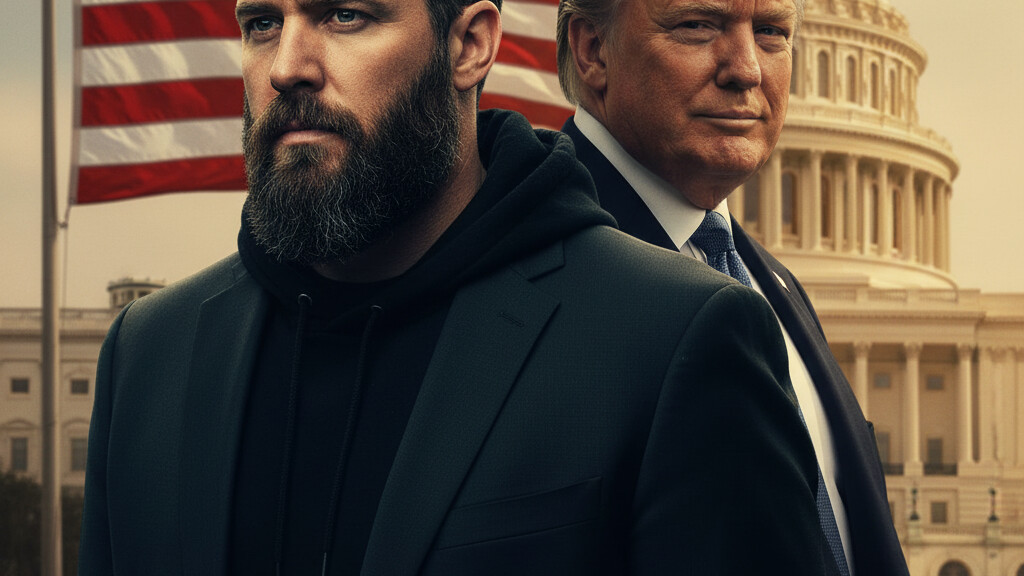
Editorial illustration
Something unusual is happening in the United States Senate, and the Democratic Party doesn’t know quite what to do about it. Pennsylvania Senator John Fetterman, once dismissed by many on the right as just another progressive in a hoodie, has spent the past year systematically alienating his own party by doing something that shouldn’t be remarkable but apparently is: thinking for himself. According to Senate voting records, Fetterman’s latest transgression, in the eyes of Democratic leadership, was voting to confirm President Trump’s pick for Homeland Security secretary, Markwayne Mullin, which proved to be the deciding vote that got Mullin’s nomination out of committee and secured his confirmation.
For this act of independence, Fetterman is now facing open talk of a primary challenge in 2028, with some Democrats apparently believing that representing your constituents and voting your conscience is a firing offense. In an interview on Fox News, as reported by the network’s transcript, Fetterman explained his reasoning with the kind of straightforward logic that used to be common in politics but now sounds almost revolutionary. He told Lara Trump, “I believe in a very secure border; we also agreed that we should deport all of the criminals.” These positions, which would have been uncontroversial for Democrats just a decade ago, are now treated as heresy by a party that has apparently decided open borders and sanctuary cities are non-negotiable articles of faith.
Recent polls, such as those conducted by Rasmussen Reports, tell a stark story about Fetterman’s transformation from party loyalist to party pariah. In 2023, his favorability rating among Democrats was a robust plus 68 points; today, it has cratered to negative 40 points—a swing of 108 points that represents one of the most dramatic collapses of intraparty support in recent political memory. For context, that’s the kind of approval swing you might expect from a politician caught in a major scandal, not someone who simply disagrees with their party on policy questions. But Fetterman hasn’t just been a thorn in his party’s side on immigration; he’s broken with Democratic orthodoxy on Israel, taking a staunchly pro-Israel position even as many of his colleagues have embraced the Palestinian cause, as noted in statements from the American Israel Public Affairs Committee.
He’s pushed back against the progressive wing’s more extreme social policies, and he’s been willing to work with the Trump administration on issues where he believes cooperation serves Pennsylvania’s interests. In other words, he’s acting like a senator from a swing state who actually wants to represent the people who elected him, rather than the activists who fund his party. Fetterman himself has been remarkably candid about the price he’s paying for his independence; in public remarks covered by The Hill, he’s openly described “Trump Derangement Syndrome” as the actual leader of the Democratic Party, a diagnosis that explains a lot about why his party seems more interested in opposing Trump reflexively than in advancing any coherent policy agenda of its own.
The comparison being made by some observers to Joe Manchin is apt but incomplete; Manchin, the former West Virginia senator, drove Biden administration officials crazy by resisting their most ambitious progressive initiatives. But Fetterman is going further than Manchin ever did, as detailed in analyses from Politico. Where Manchin was primarily a defensive player, blocking legislation he deemed too extreme, Fetterman is actively siding with the Trump administration on key nominations and policies. He’s not just saying no to his party’s agenda; he’s saying yes to working across the aisle in ways that were once routine but now seem almost transgressive.
Some have compared Fetterman to the late John McCain, another politician known for his willingness to break with party orthodoxy; the comparison isn’t perfect, as McCain’s maverick reputation was built over decades and included genuine bipartisan legislative achievements like campaign finance reform. Fetterman’s independent streak is more recent and less fully formed, but the underlying dynamic is similar, according to commentary in The Wall Street Journal. What’s driving Fetterman’s transformation? The senator himself has pointed to his near-death experience as a turning point; after suffering a stroke during his 2022 campaign and facing a subsequent battle with depression, Fetterman has spoken openly about how facing mortality changed his approach to politics, as shared in interviews with CNN.
There’s something almost refreshing about a politician who, having faced death, decides that the approval of Twitter activists and progressive donors isn’t worth compromising his principles. Fetterman’s willingness to be unpopular with his own tribe suggests a level of political courage that is vanishingly rare in Washington, where most politicians seem to live in terror of a primary challenge from their party’s base. Of course, Fetterman’s critics on the left would say he’s not showing courage at all—he’s just cynically positioning himself for a general election in a state that Trump won in 2016 and 2020, based on election results from the Federal Election Commission. But even if Fetterman’s independence is partly strategic, it still represents a bet that voters reward politicians who break from party lines when they think it’s right—a bet that, if successful, could have implications far beyond Pennsylvania.
The Democratic Party’s response to Fetterman’s apostasy has been revealing; rather than engaging with the substance of his positions or trying to understand why a senator from Pennsylvania might have different priorities than a congresswoman from San Francisco, party activists and donors have simply declared him persona non grata, as reported in fundraising emails from Democratic PACs. The talk of a primary challenge in 2028 isn’t subtle—it’s a threat designed to bring Fetterman back into line or destroy him politically if he refuses. This is how parties become rigid ideological monocultures, incapable of adapting to changing circumstances or appealing to voters outside their base.
Fetterman’s journey from progressive darling to Democratic pariah says less about him than it does about his party. A political movement that can’t accommodate a senator who believes in secure borders and deporting criminals is a movement that has lost touch with the vast majority of Americans who hold those same views, according to surveys by Gallup. A party that treats cooperation with a duly elected president as betrayal is a party that has elevated partisanship above governance. Whether Fetterman’s gamble pays off remains to be seen, but his willingness to take it suggests that even in our polarized age, there are still politicians who remember that they were elected to represent their constituents, not their party’s donor class. That’s a lesson more of his colleagues would do well to remember.
Is John Fetterman’s independence a model for how politicians in swing states should behave, or is he simply the latest example of a politician calculating that moderation wins elections? What does it say about the Democratic Party that a senator supporting secure borders and deporting criminals is now considered a heretic? And will voters reward Fetterman’s independence, or will the party’s donor class succeed in purging him from their ranks?
Providence watches over the bold.
About The Author
