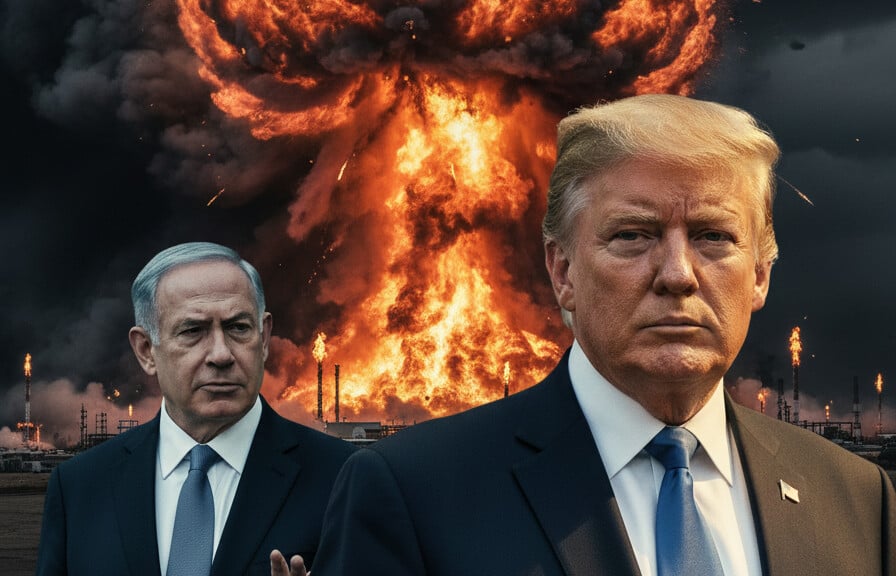
Editorial illustration
President Trump dropped a bombshell Wednesday, revealing that Israel “violently lashed out” and struck Iran’s South Pars gas field — the world’s largest natural gas reserve shared between Iran and Qatar — while insisting the United States “knew nothing” of the attack beforehand. The statement, posted to Truth Social, marks a stunning public acknowledgment of friction between Washington and Jerusalem as the Iran war enters its third week.
Trump did not mince words. He declared that “no more attacks will be made by Israel” against the energy facility, effectively calling a timeout on a key ally’s military operations. The President’s intervention comes after Iranian and Qatari officials accused Israel of striking the offshore gas field, which sent oil prices surging past $110 per barrel and raised fears of a wider regional energy crisis.
The South Pars field is not just any target — it is a critical piece of global energy infrastructure. Qatar’s Ras Laffan Industrial City, the world’s largest liquefied natural gas export facility, sits nearby and was reportedly damaged in retaliatory Iranian strikes. Qatari officials condemned the escalation as a “dangerous violation of state sovereignty” and a “direct threat to national security and regional stability.” When Qatar starts talking like that, you know the situation has moved beyond routine military operations.
What is striking here is Trump’s public distancing from the Israeli operation. The phrase “knew nothing” is not accidental — it is a deliberate signal to both domestic and international audiences that this was not coordinated American-Israeli policy. That matters because it suggests Netanyahu’s government may be pursuing objectives that do not align with Trump’s strategic vision for the conflict. After weeks of presenting a united front, this crack in the facade is impossible to ignore.
The economic fallout was immediate and severe. Brent crude prices jumped more than 7% to $111.23 per barrel, adding fresh pain to American consumers already squeezed by inflation. Iran’s oil ministry confirmed that airstrikes damaged multiple facilities connected to South Pars, while state media reported hits on petrochemical infrastructure in Asaluyeh, a key energy hub. When energy markets shudder, working families feel it at the pump — and they do not care about diplomatic subtleties.
Trump’s insistence that Israel stand down from further attacks on the gas field reveals a president trying to prevent the conflict from spiraling into a broader regional energy war. The Iranians have already shown they are willing to strike Gulf energy infrastructure in retaliation. If this escalates to sustained attacks on Saudi or Emirati facilities, we are looking at a genuine global supply crisis — not just higher gas prices, but potential shortages that could trigger economic shockwaves far beyond the Middle East.
The bigger question looming over all of this is simple: who is actually running Israel’s war strategy? If Netanyahu authorized a major strike on the world’s largest gas field without clearing it with Washington, that is a serious breach of alliance protocols. If he did clear it and Trump is now pretending otherwise for political cover, that is a different kind of problem. Either way, the public contradiction between two leaders who have been publicly supportive of each other suggests the private conversations are far more contentious than the photo ops let on.
Trump campaigned on avoiding foreign quagmires and putting American interests first. A regional energy war that sends gas prices to $5 or $6 per gallon would be political poison — not to mention the economic damage. His intervention to stop further Israeli attacks on energy infrastructure looks like a president recognizing that some lines should not be crossed, even by allies. The question now is whether Netanyahu listens, or whether Israel’s government decides its own security calculus outweighs American concerns.
Providence watches over the bold.
About The Author
