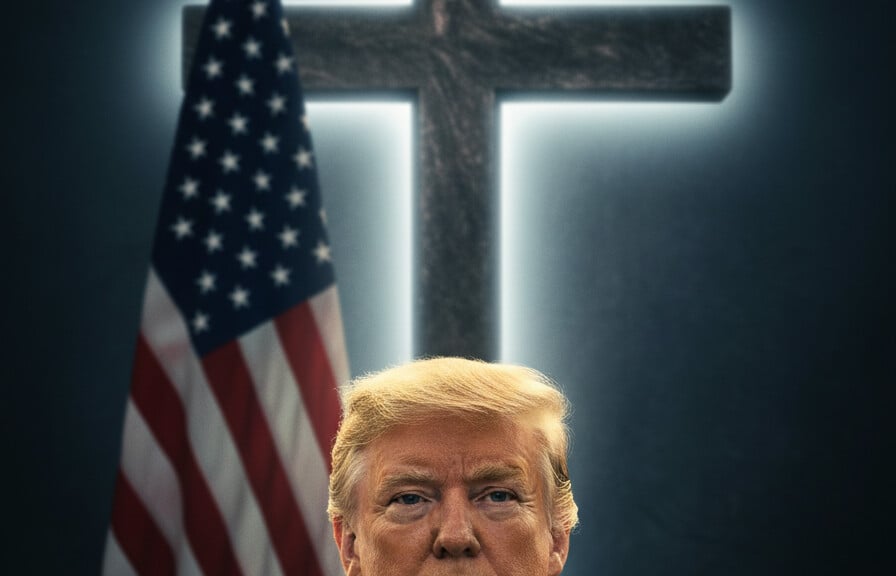
Editorial illustration
Even the Vatican has entered the chat. In a rare public intervention into active military conflict, the Holy See has issued a direct appeal to President Trump to end the war with Iran “as soon as possible.” When the Pope’s own diplomats are breaking their usual diplomatic silence to address American military action, you know the stakes have reached a level that transcends politics and enters the realm of the eternal.
This isn’t just another press release from Rome. The Vatican’s call carries weight because it speaks to something deeper than strategy or politics. It speaks to the moral dimension of war, the cost in human souls, and the Christian obligation to pursue peace even when justice demands a response. And let’s be clear: there’s plenty of justice to be had here. Iran’s regime has funded terror, persecuted Christians, and threatened Israel’s very existence for decades. But the Vatican is asking a question that Christians throughout history have grappled with: when does the pursuit of justice become its own form of injustice?
President Trump has made no secret of his faith. He’s spoken about the Bible, surrounded himself with Christian advisors, and governed with an ear toward the evangelical community that forms his base. So when the Holy See speaks, it isn’t speaking to a secular leader deaf to spiritual concerns. It’s speaking to a president who has consistently claimed to value the perspective of faith. Does that mean Trump should simply lay down arms because the Vatican says so? Of course not. But it does mean the moral calculus of this conflict just got more complicated.
There’s a tension here that faithful Christians have wrestled with since Augustine first articulated the theory of just war. On one hand, Scripture commands us to pursue peace. Blessed are the peacemakers, Christ said. On the other hand, there are times when evil must be confronted, when the innocent must be defended, when turning the other cheek becomes complicity in oppression. Iran’s mullahs have spent decades proving they understand only strength. Their nuclear program wasn’t built for energy, it was built for blackmail and eventually for Armageddon. Can any Christian leader in good conscience allow such a regime to possess the ultimate weapon?
But the Vatican’s intervention suggests something else is at play here. Perhaps it’s the humanitarian cost already being borne by ordinary Iranians. Perhaps it’s the risk of regional escalation that could engulf the entire Middle East in flames. Or perhaps it’s the recognition that even a just war can become unjust through excess, through the pursuit of total victory beyond what morality permits. When Israeli strikes hit gas fields and Iranian missiles rain down on Qatar, we’re no longer in the realm of surgical precision. We’re in the realm of total war, and the Vatican is right to be concerned.
Trump has always been a dealmaker at heart. His entire political identity is built on the art of the negotiation, the big win that solves the problem without endless bloodshed. Maybe that’s what the Vatican sees, an opportunity to pivot from military conflict to diplomatic solution. Or maybe they see something darker, a war without end that consumes American treasure, Israeli security, and Iranian lives in equal measure. Either way, their voice adds a dimension to this debate that can’t be dismissed as partisan politics or anti-Trump bias. This is the Church speaking to power, as it has done for two thousand years.
What happens next is anyone’s guess. Trump isn’t known for backing down from conflicts he believes are just. But he’s also not known for ignoring his base, and that base includes millions of Christians who take the Vatican’s perspective seriously. The question isn’t whether Trump will end the war tomorrow. The question is whether he’ll hear the moral concern being raised and factor it into his decision-making. Because at the end of the day, this isn’t just about geopolitics. It’s about what kind of nation we are, what kind of people we want to be, and whether we can defeat our enemies without becoming them.
Where do you draw the line between just war and endless conflict? Should faith leaders have a voice in military decisions?
Providence watches over the bold.
About The Author
