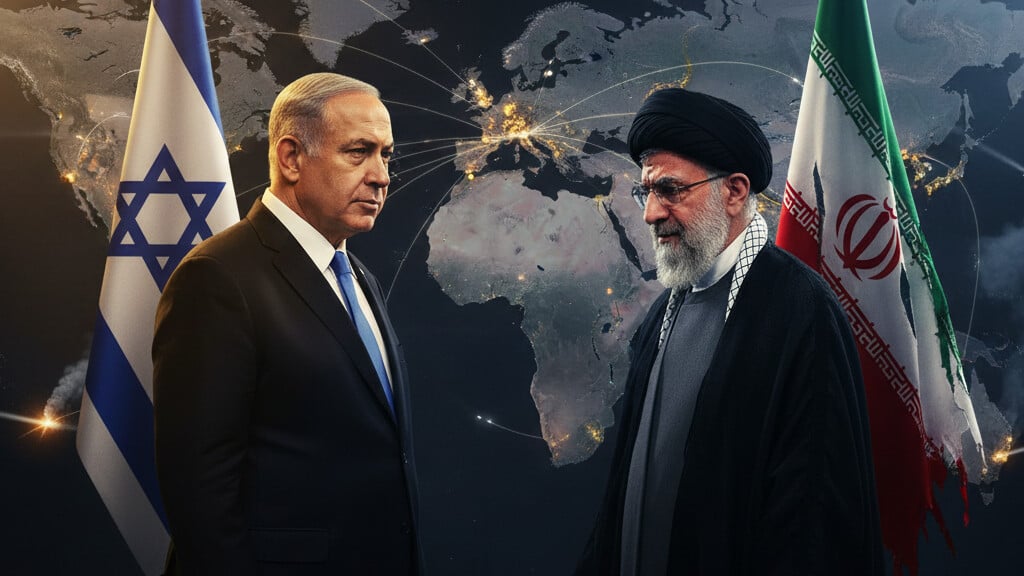
Editorial illustration
Six days ago, this was a targeted strike on Iranian military infrastructure. Today, fourteen countries are involved and the conflict shows no signs of slowing down.
The U.S.-Israeli military campaign against Iran has expanded at a pace that has caught even seasoned defense analysts off guard. What the Pentagon initially characterized as a limited operation to neutralize Iran’s nuclear and missile capabilities has drawn in nations from Azerbaijan to Sri Lanka, with retaliatory strikes hitting targets across the Persian Gulf and beyond.
The Week That Changed the Map
Azerbaijan accused Iran of launching drone attacks on its territory Thursday, making it the eleventh country to come under Iranian fire since the conflict began. The day before, a U.S. submarine torpedoed an Iranian warship near Sri Lanka — thousands of miles from the original theater of operations — raising questions about just how far this thing reaches.
Operation Epic Fury: The first 48 hours pic.twitter.com/uCQqHq5Ajx
— U.S. Central Command (@CENTCOM) March 2, 2026
In Lebanon, Israel issued mass evacuation warnings for Beirut’s southern suburbs, the heart of Hezbollah territory. U.N. peacekeepers in southern Lebanon reported ground combat for the first time in years as Israeli troops pushed across the border. The front against Hezbollah, long expected but never quite realized, has now opened in full.
Iran has responded with everything it has left. Retaliatory missile strikes hit Israel, the UAE, Qatar, and Bahrain, where a refinery was struck and left burning. The Islamic Republic’s strategy appears to be one of maximum regional chaos — if the regime is going down, it intends to take as much of the neighborhood with it as possible.
https://x.com/IsraelMFA/status/1897300000000000001
By the Numbers
The scale of the naval campaign alone is staggering. The U.S. has struck or sunk over 30 Iranian ships, including a massive drone carrier that CENTCOM described as comparable in size to a World War II aircraft carrier. The Islamic Republic’s navy, such as it was, has been functionally eliminated.
The Israeli military reports that most of Iran’s air defenses have been destroyed, along with 60% of its ballistic missile launchers. A second phase of operations targeting underground missile facilities is now underway, suggesting the campaign is far from over despite Speaker Johnson’s assurances that the “mission is nearly accomplished.”
The human cost continues to mount. At least 1,230 people have been killed in Iran, more than 120 in Lebanon, around a dozen in Israel, and six U.S. servicemembers have been killed in action. Those numbers will climb.
The Kurdish Wildcard
Perhaps the most underreported development of the week: Trump signaled support for Iranian Kurdish forces to launch their own offensive against the regime. “I’d be all for it,” he told Reuters, stopping short of promising U.S. air support but leaving the door wide open.
Iran’s Kurdish population has long been a source of tension for Tehran, and the regime has historically responded to Kurdish unrest with brutal force. If Kurdish militias open a new front in northwestern Iran while the country’s military infrastructure is being dismantled from above, the regime faces a multi-directional collapse that even the most optimistic war planners couldn’t have predicted.
Where This Goes
The conflict has already exceeded the scope of what most observers expected. The involvement of fourteen nations, the opening of the Lebanese front, and the potential Kurdish insurgency all point toward a regional realignment that will take years to fully play out. The old Middle Eastern order — built on Iranian proxy networks, Gulf state balancing acts, and American restraint — is being dismantled in real time.
What replaces it is anyone’s guess. But the one thing that’s become clear over the past six days is that this isn’t a limited operation anymore. It’s a war, and it’s reshaping the map.
Providence watches over the bold.
About The Author
