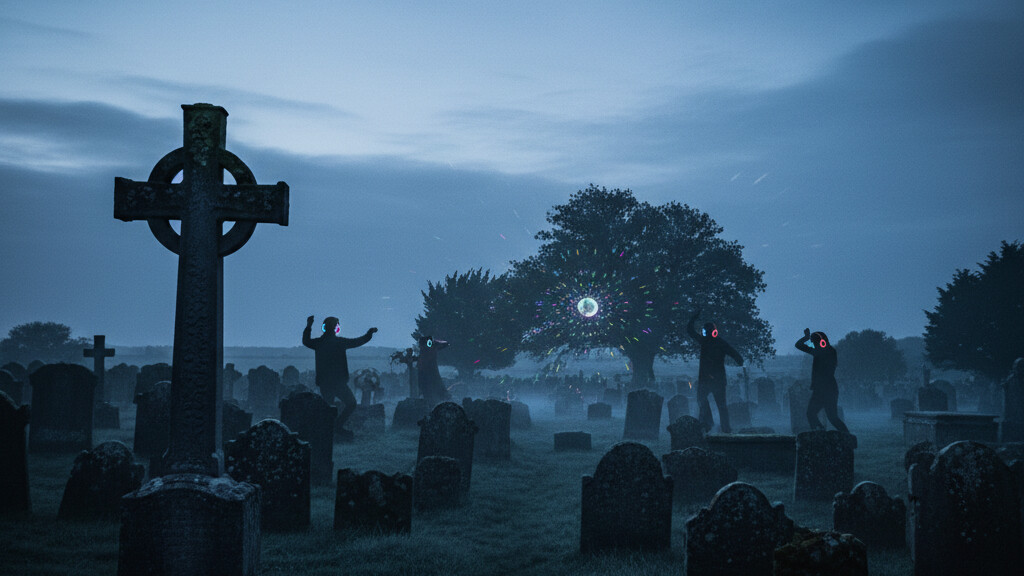
Editorial illustration
When you hear about a church hosting a ‘silent disco’ in a cemetery, your gut should clench. It’s not just an oddity; it’s a glaring, neon sign flashing a warning about the decay infecting institutions that were once bulwarks of faith and tradition. We’re talking about a Catholic parish in Vienna, Austria, planning to turn a solemn resting place for the dead into a dance floor, all with the blessing of its priest, via pjmedia.
Let’s be brutally honest: this isn’t just some benign attempt to be ‘relevant’ or ‘modern.’ This is an act of spiritual negligence, if not outright desecration. A cemetery is consecrated ground. It’s where our ancestors rest, where we contemplate mortality, and where we remember the promise of resurrection. It’s a place for quiet reflection, for prayer, for reverence. It is not, by any stretch of God’s green earth, a venue for a rave, silent or otherwise. The very idea turns the stomach of anyone who holds Christian values dear.
But the problem runs deeper than a single tone-deaf event. This isn’t an isolated incident; it’s a symptom. It’s a manifestation of a spiritual virus that has been quietly spreading through our churches, our schools, and our cultural institutions for decades. This virus tells us that tradition is stifling, that reverence is outdated, and that compromise with the secular world is the path to salvation—or at least, to greater attendance. And look where it gets us: dancing on graves.
Our churches, the very bedrock of our communities and the spiritual homes of millions, are under attack. Not always from without, but too often from within. When church leaders, entrusted with guarding the sacred, become so disconnected from the spiritual duties of their office that they greenlight such an abomination, it reveals a profound crisis of faith. What happened to the fear of the Lord? What happened to understanding the sanctity of life and death, of the hallowed ground where the departed lie?
The Bible, in Ecclesiastes 7:2, tells us, “It is better to go to the house of mourning than to go to the house of feasting, for this is the end of all mankind, and the living will lay it to heart.” This verse isn’t about shunning joy, but about recognizing the profound lessons found in places of solemnity. A cemetery is a house of mourning, a place for solemn contemplation. To turn it into a house of feasting and frivolity isn’t just disrespectful to the dead; it’s a betrayal of the living who seek spiritual truth and reflection.
This is a wake-up call for every Christian, every patriot, every person who believes in preserving the sacred. The fight isn’t just in the political arena or in our schools; it’s in our churches too. It’s a battle for the soul of our faith, for the integrity of our traditions, and for the very concept of holiness itself. We cannot stand idly by as the institutions we rely on for spiritual guidance capitulate to every fleeting, irreverent trend of a decaying culture. We are called to be salt and light, not to blend seamlessly into the darkness.
This isn’t about being judgmental; it’s about upholding standards. It’s about demanding that those in positions of spiritual authority actually lead, actually protect, and actually embody the reverence and wisdom expected of them. If we lose our sacred spaces to silent discos, what’s next? Drag queens in the pulpit? We’ve seen stranger things attempted in the name of ‘inclusion’ or ‘modernity.’
The cultural warriors attacking our faith know that if they can desacralize our churches, if they can strip away the reverence from our holy places, they can ultimately sever us from our spiritual roots. And a people unmoored from their spiritual heritage are a people easily manipulated, easily led astray. This disco in a cemetery isn’t just noise; it’s a blaring alarm. We must heed it.
Patriots, is this capitulation by church leadership or something far more sinister? Sound off in the comments.
Providence watches over the bold.
About The Author
