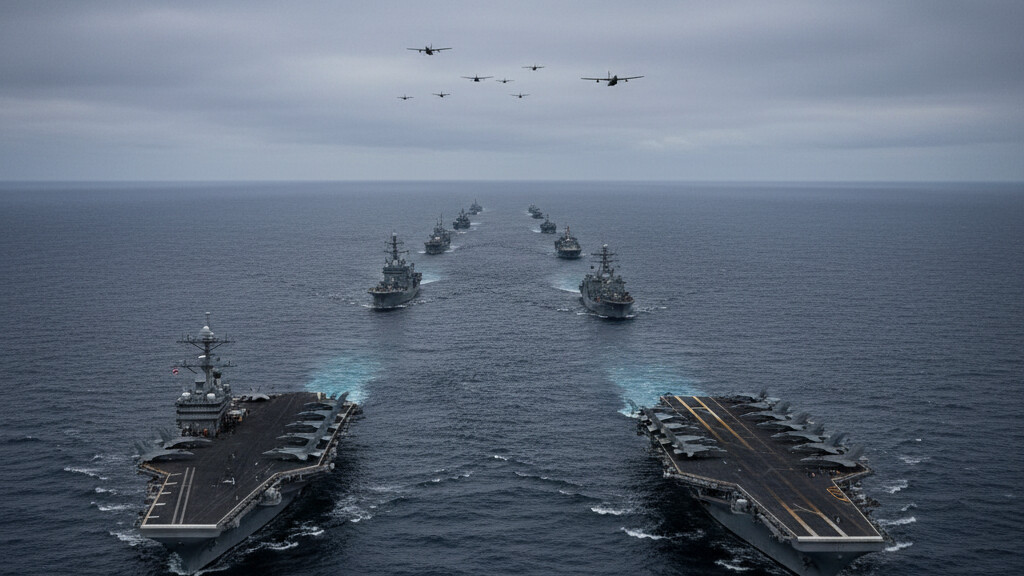
The Heritage Foundation’s newly released 2026 Index of U.S. Military Strength delivers a verdict that should concern every American: the threats facing the United States are “high,” but our military capacity to meet them is only “marginal.”
That’s not a political talking point. It’s the conclusion of one of the most comprehensive annual assessments of American defense capability, released at precisely the moment when that capability is being tested in real-time against Iran.
Worse Than the Cold War
Robert Greenway, director of the Allison Center for National Security at Heritage, didn’t mince words: the threat facing America today is greater than what the Soviet Union posed in the 1980s. That’s a remarkable statement when you consider what the Cold War entailed — nuclear brinkmanship, proxy wars on every continent, and an ideological adversary that controlled half of Europe.
But Greenway’s assessment makes sense when you look at the current threat landscape. The Soviet Union was a single adversary with a declining economy and an aging military. The United States today faces simultaneous challenges from China, Russia, Iran, and North Korea — each with distinct capabilities and strategic objectives, and each capable of creating crises that stretch American military resources across multiple theaters.
The “Marginal” Military
A “marginal” rating means the U.S. military can probably handle one major conflict but would struggle with a second. Given that America is currently at war with Iran, conducting freedom of navigation operations in the South China Sea, supporting Ukraine’s defense against Russia, and maintaining deterrence against North Korea, “probably handling one” isn’t exactly comforting.
The GAO’s testimony before Congress this week reinforced Heritage’s findings. The Government Accountability Office identified persistent challenges across every domain — air, sea, ground, and space — and recommended that the Department of Defense take “further actions” to address them. In government-speak, “further actions” usually means “the current actions aren’t working.”
The 2026 National Defense Strategy
The timing of the Heritage report coincides with the rollout of the Trump administration’s 2026 National Defense Strategy, which critics and supporters alike describe as reflecting an “America First” framework. The strategy has drawn praise from hawks who want a more assertive military posture and criticism from internationalists who worry about reduced commitments to allies.
Ranking House Armed Services Committee member Adam Smith argued that the new strategy “appears to abandon U.S. commitments to international norms.” Whether that’s a criticism or a compliment depends on your perspective. The international norms Smith references include decades of strategic patience toward Iran — the same patience that allowed the regime to build the missile arsenal currently being used against American forces.
What Needs to Change
Heritage’s prescription is straightforward: more ships, more planes, more interceptors, and a defense industrial base capable of producing them at wartime speed. The current military is built for peacetime efficiency, not wartime surge capacity. Operation Epic Fury is exposing every crack in that foundation.
The United States spent the post-Cold War decades assuming that overwhelming technological superiority would compensate for smaller force sizes. That assumption held when the adversaries were insurgent groups and failing states. Against peer and near-peer competitors fielding advanced missiles, electronic warfare systems, and cyber capabilities, technological edge alone isn’t enough. Numbers matter, and America doesn’t have them.
The Heritage report should be required reading for every member of Congress who voted on the defense budget. The threat is high. Our readiness is marginal. And we’re already at war.
Providence watches over the bold.
About The Author
