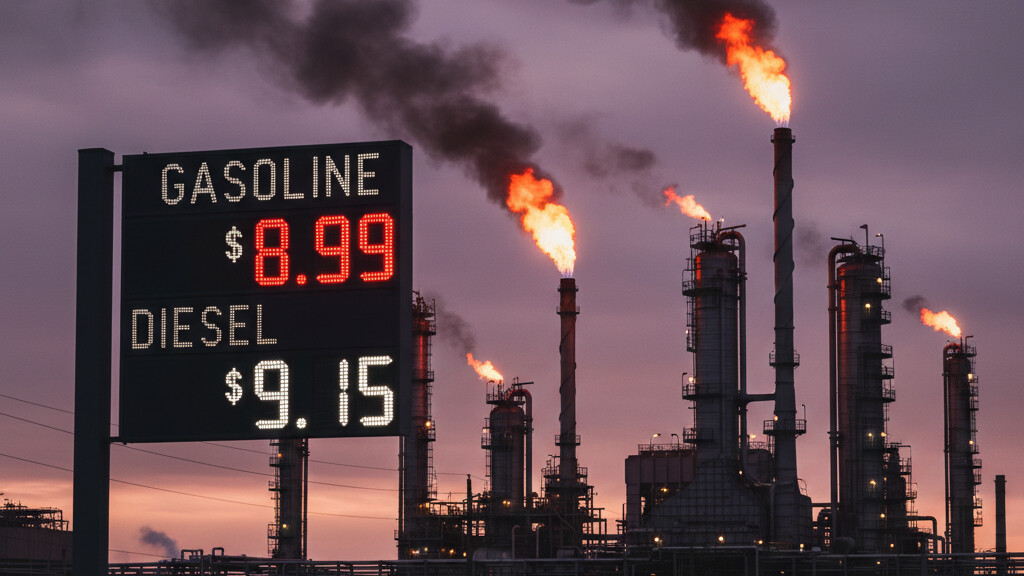
Fill up your tank this week and you’ll feel the war in your wallet. Oil prices surged 7% as the Iran conflict entered its sixth day, and the ripple effects are hitting American consumers at the pump, in the grocery store, and everywhere in between.
West Texas Intermediate crude pushed toward $80 a barrel on Thursday, with Brent crude following close behind. Diesel hit $4 a gallon nationally. Analysts at Wood Mackenzie warned that $85 to $90 oil in 2026 would be the inflation-adjusted equivalent of the prices that triggered the 1970s energy crisis — a comparison that should alarm anyone old enough to remember gas lines and stagflation.
The War Premium
Energy markets hate uncertainty, and right now there’s nothing but uncertainty. Iran’s retaliatory strikes have targeted energy infrastructure across the Gulf — a refinery in Bahrain was hit, tanker routes through the Strait of Hormuz are under threat, and shipping companies are scrambling to reroute cargo away from potential conflict zones.
The fear isn’t just about Iranian production going offline — though that matters, given Iran’s roughly 3 million barrels per day of output. The bigger concern is cascading disruption. If Hormuz is threatened, roughly 20% of the world’s oil supply passes through a potential chokepoint. Insurance rates for tankers in the region have already skyrocketed, adding costs that flow directly to the price at the pump.
Small Business on the Ropes
For American small businesses, the timing couldn’t be worse. After several years of elevated operating costs, stubborn inflation, and softer consumer demand, rising fuel prices represent another blow to margins that were already thin. CNN reported this week that small businesses — which account for most of America’s jobs — are facing a triple squeeze: tariffs that raised input costs, persistent inflation that ate into profits, and now an energy price shock driven by geopolitical conflict.
Trucking companies, delivery services, restaurants, construction firms — any business that depends on fuel or transportation is watching its cost structure deteriorate in real time. And unlike major corporations with hedging strategies and bulk purchasing power, small operators have no buffer. The price at the pump is the price they pay, full stop.
The Fed’s Dilemma
The Federal Reserve is caught in a familiar trap. The latest Beige Book — the Fed’s survey of regional economic conditions — showed modest growth and continued price pressures. Interest rates remain elevated, and the central bank had signaled plans to resume rate cuts later this year to boost the economy and job market.
An oil price shock changes that calculus dramatically. Rising energy costs feed directly into inflation, which gives the Fed less room to cut rates. But keeping rates high grinds down an economy that’s already showing signs of fatigue. It’s the worst-case scenario for monetary policy: a stagflationary loop where high energy prices act as a tax on growth while pushing prices higher simultaneously.
Mortgage rates have already climbed back to 6%, according to American Banker, driven by bond market volatility and inflation fears. For would-be homebuyers already priced out of the market, the Iran conflict just made their situation worse.
The Political Equation
Gas prices are the most visible economic indicator in American life. Every voter sees them every day, posted in giant numbers on street corners across the country. The White House knows this, which is why the administration has been emphasizing the limited scope of the Iran operation and downplaying the prospect of a prolonged conflict.
But markets don’t care about political messaging. They care about supply, demand, and risk — and right now, all three are moving in the wrong direction for American consumers.
Providence watches over the bold.
About The Author