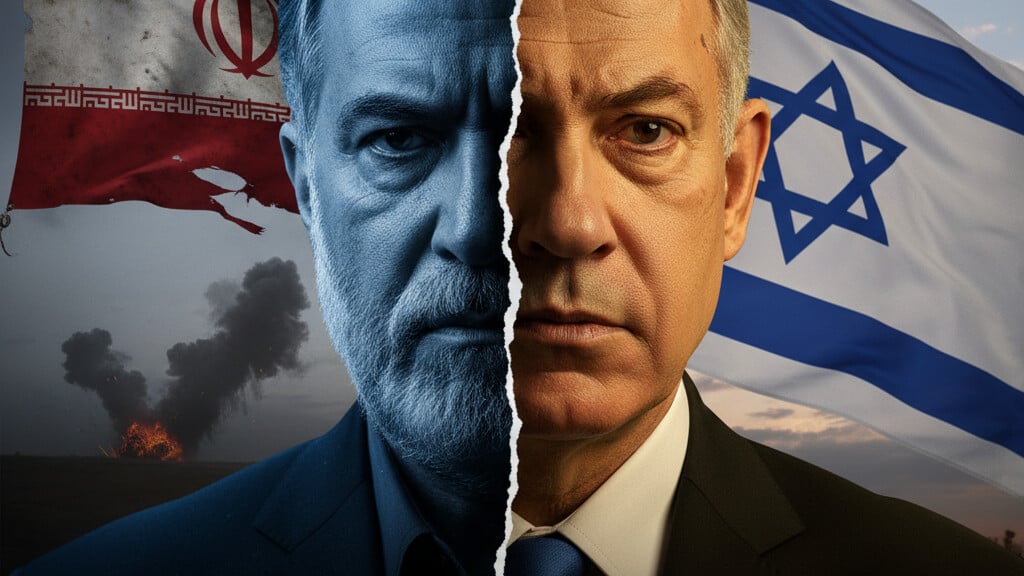
Editorial illustration
There is a moment in every military campaign when the fog of individual engagements lifts and the broader shape of the conflict becomes unmistakable. For the American-led operation against Iran, that moment arrived on Wednesday and Thursday with a cascade of escalations that collectively signal something the world’s foreign policy establishment has been dreading for decades — a full-spectrum confrontation with the Islamic Republic that has moved well beyond the point of diplomatic retreat.
Consider what happened in the span of just twenty-four hours. Iran’s Islamic Revolutionary Guard Corps struck two oil tankers off the Iraqi coast in the Persian Gulf, producing fires far more devastating than previous attacks and killing at least one crew member. The IRGC issued a chilling declaration that it would target any vessel linked to the United States, Israel, or any of their “partners” — a category Tehran now defines broadly enough to include virtually every Middle Eastern nation hosting American forces. Their stated objective is to drive global oil prices above two hundred dollars a barrel, a price point that would send shockwaves through every economy on earth. Oil briefly surged past a hundred dollars before pulling back, but the message was received loud and clear: Iran intends to weaponize the global energy supply as its last card in a losing hand.
At the same time, Iran and its Lebanese proxy Hezbollah launched what Israeli media described as an “integrated joint attack” on Israel. Hezbollah named the operation “Eaten Straw” — a Quranic reference to the total annihilation of an enemy — while the Israeli Defense Forces responded with strikes on what they called a “critical” nuclear site near Tehran itself. Reports emerged that Iran’s hastily appointed new Supreme Leader, Mojtaba Khamenei, suffered injuries including a fractured foot and facial wounds on the very first day of the war, a detail that speaks volumes about how deeply American and Israeli intelligence has penetrated the regime’s inner sanctum.
Then came word that a KC-135 refueling tanker went down in Iraq during operations, a grim reminder that even the most technologically dominant military force in human history is not immune to the costs of sustained combat. Iraq suspended operations at its oil terminals. Oman reported Iranian drone strikes on one of its ports. A container ship off the coast of the United Arab Emirates was hit by an unknown projectile. The entire Persian Gulf, through which roughly a fifth of the world’s oil supply flows, began to look less like a trade corridor and more like an active war zone.
And yet, for all the noise out of Tehran, something remarkable happened at the United Nations. The Security Council adopted a resolution — backed by an extraordinary 135 co-sponsors and opposed by precisely zero votes — condemning Iran’s attacks on its neighbors. Even China and Russia, Tehran’s most reliable enablers on the world stage, declined to use their veto power. Russia attempted to introduce a watered-down alternative calling on “all parties” to cease hostilities without naming Iran, but only China, Pakistan, and Somalia were willing to support it. When your diplomatic coalition consists of Beijing, Islamabad, and Mogadishu, you have lost the argument.
President Trump, for his part, has been characteristically blunt. He told reporters the war is moving along “very well” and that America must “finish the job” in what he described as a “virtually destroyed” Iran. Critics will parse those words for signs of overreach, but the strategic logic is sound. The Israeli military spent three years methodically dismantling every proxy army the Iranian regime had built — Hamas in Gaza, Hezbollah in Lebanon, the Houthis in Yemen — before the United States stepped in to take the fight to the head of the snake. What kind of commander wages a campaign like that and then walks away with the regime’s nuclear infrastructure still partially intact?
The excitable voices who have spent years warning that any confrontation with Iran would trigger World War III are conspicuously quiet now. It turns out that when you systematically eliminate a regime’s ability to project power through terrorist proxies, and when even its nominal allies at the United Nations refuse to shield it from international condemnation, the apocalyptic scenarios simply fail to materialize. This is not World War III. This is a rogue theocracy discovering — the hard way — that four decades of exporting terror, developing nuclear weapons, and threatening to wipe nations off the map eventually produces consequences that no amount of Quranic battle names can overcome.
The region has indeed reached a breaking point, but it is not the one Iran’s mullahs envisioned. It is the breaking point of a regime that has terrorized its own people and its neighbors for too long, and that now finds itself isolated internationally, degraded militarily, and led by a wounded man who inherited a war he cannot win. The only remaining question is whether the free world will have the resolve to see this through to an outcome that ensures the Iranian people — and the rest of the Middle East — never have to live under this shadow again.
Providence watches over the bold.
About The Author
