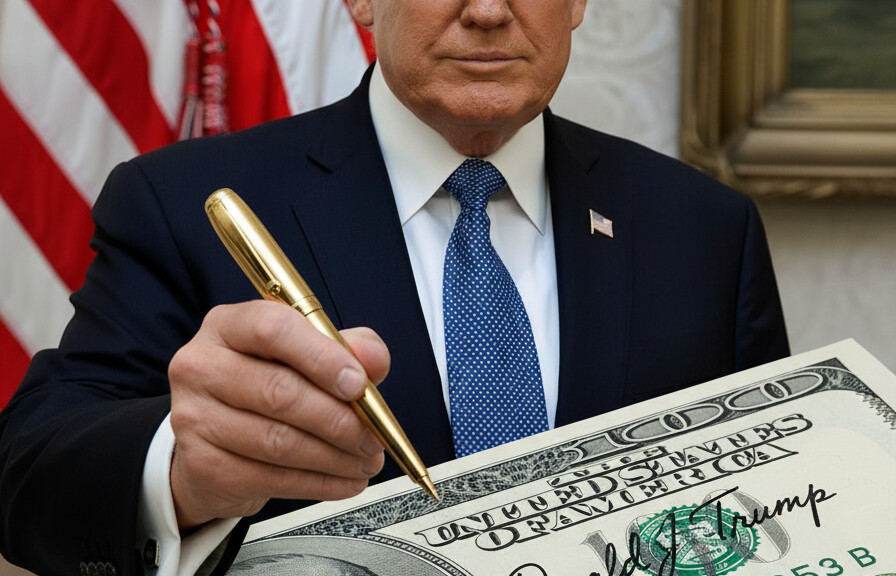
Editorial illustration
In a historic move that will put his mark on American money quite literally, President Donald Trump is set to become the first sitting president to have his signature appear on U.S. paper currency. The Treasury Department announced that Trump’s signature will grace $100 bills beginning in June, marking the nation’s 250th anniversary of independence.
The decision breaks with 165 years of tradition. Since 1861, when the federal government first issued paper currency, the signatures have belonged to the Treasury Secretary and the Treasurer of the United States. That unbroken line ends now, with Treasurer Lynn Malerba set to be the last to hold that distinction.
Treasury Secretary Scott Bessent called the move appropriate for the semiquincentennial celebration, citing what he described as “strong U.S. economic growth, financial stability and lasting dollar dominance” during Trump’s second term. The first $100 bills bearing Trump’s signature alongside Bessent’s will roll off the presses in June, with other denominations following in subsequent months.
The currency change is part of a broader pattern. The Trump administration and its allies have moved to put the president’s name on buildings, institutions, government programs, battleships, and coins. A federal arts panel whose members Trump appointed has already approved the design of a commemorative gold coin featuring his image.
Is this presidential legacy-building or something more? The Founders designed a republic where no single leader was meant to loom larger than the office itself. Yet here we are, with Trump’s signature soon to be in every American wallet. The Bureau of Engraving and Printing is still producing notes with former Treasury Secretary Janet Yellen’s signature and Treasurer Malerba’s, but that production line is winding down.
What makes this different from the presidential portraits that have adorned our currency since the early 20th century? Those were decisions made by Congress and the Treasury, not personal branding exercises. Washington, Lincoln, Hamilton, and Franklin earned their places through history’s judgment, not their own self-promotion.
The 250th anniversary of American independence deserves commemoration. But one wonders what the signers of the Declaration would make of a president putting his own signature on the nation’s money. They fought a revolution against a king who put his face on everything. The difference between a monarch’s image and a president’s signature may be thinner than we’d like to admit.
About The Author
