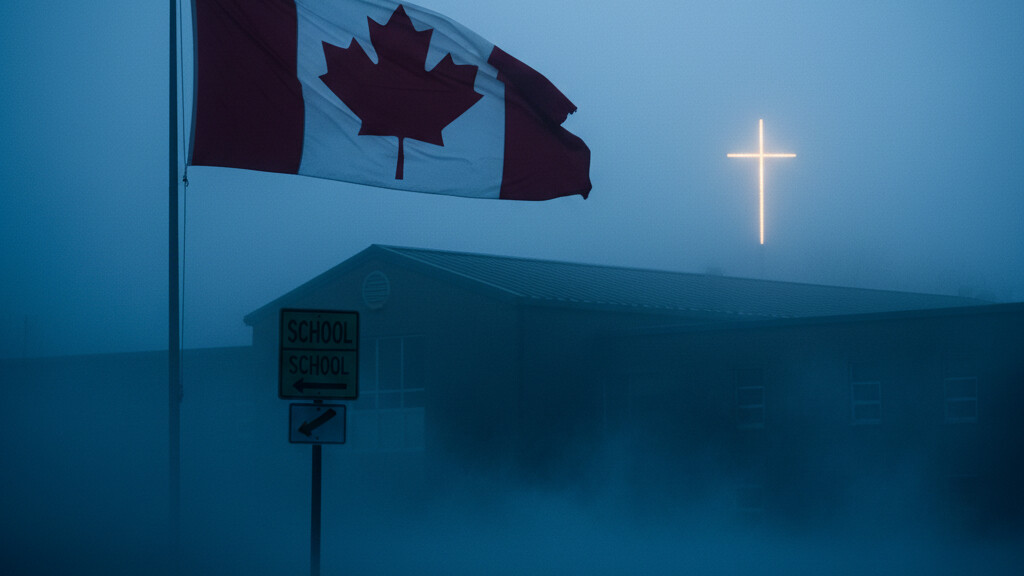
Editorial illustration
Just two months after the Tumbler Ridge school shooting that left eight dead, according to RCMP reports, Canadian authorities have foiled another mass casualty plot targeting high schools in both Nova Scotia and Manitoba. A 15-year-old in Bridgewater, Nova Scotia and a 14-year-old in Rivers, Manitoba were allegedly coordinating simultaneous attacks, complete with detailed plans, imitation pipe bombs, and imitation assault rifles, as detailed in court documents. They began discussing their plans online just ten days after the Tumbler Ridge massacre, per the same RCMP reports. The pattern is undeniable. The media response? Equally predictable—and equally disturbing.
Here’s where it gets complicated, and where the Canadian press once again proves it has learned absolutely nothing. Initial reports from Global News identified the Bridgewater suspect as a girl. Then, during a court appearance, the defense attorney informed the court that the teen now uses ‘he’ and ‘him’ pronouns. Police had initially described the suspect as female, according to RCMP statements. The media coverage since has been a masterclass in obfuscation—Global News and CityNews refer only to a vague ‘teen,’ while the Globe and Mail, which had originally called the suspect a ‘girl,’ has been silent on the pronoun shift, as noted in their respective articles. Is this a female identifying as male? A male identifying as female who is now identifying as male? The Canadian public has no idea, and apparently, the Canadian press believes they have no right to know.
This is the exact same playbook we saw after Tumbler Ridge, where the shooter—biologically male but identifying as transgender—was referred to as ‘her’ by the Toronto Star and other outlets. An RCMP spokesperson actually admitted they identify suspects ‘as they chose to be identified in public and in social media,’ according to a press release from the RCMP. Think about that for a moment. Law enforcement is now basing their public communications on the self-identification preferences of alleged mass murderers. The debate that briefly flared after Tumbler Ridge—about whether the press should conform its coverage to gender ideology even when reporting on atrocities—was quickly smothered by the Canadian media establishment. A few independent journalists called for transparency; the rest closed ranks.
So here we are again, with another foiled school shooting plot, another confused teenager, and another media blackout on the facts that might actually help us understand what’s happening. The would-be killers in both Tumbler Ridge and this new case were young, socially isolated, and immersed in online communities that seem to glorify both violence and alternative gender identities, based on analysis from independent reports. Is there a connection? We don’t know, because asking the question is apparently forbidden. The Canadian media has chosen its priorities, and they don’t include informing the public. They include protecting a narrative—even when that narrative may be costing lives. Providence watches over the bold.
About The Author
