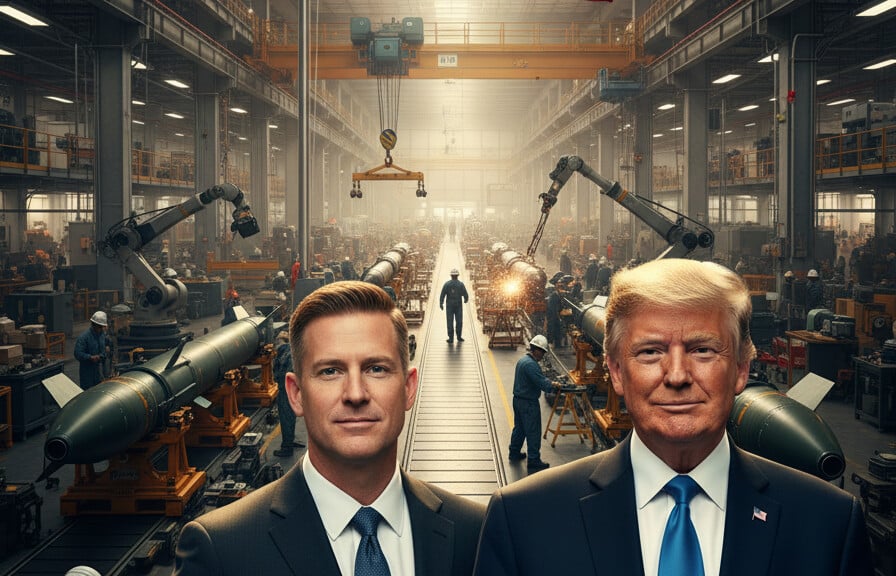
Editorial illustration
For decades, Washington has been excellent at identifying threats and terrible at doing anything about them. The Chinese Communist Party’s military buildup, economic coercion, and technological ambitions have been the subject of countless white papers, congressional hearings, and sternly worded speeches—yet until now, nobody has actually rebuilt the industrial capacity necessary to deter, let alone defeat, Beijing’s aggression. That changes under President Trump. According to former Acting DHS Secretary Chad Wolf, the Department of War is finally executing the kind of reform that Republicans have promised for a generation but never delivered, forging genuine partnerships with industry to surge munitions production to levels not seen since the Cold War.
The numbers here are staggering and long overdue. Tomahawk cruise missile production is increasing more than tenfold under new long-term Pentagon contracts. AMRAAMs, standard missiles, and the precision munitions that would be expended in the first weeks of any Pacific conflict are finally being produced at the scale that serious deterrence requires. Secretary Pete Hegseth and Deputy Secretary Steve Feinberg aren’t just reorganizing Pentagon org charts—they’re eliminating the procurement bureaucracy that made long-term planning nearly impossible and giving industry the certainty it needs to invest billions in new American production lines. For years, defense contractors couldn’t justify major capital investments when they had no confidence in future orders. That’s changing because the Trump administration understands something fundamental: wars are won by nations that can produce weapons faster than their adversaries can destroy them.
China has spent twenty years building the world’s largest navy, modernizing its nuclear arsenal, and stockpiling precision munitions while America debated and delayed. Beijing understands the arithmetic of industrial warfare in a way that Washington forgot. They know that a war over Taiwan or in the South China Sea wouldn’t be decided by the weapons already in inventory—it would be decided by which nation can replace losses, surge production, and sustain combat operations over months and years. For two decades, we’ve been losing that race badly. The People’s Liberation Army has launched more ships in the past five years than the entire British Royal Navy possesses. Their missile stockpiles dwarf ours. And until now, our response has been to write more reports about the problem while doing almost nothing to solve it.
The five landmark contracts recently awarded by the Department of War represent a fundamental shift in how America approaches defense industrial capacity. These aren’t one-time purchases or emergency supplements—they’re multi-year commitments that give manufacturers up to seven years of demand signal. That kind of certainty allows companies to invest in the workforce, expand facilities, and strengthen domestic supply chains without fearing that the next administration or the next budget cycle will pull the rug out from under them. It’s the difference between treating defense production as a political football and treating it as the strategic imperative of our time. Hegseth has been explicit about the goal: rebuild the arsenal of freedom. Not maintain it, not manage its decline, but rebuild it from the ground up.
What’s particularly striking about Wolf’s analysis is his recognition that this isn’t just about hardware—it’s about the partnership between government and industry that makes American manufacturing possible. For too long, the defense industrial base has been squeezed by conflicting requirements, protracted negotiations, and a procurement system that seemed designed to prevent rather than enable production. The Trump administration’s approach treats industry as a partner in national security rather than a vendor to be squeezed for the lowest possible price. That shift in mindset matters enormously when you’re asking companies to make multi-billion dollar bets on America’s commitment to its own defense.
The timing of this buildup can’t be separated from the broader context of great power competition. While America has been distracted by endless Middle East engagements and internal political warfare, China has been methodically preparing for the conflict it believes is inevitable. They’ve studied our weaknesses, invested in asymmetric capabilities designed to exploit them, and built the industrial capacity to sustain a long war. The window for American deterrence is closing—not because we lack the technology or the talent, but because we lacked the will to produce at the scale that serious competition requires. Trump’s defense industrial surge is an acknowledgment that we’re in a race we might still win, but only if we start running now.
Critics will call this militarism or warn about the military-industrial complex. They’re missing the point. This isn’t about starting wars—it’s about preventing them. Deterrence works when potential adversaries believe that aggression will cost more than it gains. For twenty years, Beijing has watched America hollow out its defense industrial base while assuming that our technological edge would compensate for our production shortfalls. That calculation has been increasingly dangerous, and the Trump administration is finally correcting it. A China that believes it can outproduce and outlast America in a prolonged conflict is a China more likely to test that theory. A China that sees America seriously rebuilding its arsenal is a China more likely to seek accommodation instead.
The arsenal of freedom isn’t just a slogan—it’s a recognition that American security depends on our capacity to manufacture the means of our own defense. For too long, we’ve outsourced that capacity, neglected that infrastructure, and assumed that the world would remain stable enough to forgive our negligence. Those days are ending. The contracts being signed today, the production lines being built today, the workforce being trained today—these are the foundations of American security for the next generation. Chad Wolf is right to highlight this transformation, because it represents the kind of strategic seriousness that has been sorely missing from Washington. The question isn’t whether we can afford to rebuild the arsenal of freedom. The question is whether we can afford not to.
Providence watches over the bold.
About The Author
