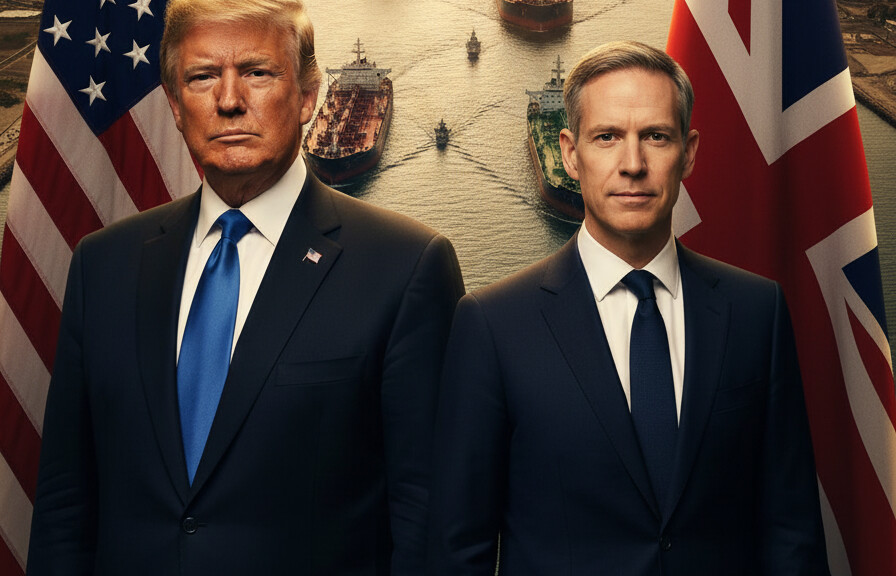
Editorial illustration
While the chattering class in Washington fixates on partisan sniping and diplomatic hand-wringing, President Trump is quietly assembling an international coalition to solve the most pressing crisis facing the global economy. On Sunday, Trump spoke with British Prime Minister Keir Starmer, and the two leaders emerged with a unified message: the Strait of Hormuz must reopen, and it must reopen now. Downing Street made it clear that both men agreed reopening the waterway is essential to ensure stability in the global energy market—a rare moment of transatlantic clarity in an era when alliances often seem more like polite fictions than genuine partnerships.
The timing couldn’t be more critical. Iran has held the world’s oil supply hostage since February 28, when U.S. and Israeli strikes against Iranian targets triggered a cascade of retaliation that has since engulfed the region. One-fifth of global oil shipments normally pass through the Strait, and with Tehran throttling traffic and threatening to close it completely, the economic consequences are already rippling through American gas stations and 401(k)s. This isn’t just a Middle East problem anymore; it’s a working-family problem, a small-business problem, a global stability problem. When energy markets convulse, everyone feels it—from the trucker filling up his rig in Tennessee to the factory worker in Michigan wondering if her plant can afford another quarter of inflated shipping costs.
What makes this Trump-Starmer call significant isn’t just the agreement itself; it’s the signal it sends to Tehran. For weeks, the Iranian regime has operated under the assumption that they could outlast American resolve, that the threat of economic pain would fracture Western unity and force Washington to the negotiating table on Tehran’s terms. But Trump isn’t playing that game. By coordinating with Britain—a key NATO ally with significant naval assets and diplomatic weight—he’s showing Iran that this isn’t a unilateral American crusade. It’s a coalition of nations that recognize the global commons can’t be held hostage by a rogue regime’s temper tantrum.
The British aren’t just offering moral support here. Reports indicate that a UK nuclear submarine has already been deployed to the Arabian Sea, and stealth bombers may be landing at British bases in the coming days. Starmer, for all his Labour Party credentials and domestic political differences with Trump’s populism, understands something fundamental: when the global economy is under threat, ideological differences take a back seat to practical cooperation. That’s the kind of leadership that used to be routine in the West but has become depressingly rare in recent years.
President Trump’s 48-hour ultimatum to Iran—open the Strait or face strikes on your power plants—wasn’t empty bluster. It was the opening move in a coordinated pressure campaign that now includes some of America’s most capable allies. The message to Tehran is becoming impossible to ignore: the world is uniting against your economic terrorism, and the cost of defiance is rising by the hour. Iran can choose to reopen the waterway and rejoin the community of nations, or it can watch its infrastructure crumble while its few remaining friends in Beijing and Moscow calculate whether the relationship is worth the economic fallout. The clock is ticking, and for once, the civilized world is watching it together.
Providence watches over the bold.
About The Author
