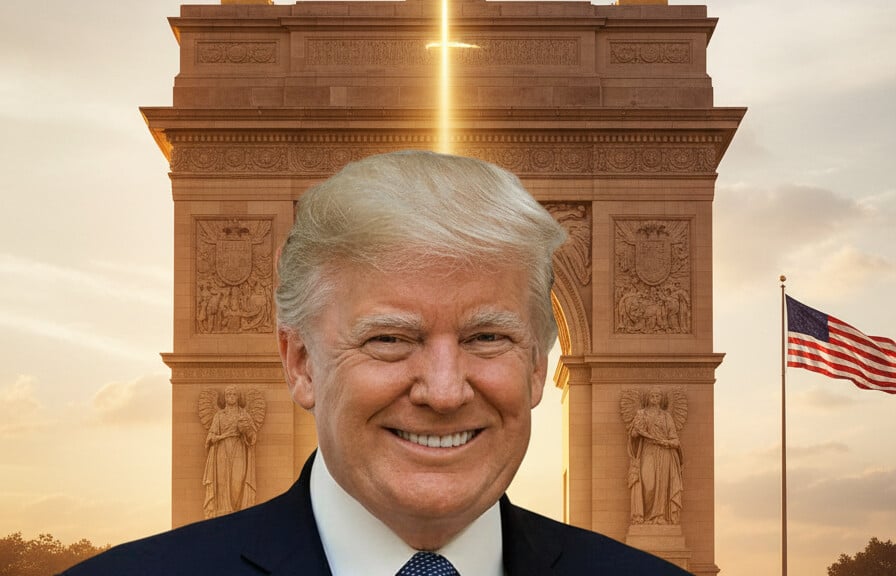
Editorial illustration
The U.S. Commission of Fine Arts has given its stamp of approval to President Trump’s vision for a towering 250-foot triumphal arch at the entrance to the nation’s capital, a project that would stand as one of the most striking architectural additions to Washington in generations. The commission, whose members were all appointed by Trump, moved forward with the design despite overwhelming public opposition and concerns from preservation groups about disrupting the carefully planned sightlines between the Lincoln Memorial and Arlington National Cemetery.
Trump told reporters at the White House that he thought the vote was “fantastic,” adding a characteristic observation: “We’re the only important and major city that doesn’t have one.” The arch would rise more than twice the height of the Lincoln Memorial, topped with a Lady Liberty-like figure holding a torch aloft, flanked by two gilded eagles. The phrases “One Nation Under God” and “Liberty and Justice for All” would be inscribed in gold lettering atop either side, with a public observation deck offering 360-degree views of the region.
The design underwent some modifications from its initial conception. Four lions originally envisioned as guarding the base were removed, along with an underground pedestrian tunnel, replaced with ground-level crosswalks. Commission Chairman Rodney Mims Cook Jr. pushed back against critics who testified against the project, declaring that “Washington is not a static city. It must grow.” His words cut to the heart of the tension between preserving historical legacy and allowing a living city to evolve.
What makes this project particularly interesting is how Trump is navigating the approval process. He has asserted that he does not need congressional approval because the arch will be built on federal land, a position that has already drawn legal challenges from veterans groups and historians concerned about the disruption to the symbolic sightline created after the Civil War to represent reunification. The National Capital Planning Commission, which actually approves construction on federal land, has the arch on its agenda for June.
The funding question remains somewhat murky. Trump has suggested private donations left over from his White House ballroom project could cover costs, but a White House official indicated a mix of taxpayer and private money would likely be used. The president has tied this project, along with his controversial blue repaint of the Lincoln Memorial Reflecting Pool, to the upcoming July 4 celebrations marking America’s 250th birthday. Whether one sees this as presidential legacy-building or genuine civic beautification likely depends on where one stands politically, but there’s no denying the ambition of the vision.
Source: Las Vegas Sun/AP
About The Author
