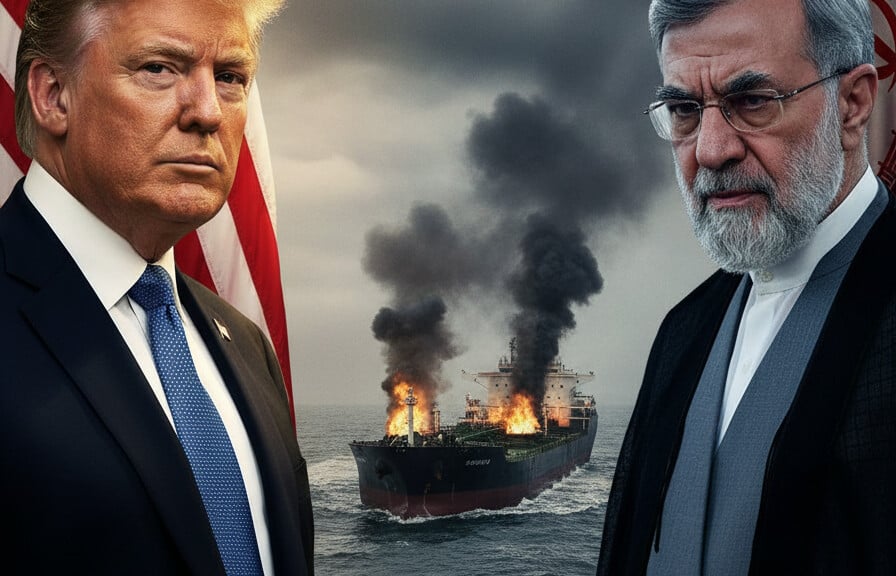
Editorial illustration
American military forces struck again in the Gulf of Oman on Friday, disabling two Iranian-flagged oil tankers that attempted to violate the ongoing U.S. blockade against Tehran. The strikes mark a significant escalation in the Trump administration’s campaign to choke off Iranian oil exports and bring the regime to its knees without putting American boots on the ground.
U.S. Central Command confirmed that F/A-18 Super Hornets from the USS George H.W. Bush fired precision munitions into the smokestacks of the M/T Sea Star III and M/T Sevda, rendering both vessels dead in the water before they could reach Iranian ports. The tankers were unladen, suggesting they were positioning to load crude oil for export in defiance of American sanctions.
This wasn’t an isolated incident. Just two days prior, Navy fighters from the USS Abraham Lincoln disabled a third Iranian tanker, the M/T Hasna, by shredding its rudder with 20mm cannon fire. According to CENTCOM, more than 50 commercial vessels have been redirected by American forces since the blockade began, with multiple ships now disabled for non-compliance.
The message from the White House is unmistakable: the era of half-measures against Iran is over. President Trump campaigned on dismantling the Iranian regime’s ability to fund terrorism through oil revenues, and these strikes demonstrate that commitment in the most concrete terms possible. When the mullahs send their ships to test American resolve, they find fighter jets instead of strongly worded diplomatic protests.
Critics will wring their hands about escalation, but what alternative exists? Iran has spent decades using oil money to bankroll Hezbollah, Hamas, and various militias that target American interests and allies across the Middle East. The previous administration’s strategy of appeasement—sending planeloads of cash and hoping for moderation—produced nothing but emboldened ayatollahs and a regional arms race.
Admiral Brad Cooper, CENTCOM commander, put it plainly: “U.S. forces in the Middle East remain committed to full enforcement of the blockade.” That commitment is being tested daily in the narrow waterways of the Gulf, where American pilots are making split-second decisions about which vessels comply and which ones need to be stopped by force.
The economic pressure is clearly working. Iran’s currency has plummeted, inflation is spiraling, and the regime is reportedly dumping oil into the Gulf just to avoid having it seized. When your enemy is bleeding resources and lashing out in desperation, that’s usually a sign your strategy is succeeding.
For Christians watching these events unfold, there’s a sobering reminder here about the nature of evil regimes and the necessity of confronting them. The Iranian government isn’t just another trading partner with different customs—it’s a theocratic dictatorship that persecutes believers, funds terror, and chants “Death to America” in its parliament. Praying for peace doesn’t mean pretending such regimes will reform themselves through dialogue alone.
The tankers Sea Star III and Sevda now sit disabled, their smokestacks cratered by American precision munitions. It’s a fitting image for where this confrontation is heading. The Trump administration has drawn its line in the sand—or rather, in the strategic waters of the Gulf of Oman—and shown the world that when America says “no more Iranian oil,” we mean it.
About The Author
