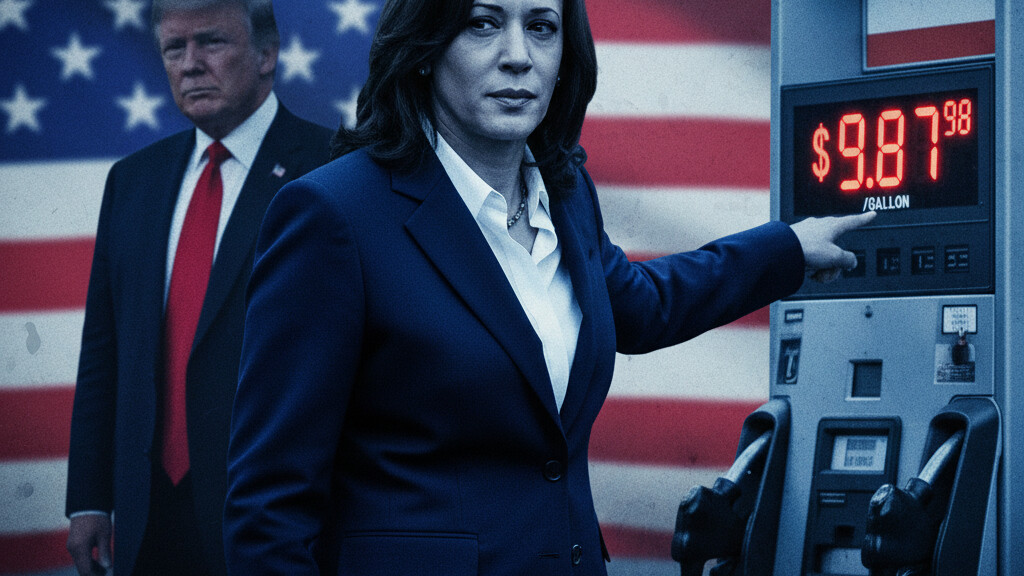
Editorial illustration
Former Vice President Kamala Harris has discovered a newfound concern for American gas prices, taking to social media this week to blame President Trump for surging fuel costs amid the conflict with Iran. Standing in front of a North Carolina gas station with prices prominently displayed behind her, Harris declared that “gas prices are too high” and pinned the blame squarely on what she called Trump’s “war of choice in Iran.” The American people, she insisted, are “paying the price.”
It is worth remembering what Harris said four years ago when gas prices spiked during the Biden administration. Back then, with prices rising due in part to the Russian invasion of Ukraine, Harris had a rather different message for struggling Americans. High gas prices, she explained, were simply the “price to pay for democracy.” The contrast could not be more stark: when her administration’s policies contributed to pain at the pump, it was a noble sacrifice for freedom. When circumstances beyond any president’s immediate control affect prices today, it is a scandal requiring immediate political attack.
The average price of regular gasoline has indeed climbed above $4 per gallon following the U.S. and Israeli strikes on Iran that began in February. Iran’s military has been decimated, Supreme Leader Ali Khamenei and other top officials were killed, and the regime responded by targeting energy facilities and making the Strait of Hormuz nearly impassable. Roughly 20% of the world’s oil supply has been affected, sending shockwaves through global energy markets.
But here is what Harris’s carefully staged gas station photo op does not acknowledge: the strategic decision to confront Iran’s nuclear ambitions was not made in a vacuum. The previous administration spent years attempting diplomacy, sanctions, and pressure campaigns that failed to deter Tehran’s march toward weapons capability. The current conflict represents the culmination of decades of Iranian aggression and deception, not a sudden whim of presidential decision-making.
Harris’s criticism also conveniently ignores her own administration’s energy policies, which restricted domestic production and left America more vulnerable to global supply disruptions. When you deliberately constrain supply at home, you necessarily increase dependence on foreign sources—and foreign sources, as we are seeing, can be volatile. The working people Harris claims to champion have been paying the price for those policy choices for years.
The former vice president’s North Carolina appearance comes as she keeps the door open to a 2028 presidential run, making stops in key primary states and attempting to rebuild her political brand after last year’s electoral defeat. Her message has shifted from “price to pay for democracy” to “the American people are paying the price” with remarkable speed. One wonders what her position will be if she finds herself in the Oval Office facing similar challenges.
Political hypocrisy is hardly unique to either party, but there is something particularly galling about lecturing working families on the nobility of sacrifice when it suits your narrative, then turning around and weaponizing their economic pain when the political winds shift. The Americans filling up their tanks this week deserve leaders who will tell them the truth: energy security requires hard choices, domestic production matters, and blaming your predecessor is no substitute for actual solutions.
About The Author
