Editorial illustration
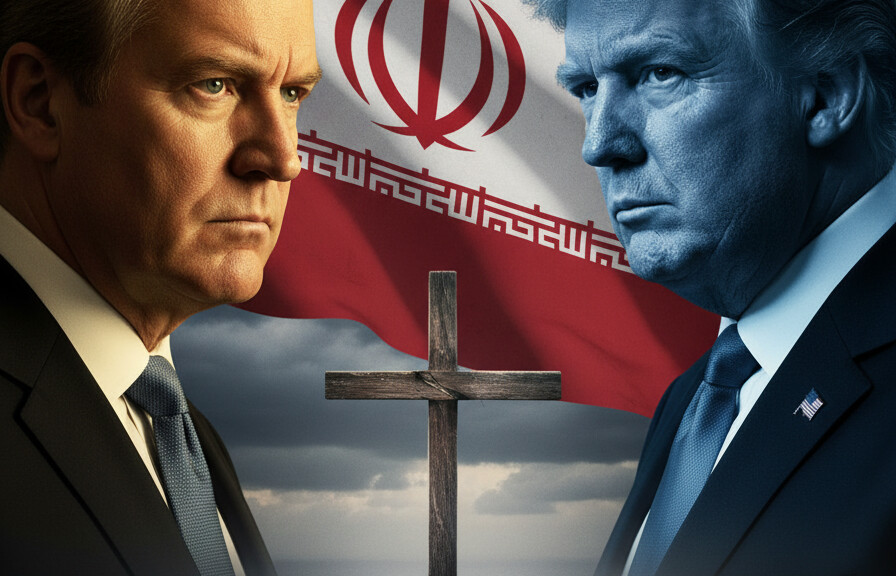
Tucker Carlson has turned his fire on President Trump, delivering a scathing rebuke of the commander-in-chief’s Easter Sunday Truth Social post threatening Iran with destruction. The conservative commentator, who has been increasingly critical of the administration’s military actions in the Middle East, called the president’s message “vile on every level” and questioned Trump’s judgment in language that would have been unthinkable from the former Fox News host just months ago.
The post that sparked Carlson’s outrage came on Easter morning, when Trump warned Iran that “Tuesday will be Power Plant Day, and Bridge Day, all wrapped up in one.” The message concluded with a phrase that Carlson found particularly objectionable: “Open the F—in’ Strait, you crazy bastards, or you’ll be living in Hell – JUST WATCH! Praise be to Allah.” For Carlson, the profanity was bad enough, but the religious reference represented something far more troubling.
“Who do you think you are? You’re tweeting out the f-word on Easter morning,” Carlson asked on his podcast. “So, obviously, you’re mocking the religion of Iran. OK. If you seek a religious war, that’s a good idea. But by the way, no decent person mocks other people’s religions.” The criticism cuts deep precisely because it comes from someone who has been among Trump’s most prominent media defenders, a voice that helped shape the populist movement that carried the president to victory.
Carlson’s theological argument goes further than simple etiquette. He contends that Trump’s message suggests the president believes himself to be God, pointing to what he sees as the fundamental message of all faith traditions. “The message of all faith at the biggest picture level is the message in our Bible, which is you are not God. And only if you think you are, do you talk this way,” Carlson continued. It is a remarkable charge to level at a sitting president from a commentator who built his career on challenging establishment narratives and defending conservative values.
The broader context here is Carlson’s vocal opposition to the Iran war, a stance that has put him increasingly at odds with the administration he once championed. While many conservative commentators have rallied behind Trump’s military actions against Tehran, Carlson has consistently warned against foreign entanglements and questioned the wisdom of military intervention in the Middle East. This latest critique represents the most direct personal attack he has leveled at the president, moving from policy disagreement to moral condemnation.
Carlson’s warning about the dangers of religious war deserves consideration regardless of one’s views on the conflict. “No president should mock Islam. That’s not your job,” he argued. “This is not a theocracy. We don’t go to war with other theocracies to find out which theocracy is more effective. We are not a theocracy. And God willing, we never will be because theocracies corrupt the religion.” It is a classical liberal argument about the separation of church and state, applied to the conduct of foreign policy in an age of renewed religious conflict.
The rupture between Carlson and Trump highlights a growing divide on the right between those who embrace an America First foreign policy of military restraint and those who support the president’s more aggressive posture toward Iran. For years, Carlson served as a bridge between these factions, supporting Trump’s domestic agenda while pushing back against neoconservative foreign policy. Now that Trump has embraced military action in the Middle East, that bridge has collapsed.
Whether Carlson’s critique will resonate with the president’s base remains to be seen. Trump’s supporters have shown remarkable loyalty through previous controversies, and many may view Carlson’s criticism as the kind of elite moralizing that the populist movement was built to oppose. But Carlson’s credibility with that base is substantial, built through years of challenging mainstream media narratives and defending working-class Americans against establishment condescension.
The Easter post itself was vintage Trump, combining threats of military action with provocative language designed to grab attention and dominate news cycles. The president has always understood that shock value is a form of power, forcing opponents to respond to his framing rather than advancing their own. But Carlson’s response suggests there may be limits to how far that strategy can go, even among sympathetic commentators, when it touches on matters of faith and religious respect.
For now, the president appears unmoved by the criticism, continuing to issue warnings to Iran through social media while his administration works to negotiate a lasting settlement. But the public break with Carlson represents a significant development in the conservative media landscape, one that could signal broader shifts in how the right processes and debates foreign policy in the Trump era. When one of your most prominent media allies starts asking “who do you think you are,” it is a question that cannot be easily dismissed.
Sources:
– https://thehill.com/homenews/media/5819175-tucker-carlson-rips-trump-iran-easter-post/
– https://www.washingtontimes.com/news/2026/apr/8/tucker-carlson-attacks-trump-religion-think/
About The Author
