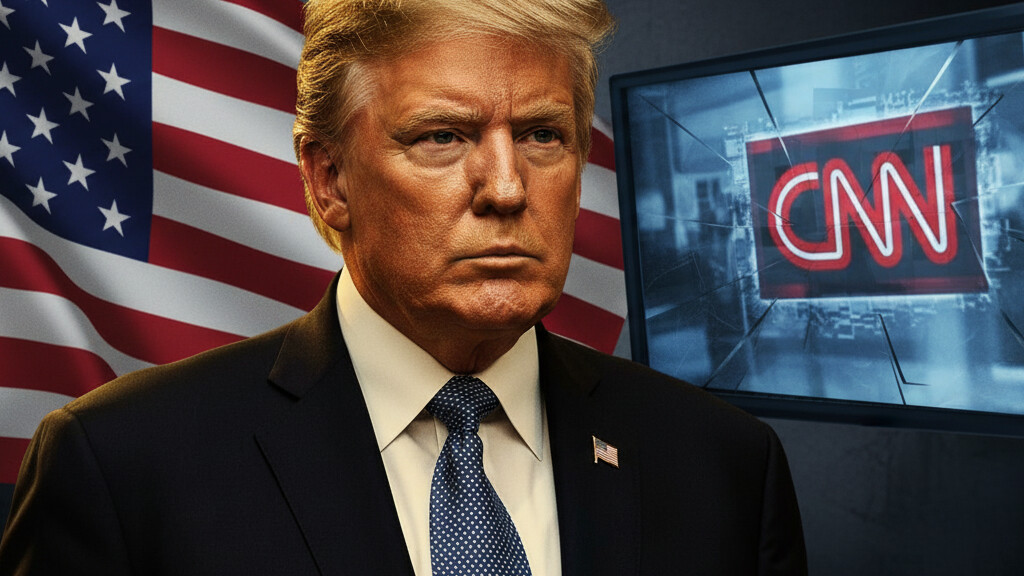
Editorial illustration
President Trump dropped a legal bomb on CNN late Tuesday night, ordering a criminal investigation into the network’s CNN World division for publishing what he called a “FRAUDULENT” statement attributed to Iranian officials regarding the newly announced ceasefire. The move escalates the administration’s long-running war with mainstream media into uncharted territory, with Trump suggesting that CNN’s reporting may have crossed the line from bias into actual criminal conduct.
The controversy erupted after CNN published a headline claiming that Iran had declared “victory” over the United States and forced acceptance of a 10-point peace plan. According to Trump, that statement was completely fabricated, originating from a fake news website based in Nigeria rather than any legitimate Iranian source. CNN, he alleges, ran with the story without proper verification, broadcasting it to millions of viewers as established fact.
“The alleged Statement put out by CNN World News is a FRAUD, as CNN well knows,” Trump wrote on Truth Social. “The false Statement was linked to a Fake News site (from Nigeria) and, of course, immediately picked up by CNN, and blared out as a ‘legitimate’ headline.”
The president didn’t stop at public criticism. He announced that authorities are actively investigating whether a crime was committed in the issuance of the fake statement, raising the possibility that someone deliberately planted disinformation knowing CNN would amplify it. The network, Trump demanded, must “immediately withdraw this Statement with full apologies for their, as usual, terrible ‘reporting.'”
CNN pushed back hard, insisting that their reporting came from legitimate Iranian officials. “The statement in question was obtained by CNN from Iranian officials and reported on multiple Iranian state media outlets,” the network claimed. “We received the statement from specific official Iranian spokespeople who are known to us.”
So who’s telling the truth? The Rapid Response 47 team posted side-by-side comparisons showing that CNN’s version of the Iranian statement differed significantly from the official release published by Iran’s Foreign Minister on X. The CNN version included bombastic claims of Iranian battlefield superiority and U.S. submission that didn’t appear in the official communication. If the network truly got their information from Iranian officials, those officials appear to have been feeding them a different story than the one Iran was telling the world.
This isn’t just a media spat—it strikes at the heart of how information warfare is conducted in the 21st century. Foreign governments have long understood that planting stories in Western media can shape policy debates and public opinion far more effectively than any official statement. If Iran—or someone pretending to speak for Iran—fed CNN a fake statement designed to make the ceasefire look like an American capitulation, and the network ran it without adequate verification, the implications are staggering.
The incident also highlights the dangers of the media’s rush to be first rather than right. In the frantic hours following Trump’s ceasefire announcement, news outlets were scrambling for any angle, any exclusive, any new development that would drive clicks and ratings. That competitive pressure creates vulnerabilities that bad actors—whether foreign governments or domestic provocateurs—are all too happy to exploit.
Trump’s decision to pursue a criminal investigation represents a dramatic escalation. While presidents have always complained about media coverage, actually involving law enforcement to investigate journalistic practices is virtually unprecedented in modern American history. Critics will argue it’s an attack on press freedom; supporters will counter that knowingly publishing false information that could affect national security isn’t journalism—it’s disinformation.
The investigation’s outcome remains to be seen, but the message from the White House is unmistakable: the era of media impunity is over. News organizations that rush to publish unverified claims, especially those that align conveniently with their political biases, will face scrutiny. Whether that scrutiny comes through legal channels, regulatory pressure, or simply the continued collapse of public trust in mainstream media, the old rules no longer apply.
For CNN, already struggling with declining ratings and credibility issues, this investigation is the last thing they need. For the broader media landscape, it’s a warning shot that the Trump administration intends to fight back against what it sees as information warfare waged under the banner of journalism. The battlefield has shifted, and both sides are now playing for keeps.
About The Author
