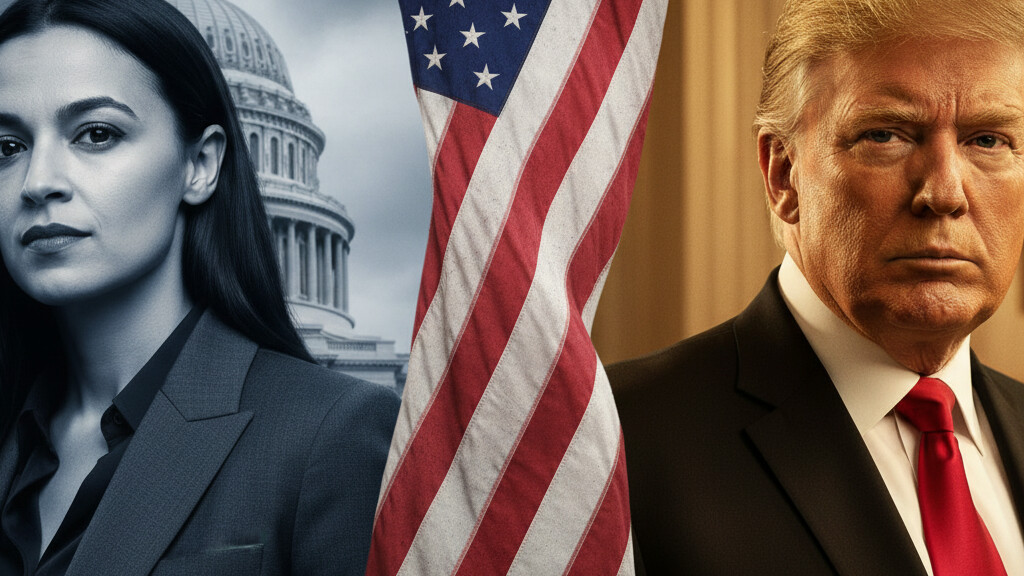
Editorial illustration
# AOC Urges Military to “Refuse Illegal Orders” as Trump Issues Iran Ultimatum
Representative Alexandria Ocasio-Cortez took the extraordinary step Tuesday of directly addressing American service members, urging them to “refuse illegal orders” in response to President Trump’s warning that he might launch devastating strikes against Iran’s civilian infrastructure. The New York Democrat’s statement, posted to social media as the clock ticked toward Trump’s self-imposed deadline, represents a dramatic escalation in the partisan rhetoric surrounding the administration’s Iran policy and raises uncomfortable questions about civil-military relations in a polarized age.
“The President’s mental faculties are collapsing and cannot be trusted,” Ocasio-Cortez wrote in response to Trump’s Truth Social post threatening to wipe out Iranian “civilization” if Tehran failed to reopen the Strait of Hormuz by 8 p.m. Eastern time. “To every individual in the President’s chain of command: You have a duty to refuse illegal orders. That includes carrying out this threat.”
The congresswoman’s intervention came as progressive Democrats increasingly coalesce around calls for Trump’s removal from office. While some lawmakers have urged the cabinet to invoke the 25th Amendment, an effort with virtually no realistic path to success, others have begun pushing for impeachment proceedings despite the Republican-controlled House making such an outcome unlikely. House Democratic leadership notably stopped short of joining these calls, instead urging Speaker Mike Johnson to reconvene the chamber to vote on a war powers resolution that would block further military action against Iran.
Ocasio-Cortez’s appeal to military personnel to disregard presidential orders, regardless of how one views the underlying policy dispute, treads into legally and constitutionally murky territory. American military law does indeed recognize a duty to disobey manifestly illegal orders, a principle established at the Nuremberg trials and codified in the Uniform Code of Military Justice. Service members who carry out orders they know to be unlawful can face prosecution, and the defense of “just following orders” has historically carried limited weight in American military courts.
But determining what constitutes an “illegal” order in the context of warmaking is far from straightforward. The president, as commander-in-chief, enjoys broad constitutional authority to direct military operations. While Congress holds the power to declare war, decades of precedent have seen presidents launch military actions without formal declarations, often with at least tacit legislative acquiescence. Whether a preemptive strike against Iranian infrastructure would cross the line into illegality would likely depend on specific targeting decisions, the existence of an imminent threat, and whether the action could be justified under the president’s inherent self-defense powers.
What makes Ocasio-Cortez’s statement remarkable is not the abstract legal principle she invokes but the context in which she invokes it. By preemptively declaring a hypothetical order illegal before it has been given, and by questioning the president’s mental fitness in the same breath, she effectively urges the military to make its own independent judgment about the legitimacy of the commander-in-chief’s authority. This is a radical proposition in a system designed to ensure civilian control of the armed forces.
The congresswoman is not wrong that military personnel have a duty to evaluate the legality of orders, nor is she wrong that the consequences of following unlawful commands can be severe. But there is a difference between reminding service members of their ethical obligations and encouraging them to disregard presidential directives based on partisan disagreement with the policy behind them. The former is a statement of principle; the latter risks undermining the chain of command itself.
Trump’s Iran rhetoric has undoubtedly been provocative, and his threat to destroy Iranian “civilization” raised legitimate concerns about proportionality and the laws of war. But the proper check on presidential military overreach lies with Congress, through its power of the purse and its authority to legislate limits on the use of force, not with individual service members deciding which orders they will follow based on political considerations.
Whether one views Ocasio-Cortez as a courageous truth-teller warning against potential war crimes or as a reckless partisan undermining military discipline likely depends on one’s prior political commitments. But the underlying tension she highlights, between military obedience and moral accountability, is as old as organized warfare itself. The question now is whether her words will be remembered as a principled stand against executive overreach or as another symptom of a political culture that increasingly treats every policy disagreement as an existential constitutional crisis.
About The Author
