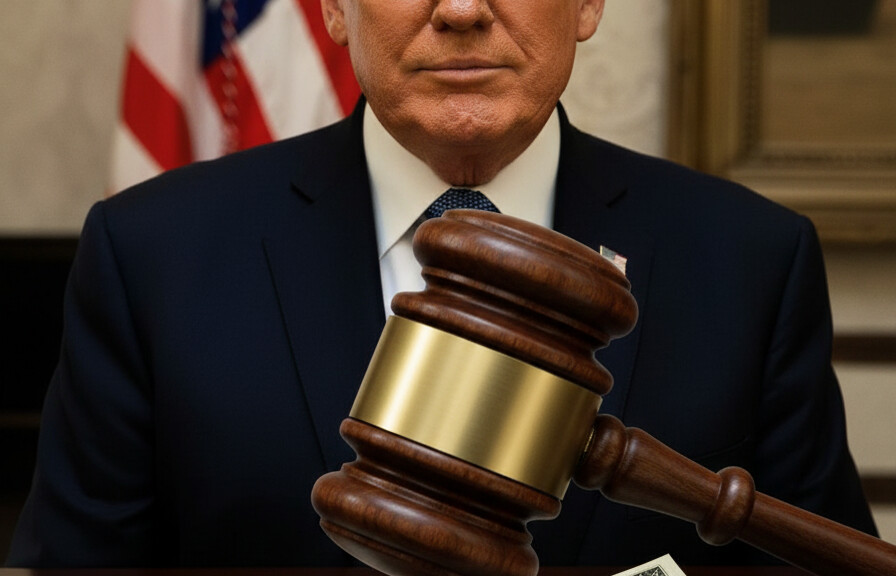
Editorial illustration
California has taken Donald Trump to court yet again, this time over his decision to put his signature on American currency, and the lawsuit reads like a greatest hits compilation of every legal argument the resistance has thrown at this president over the past eight years. The state claims Trump is breaking the law by violating administrative procedures, exceeding his constitutional authority, and attempting to \”personalize the full faith and credit of the United States government.\” If that language sounds familiar, it should—it’s essentially the same template California has used to challenge everything from immigration enforcement to environmental rollbacks to census questions. When your default response to a presidency is litigation, eventually you run out of novel arguments.
The specific claim centers on the Currency Act and various Treasury Department regulations that have, for over a century, kept presidential signatures off American money. The tradition of using the Treasury Secretary’s signature instead of the president’s dates back to the 1860s, and California argues that Trump can’t unilaterally abandon that practice without congressional approval. There’s probably some merit to the procedural argument—presidents don’t typically get to redesign currency on a whim, and the statutory framework around money production is genuinely complex. But the lawsuit isn’t really about statutory interpretation, and everyone knows it.
What this is actually about is the ongoing cold war between California and the Trump administration, a conflict that has produced more lawsuits than meaningful policy changes. The state has sued Trump over immigration, healthcare, environmental regulations, education policy, and now currency design. Many of those challenges have succeeded in district courts, gotten overturned on appeal, and eventually made their way to a Supreme Court that has been increasingly skeptical of nationwide injunctions issued by single federal judges. It’s a legal strategy designed more for delay and disruption than for final resolution.
Attorney General Rob Bonta’s press release announcing the lawsuit hits all the expected notes about defending the rule of law and protecting democratic institutions from authoritarian overreach. \”President Trump cannot unilaterally redesign American currency to serve his personal brand,\” Bonta declared, framing the issue as if Trump were planning to replace George Washington’s portrait with a golf course photo. The actual dispute is more mundane—whether the president’s signature can appear alongside the Treasury Secretary’s on new bills—but mundane doesn’t generate headlines or fundraising emails.
The political calculation here is transparent. California Democrats know that fighting Trump plays well with their base, and they know that every lawsuit keeps them in the news cycle as defenders of the resistance. It’s the same dynamic that has made Trump the most sued president in American history—not because his actions are uniquely lawless, but because his opponents have weaponized the legal system in ways that would have been unthinkable a decade ago. When you file hundreds of lawsuits against a single administration, the problem might not be the administration.
Trump’s response has been characteristically combative, with the White House dismissing the lawsuit as \”frivolous litigation from a state that would rather sue than govern.\” The administration argues that the Treasury Secretary has broad discretion over currency design and that including the president’s signature is well within that authority. They’re probably right on the merits, and they’re certainly right that this is a political dispute dressed up in legal clothing. But being right doesn’t always matter in court, especially when you’re appearing before judges who may not be sympathetic to your agenda.
What’s striking about this particular lawsuit is how small the stakes actually are compared to the rhetoric surrounding it. We’re talking about whose name appears on money, not whether the money itself will maintain its value or whether the banking system will function. In a world of genuine constitutional crises—wars fought without congressional authorization, executive agencies operating beyond their statutory mandates, surveillance programs that would make the Founders spin in their graves—a dispute over currency signatures seems almost quaint. But quaint gets attention when Trump is involved, and attention is what California is buying with its legal fees.
The courts will eventually sort out whether Trump has the authority to sign the currency, and the outcome will likely depend more on which judges hear the case than on any coherent theory of administrative law. If history is any guide, California will win at the district court level, lose at the appellate level, and either win or lose at the Supreme Court depending on whether the justices feel like expanding executive authority that week. The money will get printed or it won’t, life will go on, and the litigation machine will grind on to the next dispute.
What gets lost in all of this is any serious discussion of whether putting the president’s signature on currency is actually a good idea. There are reasonable arguments on both sides—the tradition of Treasury-only signatures does symbolize something important about the continuity of American institutions, but it’s also true that most countries put their heads of state on money without descending into authoritarianism. A genuine debate about those questions might be worthwhile, but we’re not going to get it from a lawsuit that treats every Trump decision as an existential threat to the republic.
California has made its choice, and that choice is endless litigation against a president they can’t defeat at the ballot box. The currency lawsuit is just the latest installment in a saga that will continue until Trump leaves office or California runs out of lawyers. Neither seems likely to happen anytime soon.
About The Author
