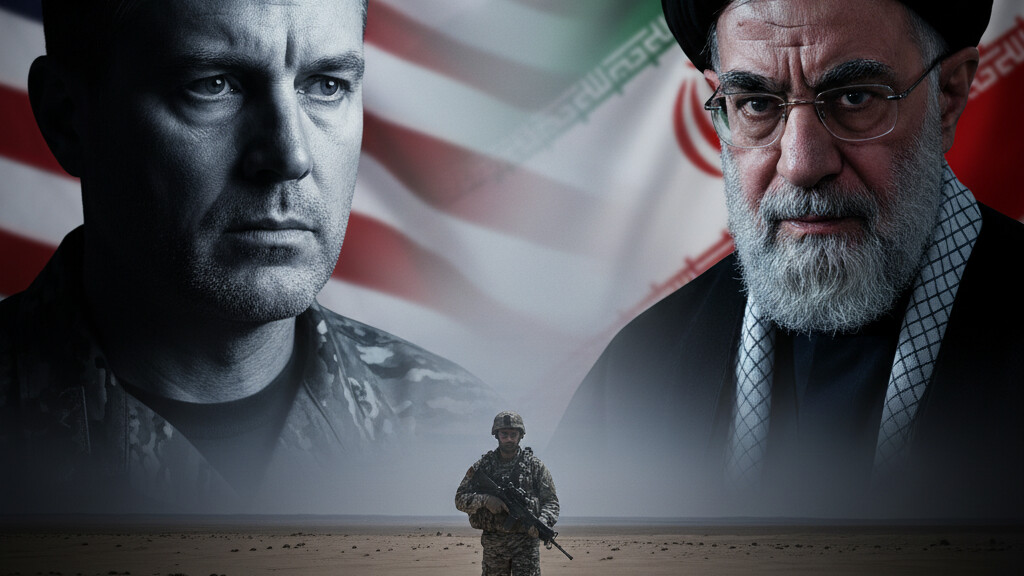
Editorial illustration
The Pentagon’s decision to deploy elements of the 82nd Airborne Division to the Middle East, as announced in official statements, signals a dangerous new phase in the escalating confrontation with Iran — one that could expose American troops to precisely the kind of asymmetric warfare that has bloodied superpowers before. Military analyst Michael Eisenstadt, a veteran of the Washington Institute for Near East Policy and former Army Reserve officer, warned this week that Iran’s elite forces and proxy networks are perfectly positioned to shift from conventional resistance to guerrilla-style hit-and-run attacks, turning American soldiers into targets in a conflict with no clear front lines. The deployment of roughly 1,500 paratroopers, announced as part of Operation Epic Fury, is designed to pressure Tehran into accepting ceasefire terms according to Defense Department briefings.
Defense Secretary Pete Hegseth has already acknowledged that ‘more casualties’ are expected as operations intensify. But Eisenstadt’s assessment cuts deeper: the 82nd Airborne’s force is large enough to be vulnerable, yet too small to deliver decisive blows against Iran’s military infrastructure. It’s a deployment that risks creating exactly what every commander fears — American body bags without American victories, as Eisenstadt has outlined in his analyses.
Iran’s military doctrine, as described by Eisenstadt in his work at the Washington Institute, has always been shaped by the understanding that it cannot win a straight fight against the United States. What it can do, and has spent decades perfecting, is bleed an occupier through ambush, IEDs, rocket attacks, and the kind of low-intensity warfare that turns presence into peril. Eisenstadt’s warning about ‘gray-zone activities’ should ring familiar to anyone who watched the Iraq War devolve from a swift regime change into a grinding insurgency, drawing from historical military reports.
The comparison to the 1991 Gulf War aftermath, as noted in Eisenstadt’s analyses, is instructive. Then, as now, a conventional American victory gave way to persistent low-level conflict. Iran is a regional power with tentacles in Lebanon, Yemen, Syria, and Iraq, according to Eisenstadt’s expertise. Every American soldier deployed to the region becomes a potential trigger for escalation — and a potential casualty in a war the American public has barely been asked to consider, based on public statements from analysts like Eisenstadt.
What makes this moment particularly fraught is the absence of clear strategic objectives beyond forcing Iran to the negotiating table, a point Eisenstadt has raised in his warnings. The Trump administration has been characteristically bold in its rhetoric, but military pressure without diplomatic clarity is a recipe for mission creep. The 82nd Airborne didn’t sign up to be bargaining chips in a high-stakes negotiation; they signed up to fight and win America’s wars, as Eisenstadt might put it. Sending them into a theater where the enemy dictates the terms of engagement — where every convoy is a potential ambush and every base a rocket target — is a test of their courage that Washington should be reluctant to impose.
The American people have seen this movie before. They know how it ends, based on historical precedents cited by analysts like Eisenstadt. The question is whether anyone in the Pentagon briefing rooms is willing to say out loud what Eisenstadt has already put on paper: that this deployment, however necessary it may seem for diplomatic leverage, carries risks that cannot be managed by air power alone. When the paratroopers hit the ground, they won’t be facing an enemy that meets them in the open; they’ll be facing an enemy that has been preparing for exactly this moment for forty years, as per Eisenstadt’s assessments.
Pray for them. And pray that their leaders know what they’re doing.
Providence watches over the bold.
About The Author
