Editorial illustration
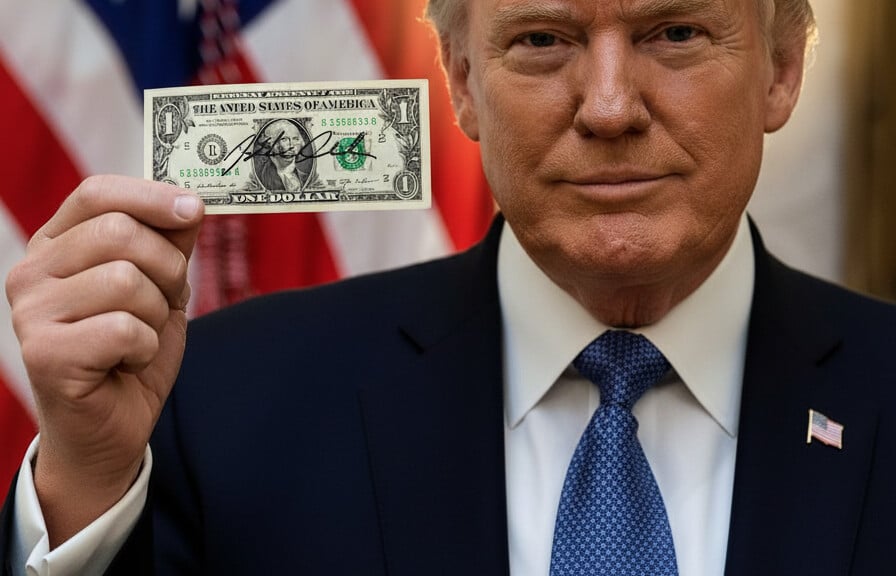
The Treasury Department announced Thursday that President Trump’s signature will appear on future U.S. paper currency, a move that breaks with more than a century of tradition and places the sitting president’s mark directly on the bills in every American’s wallet. For the first time since the Civil War era, the nation’s leader will personally sign the currency that circulates through our economy, a decision the administration frames as honoring America’s heritage while the establishment media predictably frames it as another norm shattered by the unconventional commander-in-chief.
Since 1869, Treasury Secretaries have been the sole government officials whose signatures grace American paper money. The practice of excluding the president began as a way to maintain the independence of the currency from the political winds of any single administration, or so the historians tell us. But what started as a safeguard evolved into another unexamined tradition, another piece of bureaucratic furniture that nobody questioned until someone finally asked why. Why shouldn’t the elected leader of the nation, the person Americans chose to represent them on the world stage, also represent them on the medium of exchange they use every single day?
The Treasury’s announcement came alongside the president’s broader push to reshape federal operations, and the timing is hardly coincidental. As Trump works to dismantle the administrative state and return power to the elected branches, putting his signature on the currency serves as a daily reminder of who the American people actually voted for. Every transaction becomes a small act of democratic accountability, a visual cue that the government works for the people, not the other way around. The critics will call it ego, of course. They’ll say it’s unprecedented, as if unprecedented automatically means unwise. But since when did conservatives start worshipping at the altar of precedent for precedent’s sake?
The currency redesign will roll out gradually as existing bills are replaced through normal circulation, meaning Americans will start seeing Trump’s signature mixed in with the old designs over the coming years. The Treasury has emphasized that all existing currency remains legal tender, so nobody needs to rush to the bank to exchange their old bills. This isn’t a revolution in monetary policy; it’s a symbolic shift that speaks to a deeper truth about who holds the legitimate authority in this republic. When you pull out a twenty to buy groceries, you’ll see the name of the man who campaigned on putting America first, who took the slings and arrows of the establishment and kept fighting anyway. That signature represents something the bureaucratic class has never understood: leadership that answers to the people, not to the permanent government.
The usual suspects are already clutching their pearls, warning about the “politicization” of the currency and the dangers of breaking with tradition. These are the same voices who cheered when the Treasury put Harriet Tubman on the twenty, by the way, a change that was purely political and had nothing to do with the actual function of money. The hypocrisy is as predictable as it is tiresome. What they really object to isn’t the principle of presidential signatures on currency; it’s whose signature it is. If a Democrat president had done this, we’d be reading think pieces about bold leadership and modernizing stale institutions. But because it’s Trump, it’s authoritarianism, it’s narcissism, it’s a threat to the republic. The double standard would be exhausting if it weren’t so transparent.
At its core, this decision reflects something fundamental about the Trump presidency and the movement that brought him to power. It’s about taking institutions that have been captured by the permanent bureaucracy and reminding everyone who they actually belong to. The currency doesn’t belong to the Treasury Secretary, and it certainly doesn’t belong to the career civil servants who’ve been running the show for decades. It belongs to the American people, and the American people elected Donald Trump to lead them. His signature on the bills is a small but meaningful acknowledgment of that basic fact, a daily visual reminder that we live in a republic, not an administrative state run by unelected experts who think they know better than the voters.
So the next time you open your wallet, take a moment to look at who’s signing your money. It might just remind you of something the establishment would prefer you forget: in America, the people are still sovereign, and their chosen leader has every right to leave his mark on the institutions they entrusted him to reform.
About The Author
