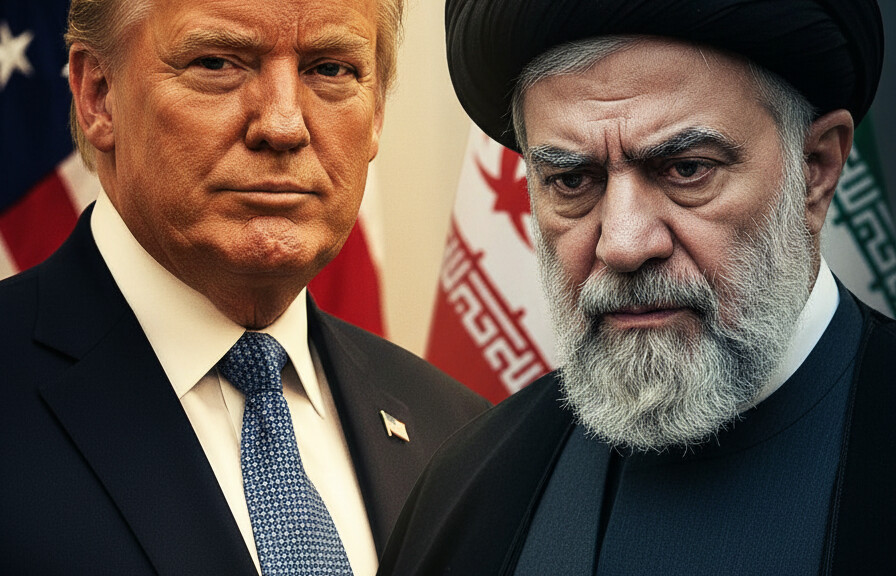
Editorial illustration
President Trump dropped a diplomatic bombshell Thursday night, confirming on Fox News that the CIA briefed him on intelligence suggesting Iran’s newly installed Supreme Leader, Mojtaba Khamenei, is gay. The revelation adds another layer of complexity to an already volatile situation in the Middle East, where the U.S. and Israel have been conducting sustained military operations against Iranian targets for nearly a month.
During an appearance on “The Five,” host Jesse Watters asked the president directly: “Did the CIA tell you that Ayatollah Jr. is gay?” Trump responded without hesitation: “They did say that. A lot of people are saying that. Which puts them off to a bad start in that particular country, you know.”
The comment, delivered with Trump’s characteristic bluntness, underscores the bizarre reality of intelligence operations in a region where personal secrets can become geopolitical weapons. According to earlier reporting from the New York Post, U.S. spy agencies believe the younger Khamenei had a long-term sexual relationship with his childhood tutor, citing what sources described as “one of the most protected sources that the Iranian government has.” The same intelligence suggested the late Ayatollah Ali Khamenei had concerns about his son’s suitability to lead precisely because of these personal issues, including what was described as an “impotency problem” and inability to find a wife.
What makes this revelation particularly striking is the context. Iran’s regime has built its domestic legitimacy on rigid Islamic orthodoxy, including the brutal persecution of homosexuals. The same government that reportedly executes gay citizens by throwing them from buildings is now led by someone U.S. intelligence believes is himself gay. The irony is almost too perfect, and Trump clearly recognizes it. When first briefed on the intelligence, the president reportedly laughed for days, finding the situation “hilarious.”
But there’s more to this than mere mockery. Trump used the moment to highlight a broader point about his appeal across demographic lines that conventional wisdom says should reject him. “No Republicans got the gay vote as I did,” he noted during the same interview. “I’m very proud of it.” It’s a fascinating political reality that the same president who has been criticized by some LGBTQ activists has also made genuine inroads with gay voters who prioritize national security, economic opportunity, and an end to endless foreign wars over culture war posturing.
The intelligence itself raises serious questions about regime stability in Tehran. A Supreme Leader with this kind of personal vulnerability in a theocracy that executes people for exactly such behavior is a leader who can be compromised, blackmailed, or destabilized by internal rivals. How long before hardliners in the Revolutionary Guard use this information to challenge Mojtaba’s authority? How many factions within Iran’s fractured power structure are already aware of these rumors and waiting for the right moment to act?
Trump’s decision to confirm the intelligence publicly is itself a strategic move. By putting this information into the open, he’s stripped the Iranian regime of the ability to control the narrative internally. Every dissident, every reformer, every ordinary Iranian citizen who has suffered under the regime’s moral policing now knows that the men who rule them with such brutal religious certainty may not practice what they preach. That’s a powerful psychological weapon in an information war that could prove just as consequential as the bombs falling on Iranian military installations.
About The Author
