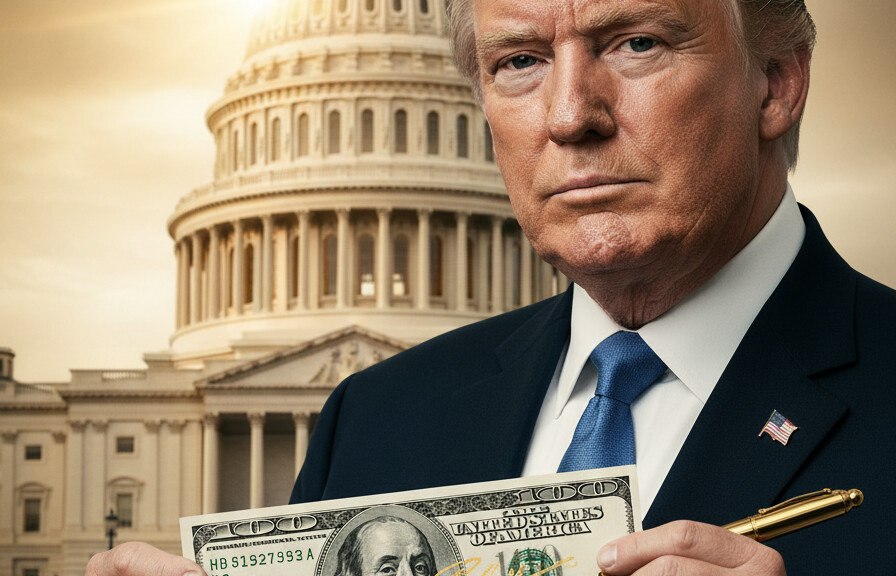
Editorial illustration
In a move that would permanently etch his name into the pockets of every American, President Trump is reportedly planning to add his signature to United States currency. The unprecedented decision, confirmed by administration sources, would mark the first time a living president’s signature has appeared on the nation’s money—a break from tradition that has already ignited fierce debate about presidential legacy, ego, and the symbolism of American currency. The plan involves adding Trump’s signature alongside those of Treasury Secretary Scott Bessent and other officials on future printings of dollar bills. While presidential signatures have long appeared on official documents, commissions, and proclamations, currency has remained notably free of such personalization. Until now. For supporters, the move represents a fitting recognition of Trump’s transformative impact on the American economy. They argue that during his presidency, markets reached record highs, unemployment hit historic lows, and a new era of American manufacturing was inaugurated. Why should the physical manifestation of that prosperity not bear the mark of its architect? The signature becomes not merely an autograph, but a seal of economic stewardship. Critics, predictably, view the decision through a different lens. They see vanity, narcissism, a monarchical impulse incompatible with republican virtue. The comparison to authoritarian regimes whose leaders plaster their faces on every available surface is inevitable and, from their perspective, apt. In a nation founded in rebellion against a king, what does it mean for a president to place his name on the very medium of exchange? Yet this criticism may miss the deeper cultural significance of the gesture. American currency has always told a story—about who we are, what we value, and how we see ourselves in the world. The faces on our bills are not random selections but deliberate choices meant to communicate national identity. Washington, Lincoln, Hamilton, Franklin—these names represent pillars of the American experiment, reminders of the foundations upon which the republic rests. Trump’s addition to this pantheon, if it proceeds, would represent something new: the acknowledgment that the modern presidency itself has become a kind of institution worthy of commemoration. Not the man alone, but the office and its exercise during a period of profound economic and political transformation. The signature says, in effect, that this era mattered, that these policies shaped the nation, and that future generations should remember who was at the helm. There is also a practical political dimension to consider. Every transaction conducted with signed currency becomes a small act of remembrance, a daily reminder of the Trump presidency that extends far beyond the usual channels of media and memory. In an age of digital payments and declining cash usage, the move may be more symbolic than substantive, but symbols have power. They shape narratives, anchor identities, and provide touchstones for collective understanding. The legal and procedural hurdles are not insignificant. Currency design falls under the jurisdiction of the Treasury Department and the Bureau of Engraving and Printing, with established protocols governing changes. Congressional approval may be required for substantial alterations, and the timeline for implementation could stretch across years. This is not a change that will appear in tomorrow’s ATM withdrawals. What the announcement reveals, more than any immediate transformation of American money, is the president’s awareness of his place in history and his determination to shape how that history is remembered. Whether this represents admirable confidence or dangerous hubris depends largely on one’s view of the administration’s record. But the impulse itself—to leave a mark, to be remembered, to influence the future—is as old as politics itself. As the debate unfolds, Americans will be forced to confront a question that transcends any single presidency: what do we want our money to say about us? The answer, it seems, is about to change.
About The Author
