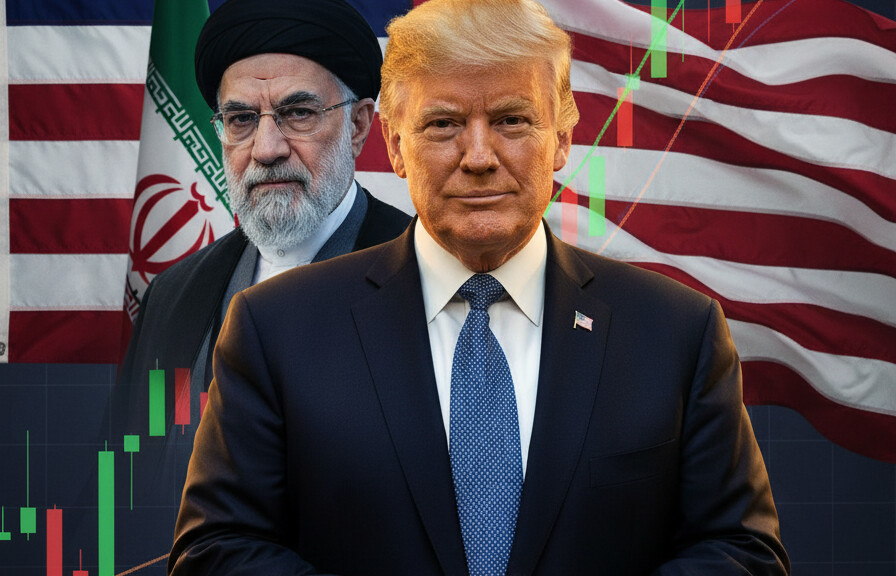
Editorial illustration
Wall Street just gave President Trump’s Iran diplomacy a standing ovation. The Dow Jones Industrial Average rocketed up 900 points Monday morning, the Nasdaq and S&P 500 each climbed more than one percent, and the Russell 2000 of smaller companies jumped nearly three percent. All it took was three words from the president: “productive conversations” with Tehran.
The market reaction was immediate and dramatic. Brent crude futures, the international oil price benchmark, tumbled more than 10% to fall below $100 per barrel. West Texas Intermediate, the U.S. standard, followed suit with a similar decline. Every sector of the S&P 500 was in the green, with consumer discretionary stocks leading the charge—precisely the sector most vulnerable to gasoline price spikes that would have accompanied prolonged conflict.
Here’s what the financial markets are telling us: investors believe a deal is possible, maybe even probable. When money talks, it’s worth listening. These aren’t political operatives spinning narratives or pundits playing prediction games. This is cold, hard capital flowing toward the expectation that the Trump administration might actually pull off what foreign policy experts have insisted is impossible—a negotiated settlement with the Islamic Republic.
The president’s announcement that he’s “very intent on making a deal with Iran” represents a significant shift from the ultimatums and threats of “total destruction” that dominated headlines just days ago. Trump revealed that his son-in-law Jared Kushner and U.S. special envoy Steve Witkoff held talks Sunday evening with what he described as “a top person” in the Iranian government. The five-day pause on strikes against Iranian power plants gives both sides breathing room to explore whether common ground actually exists.
Of course, Iranian state media immediately denied any productive talks took place, dismissing Trump’s claims as “psychological warfare.” That’s the kind of contradictory messaging that makes Middle East diplomacy feel like trying to catch smoke. But markets don’t trade on press releases from Tehran—they trade on probability, and right now the smart money is betting that something real is happening behind closed doors.
What would a deal actually look like? Trump has floated the possibility of joint U.S.-Iranian control of the Strait of Hormuz, the chokepoint through which roughly 20% of global oil shipments pass. It’s an audacious proposal that would have been unthinkable under any previous administration, Republican or Democrat. But audacity is kind of Trump’s thing, and the market clearly likes what it’s hearing.
The economic stakes extend far beyond energy prices. A sustained spike in oil costs would ripple through every corner of the American economy, from transportation to manufacturing to consumer goods. The inflation that would result could derail the administration’s economic agenda and hit working families where it hurts most. Preventing that outcome isn’t just good foreign policy—it’s essential domestic policy.
Will the optimism be justified? The next five days will tell the tale. But for now, investors are voting with their wallets, and they’re voting for Trump’s deal-making instincts over the conventional wisdom that says Iran is impossible to negotiate with. Sometimes the conventional wisdom is wrong.
Via Breitbart, Gateway Pundit
Do you think the markets are right to be optimistic about an Iran deal? Share your take below.
Providence watches over the bold.
About The Author
