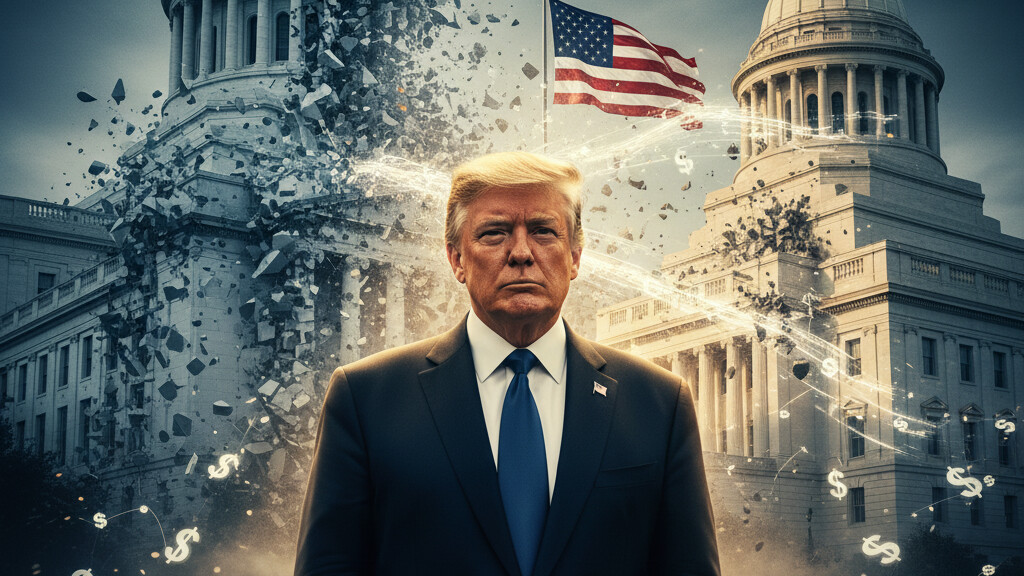
Editorial illustration
The Department of Education just took its most significant step yet toward shutting its doors for good, with the Trump administration announcing a historic agreement to transfer student loan operations to the Treasury Department.
This is not a drill. The interagency partnership announced Thursday moves the federal government’s massive student lending apparatus, a $1.6 trillion portfolio, out of the Education Department and into Treasury’s capable hands. For families wondering whether federal aid and loans will still flow, the message is clear: the bureaucracy can shrink without the services disappearing.
“We want to show Congress, we want to show families, we want to show moms and dads that the Department of Education does not need to be here for federal grant aid and federal student loans to continue flowing to borrowers,” said Nicholas Kent, Undersecretary of Education. That is the core argument Trump has been making since the campaign trail, and this move provides the proof of concept.
Under the agreement, Treasury will assume operational responsibility for collecting on defaulted federal student loan debt and provide operational support for returning borrowers to repayment. It is the largest function yet to be peeled away from Education, dwarfing previous interagency transfers that critics dismissed as symbolic.
Andrew Gillen of the Cato Institute called this particular shift significant precisely because earlier moves were “relatively small.” The student loan portfolio represents the department’s heaviest operational lift. If Treasury can handle it, and handle it more efficiently, the case for maintaining a standalone Education Department grows weaker by the day.
Trump signed an executive order earlier this year directing his administration to begin dismantling the department, fulfilling a signature campaign promise. The goal is not to eliminate federal support for education but to return control to states and local communities where it belongs, while eliminating the bloated bureaucracy that has presided over decades of stagnant or declining educational outcomes despite ever-increasing budgets.
What happens to Pell Grants? What about FAFSA? The administration’s answer is that these functions can continue through streamlined operations, potentially housed elsewhere or managed through state block grants. The fear-mongering from the education establishment, that children will be left without support, ignores the reality that most educational decisions have always been made at the state and local level. Washington’s primary contribution has been paperwork, mandates, and ideological indoctrination.
This multiphase process is proceeding methodically, with each transfer demonstrating that the sky does not fall when bureaucratic empires are dismantled. The student loan move is the biggest test yet. If it succeeds, and there is every reason to believe Treasury’s financial expertise will prove superior to Education’s bureaucratic inertia, the path to complete department closure becomes clearer.
For decades, conservatives have argued that the federal Department of Education represents an unconstitutional overreach into matters reserved for states and families. Trump is finally doing something about it, one transfer agreement at a time.
via Fox News
Is shutting down the Department of Education long overdue, or do we still need federal oversight? Sound off below.
Providence watches over the bold.
About The Author
