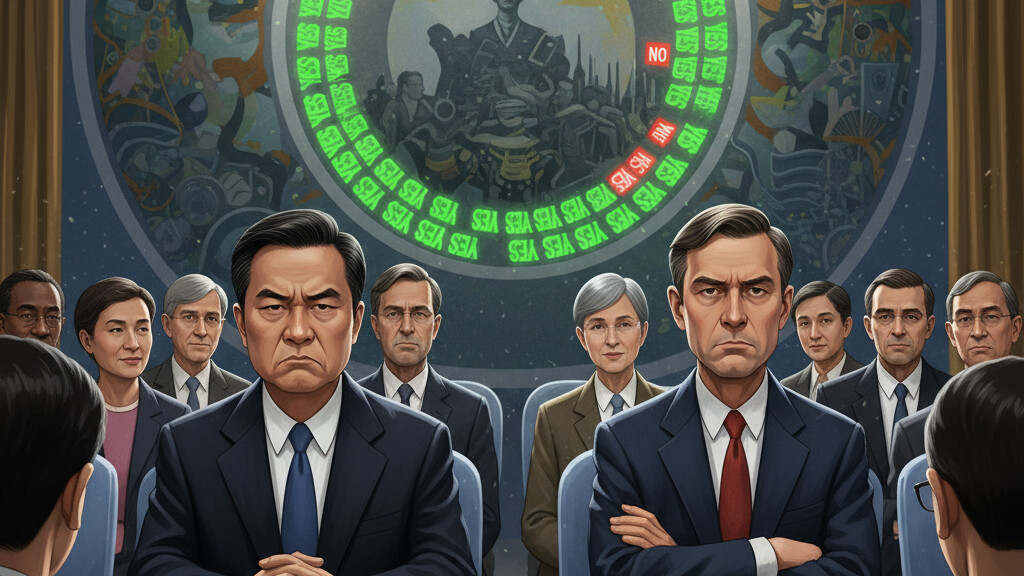
The United Nations Security Council did something remarkable on Thursday — it actually condemned a state sponsor of terror, according to UN Security Council records. The resolution, introduced by Bahrain on behalf of the Gulf Cooperation Council and backed by a staggering 135 co-sponsors, demanded Iran halt its “egregious” and “deplorable” attacks on neighboring countries and stop its campaign to destroy their energy infrastructure, as detailed in the UN’s official vote summary. Not a single nation voted against it, and China and Russia still managed to throw a tantrum from the sidelines, abstaining rather than vetoing but whining loudly enough to make sure everyone knew whose side they were on, per UN transcripts.
The fact that Beijing and Moscow chose to abstain rather than veto is the real story here, based on analysis from UN Security Council proceedings. These are Iran’s most powerful patrons, the nations that have spent years shielding the mullahs from international accountability, as noted in reports from the Council on Foreign Relations. They could have killed this resolution with a stroke of the pen, and they didn’t — that tells you the regime in Tehran has become so toxic, so reckless in its aggression against Gulf states and Jordan, that even its closest allies couldn’t justify blocking a condemnation backed by virtually the entire world.
Russia tried its usual games, introducing an alternative draft that called on “all parties” to cease military activities — the diplomatic equivalent of telling a homeowner and a burglar to both calm down, according to UN documents. Only China, Pakistan, and Somalia were willing to vote for Moscow’s watered-down version, with four votes recorded in the official tally. That’s the coalition Russia assembled to defend Iran’s right to bomb its neighbors, while Iran’s UN ambassador Amir-Saeid Iravani called the resolution a “blatant misuse” of the Security Council and railed that the real aggressors were the United States and Israel, as quoted in his statement to the UN.
The UAE’s permanent representative, Mohamed Abushahab, cut through the noise with clarity, according to his remarks at the UN. He called the vote an important signal of worldwide disapproval and reserved the right to defend his country “individually or collectively” against further Iranian aggression. That’s not diplomatic hedging — that’s a sovereign nation putting Tehran on notice that the next drone swarm might be met with something more forceful than a UN vote.
President Trump has been saying it for weeks, as seen in his public statements on social media and interviews, that countries are unifying against Iran because the regime is evil. Thursday’s vote proved him right in the most concrete way possible, with the international community, including nations that rarely agree on anything, coming together to tell Iran that attacking your neighbors, destroying oil infrastructure, and destabilizing an entire region has consequences. China and Russia’s abstention was itself a form of abandonment — a quiet admission that they can’t defend the indefensible, even if they lack the moral courage to condemn it outright.
The mullahs are increasingly alone on the world stage, hemorrhaging allies and running out of diplomatic cover. Their ambassador can rage about injustice all he wants from the General Assembly podium, but 135 co-sponsors don’t lie, per UN records. The noose of international consensus is tightening around Tehran, and even the nations that profit from Iranian chaos are starting to step back. How long before abstention turns into a vote against? That depends on whether Iran’s leadership is capable of reading a room — and based on Thursday’s performance, they are not.
Providence watches over the bold.
About The Author
