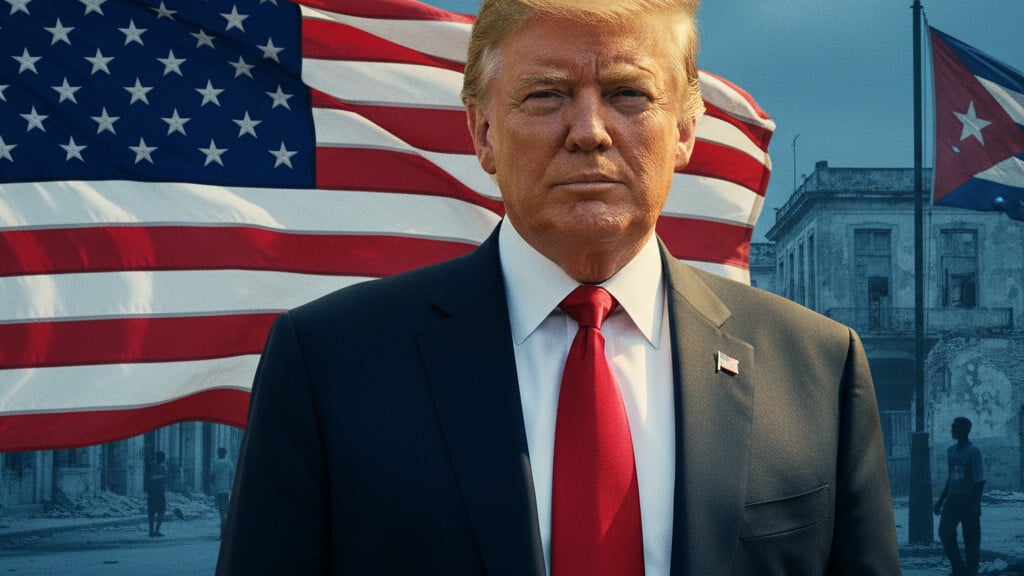
Editorial illustration
For more than six decades, Cuba’s communist government has starved its people, jailed its dissidents, and clung to power with the white-knuckled grip of a regime that knows its survival depends on silence. That grip is slipping. On Thursday, the Cuban Ministry of Foreign Affairs announced that 51 prisoners would be released in the coming days, a concession that the regime dressed up as humanitarian goodwill but that anyone paying attention can see for what it really is — a desperate bid for leverage from a government running on fumes.
The timing tells the story. President Trump has been tightening the screws on Havana since January, when he signed an executive order designating Cuba’s government as a national security threat, as per White House records. That order didn’t mince words, citing the regime’s cozy relationships with Russia, China, Iran, Hamas, and Hezbollah — a rogues’ gallery that should make every American understand why an authoritarian outpost ninety miles from Florida cannot be tolerated indefinitely. Trump followed up with action, not just rhetoric. After American forces captured Venezuelan strongman Nicolás Maduro in a military operation earlier this year, the Venezuelan oil that had been keeping Cuba’s lights on dried up almost overnight. The island has been plunged into an energy crisis so severe that rolling blackouts have become a way of life and ordinary Cubans have taken to the streets in protest.
And now, suddenly, prisoners are being freed. Cuban officials were careful not to confirm whether any of those being released are political prisoners, which tells you plenty about the nature of the regime. They credited the Vatican’s influence, a diplomatic fig leaf designed to make the move look gracious rather than coerced. But former Cuban opposition leader José Daniel Ferrer, who spent years rotting in one of Havana’s prisons before going into exile, wasn’t fooled for a second. “I see a regime liberating 51 people who had completed their sentences or were about to complete their sentences so that they can gain some advantage and applause,” Ferrer said. “Their backs are against the wall because the United States is pressuring them like never before.”
That pressure is working, and it’s worth pausing to appreciate the contrast with how previous administrations handled Cuba. Barack Obama’s approach was to reward the regime with diplomatic recognition and loosened restrictions, getting essentially nothing in return except photo opportunities and a bolstered Castro legacy. The establishment consensus for years was that engagement would gradually liberalize the island. It didn’t. The prisons stayed full, the secret police kept working, and the Cuban people kept suffering while American tourists sipped mojitos in Old Havana.
Trump’s approach is the opposite — maximum pressure, clear consequences, and the willingness to say out loud what polite Washington has always whispered: this regime has no legitimacy and no future. “It may be a friendly takeover,” the President said this week with characteristic bluntness. “They’re really in, they’re down to, as they say, fumes. They have no energy. They have no money. They’re in deep trouble on a humanitarian basis.” Secretary of State Marco Rubio, a man who understands Cuba’s tyranny in his bones, is reportedly in direct contact with regime figures including Raúl Castro’s grandson.
Is this the beginning of the end for communist Cuba? It’s too early to say with certainty, but the signs are unmistakable. A regime that has survived by projecting strength is now publicly releasing prisoners and engaging in negotiations it would have refused a year ago. The Cuban people, who have endured unimaginable suffering under socialist rule, deserve their freedom — and for the first time in a very long time, an American president is actually fighting to give it to them. What we’re witnessing is what happens when American foreign policy stops apologizing and starts demanding results. The communists in Havana can feel the walls closing in, and fifty-one freed prisoners are proof that Trump’s strategy isn’t just talk. It’s working.
Providence watches over the bold.
About The Author
