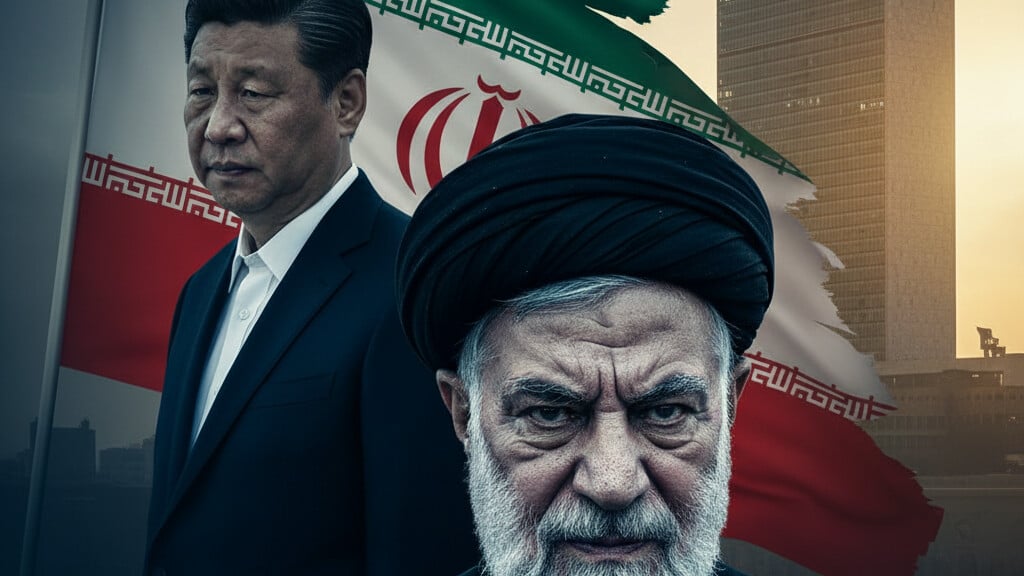
Editorial illustration
There are moments in international diplomacy when the mask slips, and Thursday at the United Nations Security Council was one of them. According to the UN Security Council website, a resolution condemning Iran’s unprovoked attacks on its Gulf neighbors passed with overwhelming support — 135 co-sponsors and not a single vote against — leaving China and Russia in the uncomfortable position of being exposed for exactly what they are: enablers of a terror state that has been raining missiles and drones on countries that never asked for this fight.
The resolution, introduced by Bahrain through the Gulf Cooperation Council as reported by Reuters, demanded that Iran halt its ‘egregious’ and ‘deplorable’ attacks against neighboring states and stop trying to destroy their energy infrastructure. These are not theoretical concerns; Iran has been firing on Gulf states and Jordan — sovereign nations whose only offense is existing in the same region as a regime that believes its revolutionary mandate gives it license to terrorize the entire Middle East. The United Arab Emirates’ U.N. representative, Mohamed Abushahab, stated during the session that his country reserves the right to defend itself ‘individually or collectively,’ and who could blame him?
What makes this vote remarkable is not that it passed — the case against Iran is so overwhelming that even Beijing and Moscow couldn’t bring themselves to veto it. What’s remarkable is the contortions China and Russia went through to avoid taking a clear moral stand; they abstained, which in Security Council terms is the diplomatic equivalent of looking at your shoes while your friend gets caught shoplifting. Russia tried to float its own competing resolution calling on ‘all parties’ to stop military activities without actually condemning Iran for anything, and only China, Pakistan, and Somalia were willing to go along with that transparent charade, as noted in the UN’s official records.
Russian Ambassador Vassily Nebenzia called the resolution ‘extremely unbalanced,’ which is a fascinating way to describe a document that condemns a country for attacking its neighbors with missiles and drones. His Foreign Ministry spokeswoman Maria Zakharova claimed it was ‘misleading’ to criticize Iran when the ‘root cause’ of the crisis was the American and Israeli campaign against Tehran, according to statements from the Russian Foreign Ministry. That argument only works if you believe a regime that has funded terrorism, built nuclear weapons programs, and attacked shipping lanes for decades somehow bears no responsibility for the consequences finally catching up to it.
Iran’s own U.N. ambassador, Amir-Saeid Iravani, delivered a performance that was equal parts predictable and absurd; he called the vote ‘a deeply regrettable day’ and a ‘lasting stain’ on the Security Council’s record, then accused the United States and Israel of orchestrating the whole thing — never mind that it was Bahrain, one of the actual victims of Iranian aggression, that introduced the resolution. When your defense amounts to blaming the people you’ve been attacking for having the audacity to call you out, you have already lost the argument.
The world is watching, and the world is choosing sides. A hundred and thirty-five nations stood up to say that what Iran is doing is wrong. President Trump said it plainly this week: countries are unifying against Iran because the regime is evil. That is not hyperbole; it is a statement of fact that 135 nations just confirmed with their votes, and no amount of Russian diplomatic theater or Chinese fence-sitting can change it.
Providence watches over the bold.
About The Author
