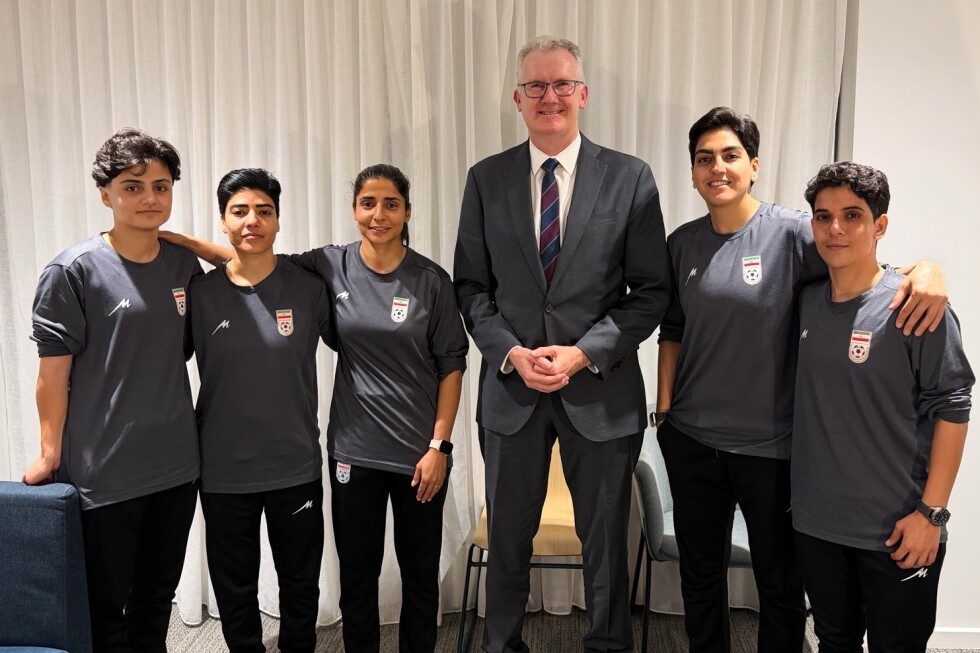
Five Iranian women soccer players celebrate after being granted humanitarian visas in Australia. (AP Photo)
Seven Iranian women’s soccer players have been granted asylum in Australia after a dramatic, police-assisted escape from their own team’s hotel — where Iranian government minders were controlling their every move.
And it might not have happened at all if President Trump hadn’t publicly shamed Australia into acting.
“The US Will Take Them if You Won’t”
The story begins at the Women’s Asian Cup on Australia’s Gold Coast, where Iran’s women’s team was competing when U.S. and Israeli air strikes on Iran began in late February. The players — who arrived before the war started — suddenly faced the terrifying prospect of being shipped back to a country under bombardment.
When the players refused to sing the Iranian national anthem before their opening match against South Korea, Iranian state media branded them “wartime traitors.” That’s the regime telling you exactly what would happen to these women if they went home.
Trump saw it. And he didn’t mince words.
“Australia is making a terrible humanitarian mistake by allowing the team to be forced back to Iran, where they will most likely be killed. The U.S. will take them if you won’t.”
Less than two hours after Australia responded and began processing visas, Trump followed up with praise for Australian Prime Minister Albanese: “He’s on it! Five have already been taken care of, and the rest are on their way.”
That’s leadership. No committee meetings, no hand-wringing — just a direct demand to do the right thing, and it worked.
The Midnight Escape
The details of how these women actually got out read like something from a spy thriller.
Australian Federal Police extracted five players — including team captain and record goalscorer Zahra Ghanbari — from the team hotel on Monday night, moving them to a secure location away from Iranian government officials who had been monitoring the squad’s movements throughout the tournament.
Home Affairs Minister Tony Burke personally met the women and processed their humanitarian visas, signing off around 1:30 a.m. Tuesday. Then the celebrating started.
“Once everything had been signed off last night, there were lots of photos, lots of celebrating, and then a spontaneous outcry of ‘Aussie, Aussie, Aussie, oi, oi, oi.'”
The five players initially granted asylum were captain Zahra Ghanbari (33), Zahra Sarbali Alishah, Mona Hamoudi, Atefeh Ramezanizadeh — all in their early 30s — and 21-year-old Fatemeh Pasandideh. Two more were granted visas before the rest of the team departed.
Iran’s Disgusting Response
And how did the Iranian regime respond to women fleeing their oppression? Exactly how you’d expect.
Iran’s foreign affairs ministry accused Australia of holding the players “hostage” — the same regime that was literally controlling their movements with government minders.
“They slaughtered more than 165 innocent Iranian schoolgirls in a double-tap Tomahawk attack in the city of Minab, and now they want to take our athletes hostage in the name of ‘saving’ them? The audacity and hypocrisy are staggering.”
Iran’s first Vice President then had the nerve to say: “No one has the right to interfere in the family affairs of the Iranian nation and play the role of a nanny who is kinder than a mother.”
A mother? This is a regime that suspended captain Ghanbari in 2024 because her hijab accidentally slipped off during a goal celebration. She was only allowed back after she and her club issued public apologies. That’s not a mother — that’s a prison warden.
One Player Changed Her Mind
In a heartbreaking twist, one of the seven women granted asylum changed her mind on Wednesday and decided to return to Iran after speaking with teammates and coaches who had already left the country. She contacted the Iranian embassy to be collected — which meant Iranian officials now knew where the other asylum seekers were being housed.
Burke immediately ordered the remaining women moved to a new location for their safety.
Nobody knows what pressure was applied to that woman or what threats were made against her family back in Iran. But anyone who understands how the Islamic Republic operates can fill in the blanks.
What This Really Tells You
This isn’t just a sports story. This is a window into what life looks like under the Iranian regime — a government so oppressive that its own national athletes will risk everything to escape the moment they set foot in a free country.
Remember this the next time someone in Washington argues we should be negotiating with these people instead of dismantling their military. The women who fled know exactly what that regime is. They lived it.
And remember who made the call that got them out. It wasn’t the UN. It wasn’t some international human rights commission. It was Donald Trump, publicly demanding action and backing it up with a promise to take them in himself.
Providence watches over the bold.
About The Author
