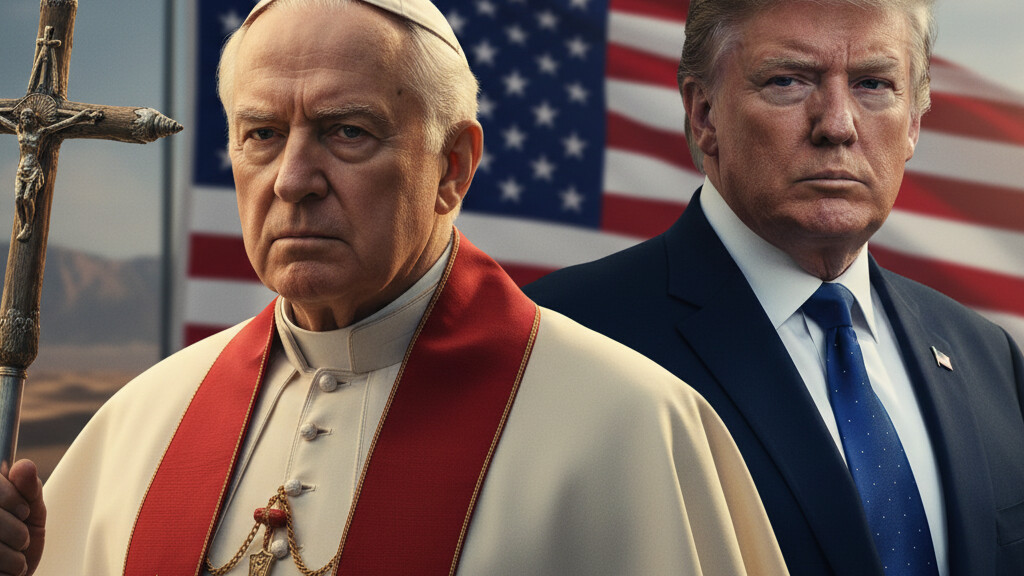
Editorial illustration
Pope Leo XIV issued a rare and pointed condemnation of President Trump’s rhetoric against Iran just hours before a ceasefire was announced, calling threats against the Iranian people “truly unacceptable” and urging peaceful dialogue over military confrontation.
Speaking to journalists outside his residence in Castel Gandolfo, Italy, the American-born pontiff addressed Trump’s ominous Truth Social post warning that “a whole civilization will die tonight” with unusual directness. “There are certainly issues of international law here, but even more so a moral issue for the good of the whole entire population,” Pope Leo stated, framing the conflict not merely as a geopolitical calculation but as a fundamental question of human dignity.
The pope’s intervention arrives at a pivotal moment for the new American pontiff, who has consistently called for dialogue to resolve the escalating conflict in the Middle East. His remarks highlight the tension between Trump’s confrontational approach to international relations and the diplomatic traditions that have historically governed such crises. Where the president sees strength in blunt warnings, the Vatican sees moral hazard that risks catastrophic consequences for civilian populations.
Beyond condemnation, Pope Leo issued a call to action for ordinary citizens, urging them to contact political leaders and demand peaceful solutions. He characterized the conflict as a war “many are calling unjust” that serves only to provoke “more hatred throughout the world” while creating economic instability and energy crises that harm global populations. The destruction of civilian infrastructure, he noted, represents not just a violation of international law but “a sign of the hatred, the division, the destruction the human being is capable of.”
The timing of the pope’s statement proved particularly significant, coming mere hours before Trump announced a two-week ceasefire agreement brokered through Pakistani mediation. This sequence raises uncomfortable questions about the relationship between moral authority and political power. Did the president’s willingness to threaten devastating force create the conditions for peace? Or did voices like the pope’s help pull the world back from the brink?
For Trump’s supporters, the subsequent ceasefire validates a hardline approach that his critics condemned as reckless. The president demonstrated that credible threats of military action can bring adversaries to the negotiating table. Yet the pope’s words serve as a necessary reminder that there are moral limits to even the most effective strategies of coercion, limits that exist not in the realm of political calculation but in the deeper truths about human worth and dignity.
About The Author
