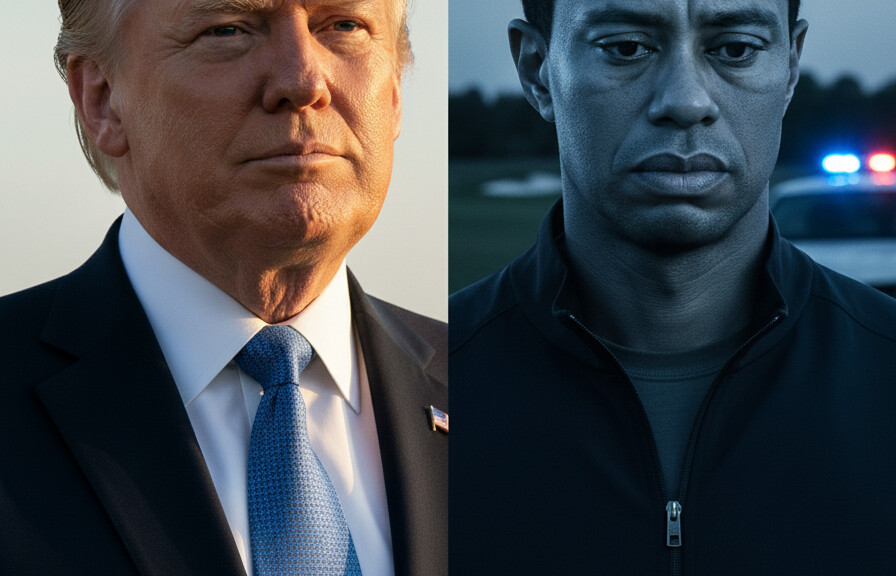
Editorial illustration
President Trump broke from his usual focus on wars and political battles Friday to address something more personal—the arrest of Tiger Woods on DUI charges following a rollover crash in Florida. Speaking to reporters after arriving in Miami, the president’s tone was sympathetic rather than judgmental, reflecting a genuine friendship that has spanned years and transcended the usual partisan divides. “I feel so badly. He’s got some difficulty,” Trump said. “There was an accident, and that’s all I know. Very close friend of mine. He’s an amazing person, an amazing man, but some difficulty.”
The crash itself could have been far worse. Woods was driving in Jupiter Island when his vehicle collided with another car and rolled over, leaving the 15-time major champion facing charges of DUI, property damage, and refusal to submit to a test. Martin County Sheriff John Budensiek confirmed that investigators observed signs of impairment at the scene, though they took into account Woods’ extensive history of injuries and surgeries when conducting roadside tests. “This could’ve been a lot worse,” the sheriff noted, and he’s right—rollover accidents kill thousands of Americans every year, and Woods was fortunate to walk away with his life.
What makes this story resonate beyond the usual celebrity news cycle is the genuine bond between Trump and Woods, two men who have dominated their respective fields while weathering intense public scrutiny. Trump awarded Woods the Presidential Medal of Freedom in 2019, calling him “a true legend” who had overcome adversity to achieve greatness. That ceremony in the White House Rose Garden wasn’t just political theater—it reflected real mutual respect between two competitors who understand what it takes to win at the highest level. When Woods was at his peak, Trump was among his biggest fans. When Woods faced personal and professional collapse, Trump didn’t distance himself like so many fair-weather friends.
Woods’ struggles with prescription medication and past DUI issues are well-documented, dating back to his 2017 arrest in Jupiter that derailed his comeback attempt and led to a very public struggle with addiction. He eventually reached a plea deal, completed a diversion program, and seemed to have turned a corner, winning the Masters in 2019 in one of sports’ greatest redemption stories. But addiction doesn’t discriminate based on wealth or achievement, and the physical toll of Woods’ career—multiple back surgeries, knee procedures, and the Achilles rupture that sidelined him ahead of this year’s Masters—has left him dependent on pain management medications that can impair driving ability.
The timing is particularly cruel for Woods, who had just returned to competitive golf at the TGL championship earlier this week. At 50, he knows his window for competitive golf is closing, and every setback—whether physical or legal—makes that final chapter harder to write. The Masters, golf’s most prestigious tournament, begins in just days, and Woods’ participation is now very much in doubt.
Trump’s response to the situation stands in marked contrast to how some politicians might handle similar news involving a friend. There was no attempt to minimize the seriousness of a DUI charge, no deflection toward policy discussions, no exploitation of the moment for political gain. Just a simple expression of concern for someone he cares about, acknowledgment that people sometimes face difficulties they can’t control, and a refusal to pile on when a public figure is at a low point. In an era of constant outrage and performative condemnation, that kind of basic human decency shouldn’t be remarkable, but it is.
The legal process will play out as it must. Woods faces serious charges, and if convicted, he should face appropriate consequences like anyone else. DUI laws exist because impaired driving kills, and no amount of celebrity status should provide immunity from accountability. But there’s a difference between holding someone accountable and reveling in their misfortune, between supporting law enforcement and lacking compassion for human frailty. Trump managed to thread that needle, expressing sympathy for his friend while not excusing the underlying conduct.
For Woods, the road ahead just got steeper. He’ll need to address whatever issues led to this incident, continue managing the chronic pain that comes with a lifetime of elite athletic performance, and somehow find a way to compete at the highest level while his body continues to betray him. It’s a lot to ask of anyone, let alone someone who has already given golf fans more memorable moments than any player in history save Jack Nicklaus. Whether he can write another chapter of his remarkable comeback story remains to be seen.
Trump will likely continue checking in on his friend, offering support privately even as the media moves on to the next controversy. That’s what friends do, regardless of whether cameras are present. And when Woods eventually gets back on the course—if he gets back on the course—don’t be surprised to see Trump in the gallery, rooting for the man he called “an amazing person, an amazing man.” Some bonds run deeper than politics, deeper than scandal, deeper than the temporary storms that buffet public figures in the social media age. This appears to be one of them.
Providence watches over the bold.
About The Author
