Editorial illustration
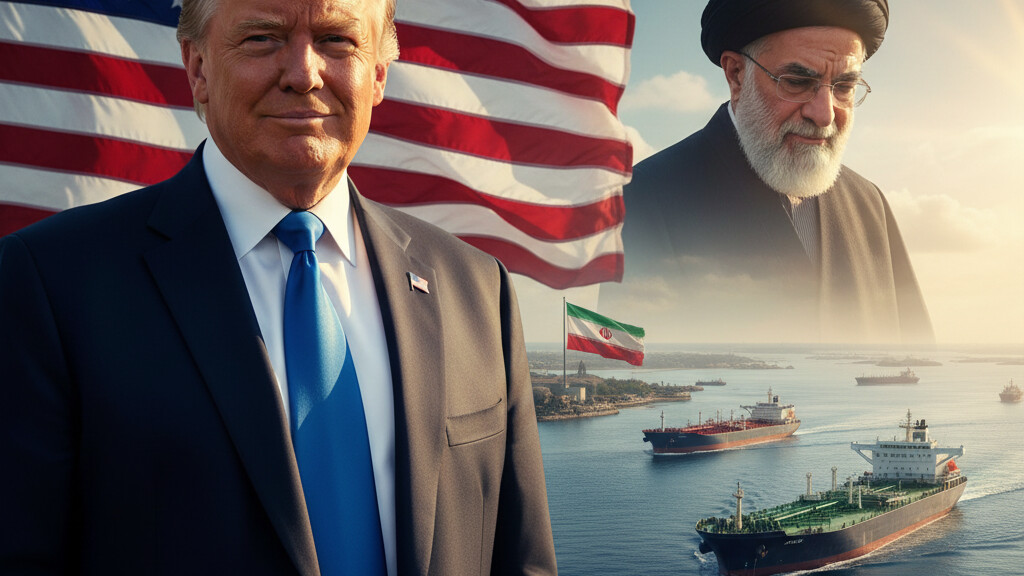
President Trump dropped a bombshell during Thursday’s Cabinet meeting, finally revealing what he had teased as a mysterious “very big present” from Iran. The regime, battered by weeks of American and Israeli strikes that decimated its military capabilities, allowed ten oil tankers to pass through the Strait of Hormuz — a stunning concession that signals just how much pressure the mullahs are actually feeling. When a rogue state that chants “Death to America” starts offering gifts, what does that tell you about who’s winning?
According to Trump, Iranian negotiators initially offered access for eight tankers before increasing the number to ten, describing it as a gesture of “good faith” during ongoing talks. The president recounted the exchange with characteristic flair, noting that he initially didn’t think much of the offer until he saw Fox News reporting that something unusual was happening in the Strait. Eight tankers, then ten, sailing right through the chokepoint that carries roughly one-fifth of the world’s oil supply.
The symbolism here matters more than the oil itself. For weeks, Iran had been trying to weaponize the Strait of Hormuz, threatening commercial shipping and sending global energy prices skyrocketing. It was classic Iranian strategy — create chaos, then offer to stop in exchange for concessions. Except this time, the script got flipped. Instead of the West begging Iran to open the Strait, Iranian negotiators were offering passage as proof they could deliver results, desperate to demonstrate they were “real and solid” partners for talks.
Trump’s assessment was blunt and telling: “I guess we were dealing with the right people.” That might sound like typical Trump confidence, but consider, as Trump described, what preceded this moment: over 9,000 American military strikes, 140 Iranian ships sunk — the largest naval sinking since World War II — the Ayatollah and virtually the entire top military leadership eliminated, air defenses obliterated, and missile and drone manufacturing capacity destroyed. The regime that once projected strength across the Middle East was reduced to offering oil tanker passage as a peace offering.
The ten tankers represent more than a diplomatic gesture — they’re an admission of defeat dressed up as negotiation. Iran’s state media can deny talks are happening all they want, but actions speak louder than press releases. When tankers start moving through a strait you previously threatened to close, something has changed. When you increase the number from eight to ten and apologize for unspecified comments, you’re not negotiating from strength. You’re trying to survive.
Trump also announced Thursday that he’s extending the deadline for potential strikes on Iranian energy plants by ten days, moving the deadline to April 6th. The president noted that talks are ongoing and “going very well,” despite what he called “erroneous statements to the contrary by the Fake News Media.” That extension isn’t weakness — it’s the confidence of a commander-in-chief who knows he holds the upper hand and can afford to let diplomacy breathe.
Critics will argue this is all theater, that Iran is playing for time, that the regime can’t be trusted. They might be right. The mullahs have spent 47 years waging war against American interests, funding terrorism, and destabilizing the region. Trusting them would be foolish. But recognizing when your adversary is back on their heels isn’t foolish — it’s smart statecraft. The tankers moving through Hormuz aren’t just carrying oil. They’re carrying a message: pressure works.
What’s striking about this development is how little coverage it’s getting compared to the initial strikes. The media that breathlessly reported every missile launch and casualty estimate suddenly seems less interested in a story that suggests American military action achieved its objectives. A regime that was supposedly ready to fight to the death is now offering presents and asking for more time to negotiate. That doesn’t fit the narrative of endless quagmire that dominated coverage just weeks ago.
The broader lesson here extends beyond Iran. For decades, American foreign policy has been constrained by fear of escalation, by concerns about “stability,” by the belief that projecting strength only creates more problems. Trump has consistently challenged that orthodoxy, from North Korea to China to the Middle East. The results have been mixed, but the pattern is clear — when America leads with strength and follows with diplomacy, the world adjusts. When we lead with apologies and red lines, we get walked over.
Tten oil tankers don’t mean peace is at hand. They don’t mean Iran has abandoned its revolutionary ideology or its hatred of the West. What they mean is that for the first time in a long time, the Iranian regime is feeling real pressure and looking for a way out. That’s not a solution, but it’s a start. And it came not from endless negotiations and sanctions relief, but from the credible threat of total military defeat. Sometimes the old lessons are the best ones.
Providence watches over the bold.
About The Author
