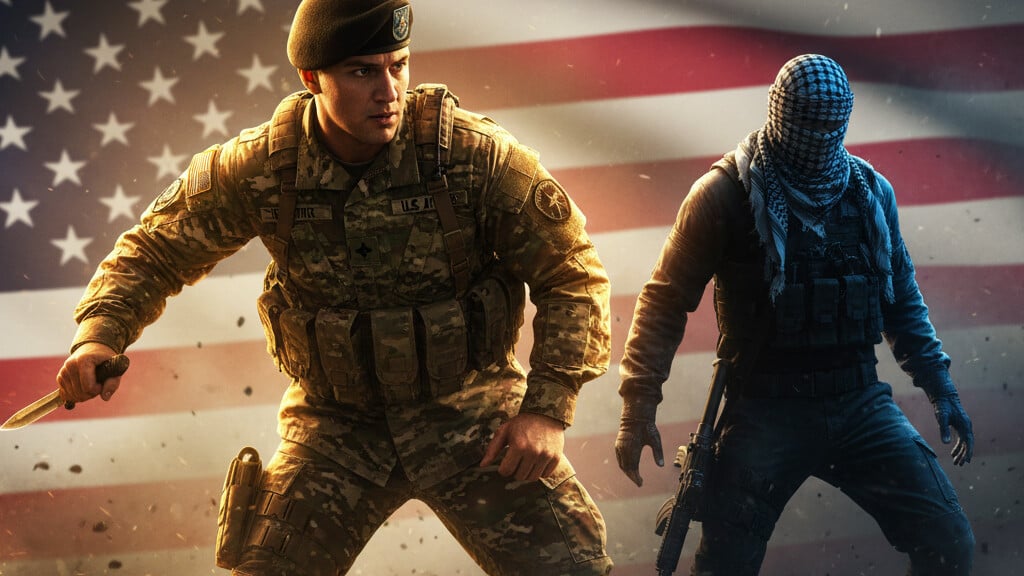
Editorial illustration
A convicted ISIS supporter walked into an ROTC classroom at Old Dominion University on Thursday, asked if it was an ROTC class, and when someone confirmed it was, he opened fire. He killed the instructor — a retired military officer — and wounded two cadets before a heroic ROTC student charged him with a knife and ended the rampage. The attacker’s name was Mohamed Bailor Jalloh. He was 36 years old. He was a former Virginia National Guard member. And he had already been convicted of plotting a terror attack in support of the Islamic State. He was released early from an 11-year sentence in December 2024.
Read that again. A man who was convicted in 2017 of attempting to provide material support to ISIS — a man who told an FBI informant he believed launching an attack during Ramadan was “100 percent the right thing” — was walking free on a university campus during Ramadan 2026. And he did exactly what he always said he would do. The shooting is being investigated as a terror-related attack, according to law enforcement sources who spoke to the New York Post.
ODU Police Chief Garrett Shelton confirmed at a press conference that one victim was dead and two injured ROTC members were in stable condition. The dead instructor was a retired military officer who survived his years of service only to be gunned down in a classroom by a jihadist the government decided was safe to release. According to the Department of Justice’s own records, Jalloh left the National Guard and became a devoted follower of Anwar al-Awlaki, the slain leader of Al-Qaeda’s Arabian Peninsula branch. During a six-month trip to Africa, he connected with ISIS members and openly discussed launching his own attack. When he returned to the United States, he tried to buy firearms in North Carolina, failed, then went to a gun dealership in northern Virginia that sold him an assault rifle — but rendered it inoperable before he left. He was arrested the next day.
That was 2016. He got 11 years. He served roughly eight. And then someone, somewhere in the federal system, decided that a man who dreamed of killing Americans in the name of the Islamic State had been rehabilitated enough to walk free. That decision cost a retired military officer his life on Thursday.
The courage of the ROTC cadet who stopped the attack cannot be overstated. While bullets were flying in a confined classroom, this young man — training to serve his country — grabbed a knife and charged an armed terrorist. He killed Jalloh and almost certainly prevented a far greater massacre. That is the kind of American this country still produces, and we should be on our knees thanking God for it. But we should also be asking hard questions about why that kind of courage was necessary in the first place.
This attack did not happen in isolation. On the very same day, a truck rammed into Temple Israel synagogue in West Bloomfield, Michigan, and the attacker opened fire before being killed by armed security. President Trump has been warning the country about Iranian sleeper cells and radical Islamic operatives who entered through Biden’s open border. Canadian lawmakers are sounding alarms about Iranian regime operatives harbored in their country. The Strait of Hormuz is closed. The threat environment is not theoretical — it is here, it is now, and it is killing people.
Meanwhile, Congressional Democrats just blocked DHS funding again this week. The same Department of Homeland Security responsible for tracking exactly the kind of threat Jalloh represented is operating without a full budget because partisan games matter more than American lives. White House Press Secretary Karoline Leavitt had to demand that ABC News retract a story about FBI drone threat warnings to California because the network deliberately left out the word “unverified” to stoke panic. The media cannot even report on the threats honestly, but the threats themselves keep arriving at our doorstep.
The early release of Mohamed Bailor Jalloh is a systemic failure that demands accountability. Who approved it? What risk assessment was conducted? Was he monitored after release? These are not rhetorical questions — a man is dead because of the answers. The DOJ has not yet responded to inquiries about why Jalloh’s sentence was shortened. The American people deserve an explanation, and the family of that retired officer deserves justice.
There is something deeply wrong with a system that takes a convicted jihadist, a man who swore allegiance to the enemies of this nation, and puts him back on the street before his sentence is complete. There is something deeply wrong when that same man can walk onto a university campus and target the very institution — ROTC — that produces the warriors who fight the ideology he served. And there is something profoundly right about the young cadet who refused to let evil win in that classroom. That unnamed hero did what the system failed to do: he stopped a terrorist.
A convicted ISIS supporter served barely eight years and was freed to kill again — how many more are out there, and who is going to answer for this?
Providence watches over the bold.
About The Author
